Get Full Government Meeting Transcripts, Videos, & Alerts Forever!
Get email alerts on the Employee Benefits topic
No spam. Unsubscribe anytime.
Franklin County studies benefit funding after officials say VEBA payouts strained budget
Summary
County commissioners and benefits consultants reviewed Franklin County’s health plan funding, concluding the board must change contribution rules that have increased costs tied to VEBA/cash-in-lieu payments; consultants recommended fixes and possible moves to level-funded or self-funded arrangements, with a decision target in July.
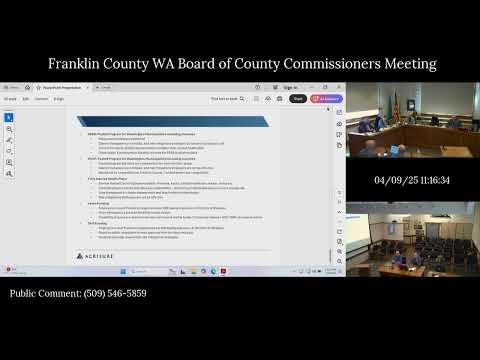
Franklin County commissioners spent a workshop reviewing the county’s employee benefits funding on April 9, hearing from brokers with AcroSure about how the county’s contribution structure and VEBA/cash-in-lieu payments have driven up health-plan costs.
The county’s benefits consultant, Brooks (AcroSure), told commissioners the county’s defined-contribution approach and large VEBA/cash-in-lieu payments have created incentives for lower‑risk employees to decline enrollment, which can raise premiums for those who remain on the county plan. “Adverse selection is what happens when higher‑risk individuals jump on the plan,” Brooks said during the presentation, describing the mechanics by which rising premiums can feed further withdrawals from the employer plan.
The presentation laid out benchmark data for Washington public employers and compared Franklin County’s per-employee contribution levels to regional averages. Brooks and his colleague Brandon Simon (AcroSure) said the county’s current structure—large fixed dollar contributions and VEBA/cash‑in‑lieu tied to rising premium rates—has increased the county’s outlays and risk. Simon described practical options, saying insurers offer “a sliding scale of funding arrangements” (fully insured, level funded, self‑funded) and that each step away from fully insured moves some financial risk onto the county but also offers opportunities to control claim costs.
Commissioners and the county administrator pressed on near‑term feasibility. Commissioner Baumann and others said the county needs a workable short‑term change to stop ongoing budget harm from what one commissioner called “unconstitutional pay” (cash‑in‑lieu/VEBA arrangements adopted in earlier years). County Administrator Danzel confirmed the county is paying both VEBA and health‑plan premiums that have increased the budget burden and noted July as the practical deadline for any funding changes this year.
The consultants cautioned that an Individual Coverage Reimbursement Arrangement (ICRA) is unlikely to save money for Franklin County employees because individual plans available on the Washington exchange tend to have narrower networks and, for many employees, higher out‑of‑pocket costs than group coverage. Brooks said, in the county’s market, many individual plans have “higher out‑of‑pocket maximums” and may be more expensive for families than the county’s group offerings.
The presentation concluded with consultants recommending that the board (1) revise the contribution model to remove incentives that encourage low‑risk employees to waive coverage in exchange for cash; (2) consider a level‑funded plan with transparency and potential refunds as an interim step; and (3) develop a multi‑year plan if the county moves toward self‑funding. The consultants emphasized that contribution changes should precede any move toward greater county funding risk.
No formal policy change was voted at the workshop. Commissioners asked staff to continue work with brokers and carriers and to return with options and numbers; the county administrator said staff will continue the review toward the July decision deadline.
Ending: The discussion will continue with staff and benefits advisors; consultants and county staff said they will provide more detailed cost models and benchmarks to inform the board’s July decision.