Get Full Government Meeting Transcripts, Videos, & Alerts Forever!
Get email alerts on the Animal Control topic
No spam. Unsubscribe anytime.
Mount Pleasant holds public workshop on proposed animal-control ordinances including mandatory microchipping
Summary
City staff presented four proposed changes to Chapter 97 — mandatory microchipping for animals impounded or housed within city limits, limits on public sales/displays, a ban on feeding strays, and required sterilization on reclaiming impounded animals; residents voiced support and concerns about enforcement, costs and drop-off boxes.
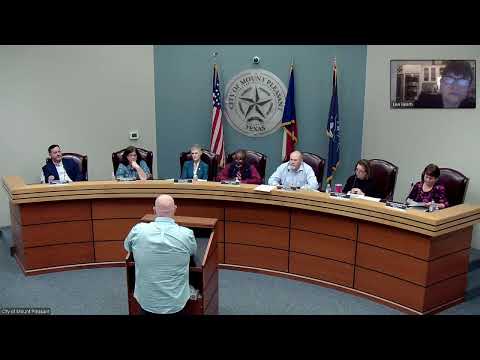
Mount Pleasant held a public workshop March 18 to discuss proposed changes to the city’s animal-control code, including a requirement to microchip animals kept inside city limits, a ban on public display or sale of animals in parking lots, restrictions on feeding stray animals, and a requirement that animals reclaimed from the shelter be sterilized within a specified period.
Animal Control Chief said the microchipping proposal is found in Chapter 97, subsection 97.11 and “required if somebody lived in the city residence or housed an animal in the city, a cat or a dog, they were required to microchip that animal.” He told residents the sterilization requirement would apply to animals impounded by the shelter and reclaimed by their owners, with a typical compliance window of 30 days and limited exceptions for licensed breeders or circumstances outside an owner’s control.
Why it matters: city staff and local rescue groups said the measures are intended to reduce shelter intake and euthanasia by improving owner identification, discouraging unregulated roadside sales and curb the growth of feral-cat colonies that can carry disease. Several residents and rescue representatives supported microchipping and spay/neuter programs but cautioned about enforcement, costs and unintended harms from drop boxes or unattended surrender points.
Details of the four proposals and enforcement - Microchipping (Chapter 97.11): City staff described a plan to require microchips for animals housed inside the city limits. The shelter currently offers microchips for $10 and ran a free microchipping event in February that placed over 50 microchips. - Public display/exchange (Chapter 97.13): The proposed language would make it unlawful for a manager, operator or property owner within city limits to allow public display or sale/exchange of animals at retail parking lots, a change aimed at weekend roadside giveaways that avoid shelter safeguards. - Feeding strays: The draft ordinance would prohibit intentionally placing food to feed stray animals or leaving food accessible to community/stray cats where doing so attracts wildlife and creates disease and nuisance risks. Chief said enforcement would be complaint-driven and officers would exercise discretion. - Sterilization on reclaim/adoption: The shelter’s proposed redemption/adoption requirement would require sterilization within a specified period (chief cited 30 days) for animals reclaimed from impound, with stated allowances for breeders and force‑majeure situations. Staff emphasized this would not impose a citywide mandatory spay/neuter on all privately owned pets.
Public questions and staff answers Residents asked how enforcement would work and what penalties would apply. Chief said the microchipping violation would be citable under the proposed ordinance and described it as a city offense; municipal court fines were discussed in general terms (the chief referenced municipal‑court fine ranges but did not provide a fixed penalty schedule). He said officers would use discretion and that enforcement would often follow citizen complaints.
Costs and support programs The shelter charges $10 to microchip an animal and has used donated funds for free clinics. Chief and rescue representatives discussed vouchers and low-cost spay/neuter opportunities: a local provider (identified in comments as a mobile unit operated by a regional spay/neuter group) charges roughly $70–$80 for dogs and $45–$50 for cats at discounted clinics. The Titus County SNAP project was cited as having about 90 applications pending for free spay/neuter and microchipping; staff and volunteers described many requests coming from feral‑cat colony control.
Shelter statistics and stray intake Chief provided year‑end 2024 shelter data: the shelter took in about 2,300 animals in 2024 and euthanized about 1,000 animals, roughly 40 percent, largely attributable to disease among feral animals and large colony intake in some months. For 2025 to date, staff reported 463 total animals recorded for the city, with 307 brought in by the public (the difference included animals brought in by animal-control officers).
Concerns from residents and rescuers Several people urged caution about unattended drop boxes or “owner‑surrender” bins, citing heat risks, contagion (parvo, rabies) and difficulty in caring for and separating intact animals and litters. Crystal Trumbull, who identified herself as a resident active in both rescue and regulated breeding, said: “There’s no GPS on any microchip. The government’s not stalking you. You cannot track a dog by a microchip. It’s not going to cause cancer.” She also explained that microchip registration requires the owner to submit paperwork; a chip alone does not expose personal information unless the owner has completed the registration with the microchip company.
Other suggestions from public commenters included a low‑cost annual registration tied to rabies records, grandfathering approaches for spay/neuter, and the shelter’s existing $25 owner‑surrender fee. Speakers representing rescue groups urged a combination of microchipping, increased access to low‑cost sterilization and continued public education.
What’s next Council opened the workshop for public input and heard multiple residents, rescue representatives and shelter staff. No formal ordinance vote was taken at the workshop; staff said they would revise the proposed code language as needed and bring a finalized ordinance back to council for consideration at a future meeting.
Ending note: residents and staff expressed broad agreement on the goal of reducing shelter euthanasia and improving public health, while differing on enforcement mechanics and costs.