Get Full Government Meeting Transcripts, Videos, & Alerts Forever!
Get email alerts on the Education topic
No spam. Unsubscribe anytime.
East Greenwich residents press council to boost school funding; state representative outlines bill to soften funding cut
Summary
Dozens of residents, many of them teachers and parents, urged the East Greenwich Town Council on March 24 to increase school funding, and State Representative Justine Caldwell described a bill that would restore a larger share of lost state aid for affected districts.
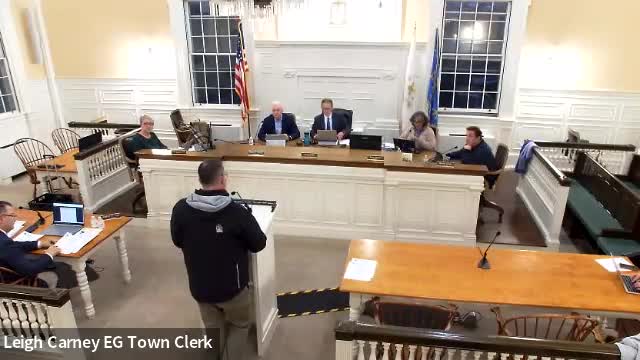
Dozens of residents, many of them teachers and parents, urged the East Greenwich Town Council on March 24 to increase local school funding and stop what they described as a multi-year pattern of underfunding.
"East Greenwich must do better. Starting now," said Michael Simonetti, listing historical budget-transfer figures and saying the town's yearly transfers to schools have not kept pace with costs. Multiple speakers — Erin Logue, Joanne Leach, Renee Haskins and Kate McDevitt — repeated similar concerns about overcrowded classrooms, aging facilities and low teacher pay. McDevitt identified herself as a fourth-grade teacher and a parent of three East Greenwich students.
The strong public turnout came ahead of a council discussion and a legislative briefing by State Representative Justine Caldwell, who described a bill she introduced, House Bill H5749, intended to limit the immediate drop in state categorical aid when towns' formula-based aid falls.
Caldwell described how the state funding formula and a smoothing mechanism operate: under current law a district that would lose 2% in formula aid receives 50% of that loss in a stabilizing payment; her bill would increase that smoothing percentage to 75% for affected districts. Caldwell said that change would translate to about $535,000 more for East Greenwich this year, and that the categorical aid would come from outside the funding "pie," so districts would not be reallocating money from other towns.
Caldwell urged coordinated local advocacy — coordinated testimony at the Finance Committee hearing, working with nearby towns such as Barrington and Warren, and making a clear case about what lost aid would mean for students. She warned that the state budget process runs late into the spring and that uncertainty at the federal level (including potential cuts to federal reimbursements such as Medicaid) could reduce the state’s ability to add funds.
Council Vice President Michael Donegan acknowledged the public concerns and summarized the council’s current approach: he said the council intends to "max fund" the schools again this year under the 4% property-tax levy cap and is working with state representatives and the League of Cities and Towns to pursue options above statutory caps and to secure state assistance for school infrastructure projects. Donegan noted that shifting reimbursement timing and the disappearance of previously available "pay-go" funds mean the town may need to seek relief from the General Assembly to front soft costs for school construction.
Council members and town staff said they will continue budget coordination with the school committee as the town finalizes its budget; the council reminded the public that the town budget adoption is scheduled for June 10 and that further discussion will take place at joint meetings.
Votes at a glance from the meeting also included several council procedural actions and an executive-session appointment (see separate roundup). The council encouraged residents to attend upcoming Finance Committee hearings and to coordinate testimony when the General Assembly posts the bill for hearing.
The council and town staff said they will continue to update residents during the budget process and invited commenters to bring specific, concrete examples of how funding losses translate into classroom impacts when they testify at the State House.