Get Full Government Meeting Transcripts, Videos, & Alerts Forever!
Get email alerts on the Sb 884 Undergrounding Guidelines topic
No spam. Unsubscribe anytime.
CPUC staff seek input on updates to SB 884 undergrounding guidelines as stakeholders press for stronger review, data and cost limits
Summary
California Public Utilities Commission staff on an April workshop (date provided to participants but not in the record) convened stakeholders to discuss proposed updates to the Commission’s guidelines implementing SB 884 — the expedited undergrounding program for large investor‑owned electric utilities — and to solicit written feedback on application requirements, phase‑2 conditions, audit and review procedures, and data retention.
California Public Utilities Commission staff on an April workshop (date provided to participants but not in the record) convened stakeholders to discuss proposed updates to the Commission’s guidelines implementing SB 884 — the expedited undergrounding program for large investor‑owned electric utilities — and to solicit written feedback on application requirements, phase‑2 conditions, audit and review procedures, and data retention.
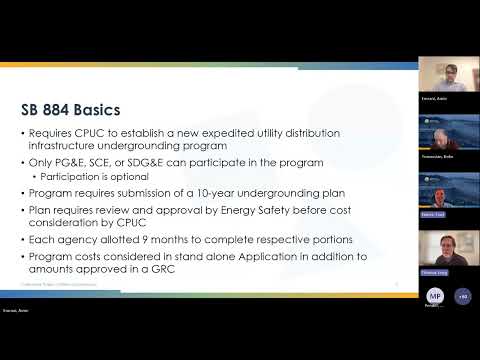
The workshop matters because SB 884 makes undergrounding optional for the three large investor‑owned utilities (PG and E, Southern California Edison and San Diego Gas & Electric) but ties cost recovery to a two‑agency, time‑limited review process. Any change to the CPUC guidelines affects what information utilities must provide, what costs can be recorded to balancing accounts or memorandum accounts, how and when ratepayers may ultimately bear costs, and how projects will be prioritized for wildfire risk reduction.
Staff summarized the 3‑phase structure in the current SPD‑15 guidance: Phase 1 is Energy Safety’s plan review; Phase 2 is the CPUC cost‑recovery application and conditional approval for costs to be recorded to a one‑way balancing account; Phase 3 is construction and monitoring, with six‑month progress reports and post‑implementation review mechanisms. Staff proposed a set of specific additions to the Phase‑2 application requirements, new Phase‑2 conditions and two alternative approaches for auditing/reviewing costs recorded to the balancing account.
Proposed application and documentation additions
CPUC staff proposed requiring utilities to submit a forecasted scope for all projects across the 10‑year plan (noting that staff understands forecasts will change), and to provide a detailed explanation whenever a project includes spans extending beyond the High Fire Threat District (HFTD). Staff also proposed that utilities include an updated depreciation study tied to the assets affected by SB 884 projects and present a present‑value, lifetime revenue‑requirement calculation for each capital project. Finally, staff would require utilities to retain all tabular and geospatial data submitted with the initial application and in six‑month progress reports so the Commission and intervenors can track changes over time.
Phase‑2 conditions under discussion
Staff identified several possible new phase‑2 conditions for Commission consideration: (1) a variance rule that would compare forecasts filed with the application to recorded values in six‑month reports and could move material differences into the memorandum account for separate review; (2) a minimum recorded cost‑benefit ratio (CBR) threshold, or a rule that requires additional justification for projects below a threshold; and (3) a comparative‑CBR rule that would remove from eligibility undergrounding projects when one or more alternatives (for example, overhead hardening, covered conductor, or remote grids) have materially higher CBRs. Staff noted that any specific numeric thresholds would be set later in the Phase‑2 decision based on the evidentiary record.
Audit and review options: staff resolution vs. independent auditor
Staff presented two alternative structures for reviewing whether costs recorded to the balancing account met phase‑2 conditions:
- Option 1: An annual post‑implementation review that uses six‑month progress reports, allows intervenor participation through protests and comments on an advice‑letter/resolution pathway, and disposes of true‑up entries by staff resolution. Intervenors would be able to contest filings in that advice‑letter/resolution process.
- Option 2: An annual independent audit conducted by a third‑party auditor overseen by the CPUC that reviews whether recorded costs met the audit objectives; costs could be recorded to the balancing account pending the audit, and if the auditor finds costs were improperly recorded the Commission could order refunds. Staff said this option would reduce direct intervenor participation in the post‑implementation review and place review authority largely with the third‑party auditor.
Stakeholder concerns and clarifying exchanges
Consumer advocates and intervenors repeatedly pressed CPUC staff on timing, transparency and opportunities for meaningful participation. Tom Long (Tern) said, “I’m struggling with understanding how the rate making is going to work after a phase 2 decision is issued,” and raised concerns that a short protest window on advice letters would not permit adequate discovery on complex CBR methodologies. Staff acknowledged that Option 2 would reduce intervenor participation and that Option 1 would preserve protest and comment rights but would require staff resolution dispositions.
Stakeholders also urged clearer guidance on CBR methodology, discount rates and the use of scaling functions. Julian Ennis and other staff flagged that the Energy Safety screening process (screens 1–4) produces project data at different levels of scoping: CPUC will often be reviewing projects while they are still “screen‑2” unscoped projects, and more accurate costs and CBRs appear later when projects pass through screens 3–4. That timing creates the staff proposal for a variance rule that would move substantial changes to the memorandum account for fuller review.
Cost caps, memorandum account and revenue‑requirement mechanics
Staff floated a possible cap on the memorandum account (an example 25% of the ten‑year sum of annual balancing‑account caps was used only to stimulate discussion). Tom Long and others supported some cap on the memorandum account to constrain potential overruns. Stakeholders pressed for clarity on whether cost accounting would track capital expenditures or annual revenue‑requirement impacts, noting tax and first‑year depreciation effects that can distort short‑term revenue‑requirement figures. PG and E representatives asked how quickly CPUC could finalize revised guidelines so utilities can begin Phase‑1 filings; staff said it aims to issue a follow‑on Staff Resolution in Q2–Q3 and will circulate post‑workshop questions (staff planned to issue revised questions April 11 and ask for written responses by April 22).
Data, KDMM and independent monitor interactions
Staff asked if the Commission should require utilities to submit project‑level KDMM data the CPUC could use to confirm energy safety’s screening conclusions. Staff also queried whether the Commission should give more structured guidance on how utilities disaggregate territory for monetized reliability benefits (for example, HFTD‑based or operational region approaches), and on discount‑rate scenarios used for CBRs. Several participants urged a data‑template working group to specify the granular inputs needed to evaluate CBR calculations.
Next steps and how to participate
CPUC staff said they will publish post‑workshop questions and a revised question set for written responses, and will consider stakeholder submissions when drafting a follow‑on staff resolution to refine SPD‑15 guidance. Staff encouraged participants to provide written comments to the SB‑884 service list.
Ending
The workshop produced shared recognition of the program’s novel procedural design and a clear split among stakeholders over how much post‑implementation review should include formal intervenor participation versus independent audit mechanisms. Staff’s next formal steps — the revised question set and a second staff resolution — will shape both the evidentiary scope of Phase‑2 applications and the balance between timely implementation and the safeguards stakeholders said are needed for ratepayer protection.