Get Full Government Meeting Transcripts, Videos, & Alerts Forever!
Get email alerts on the Impact Fees topic
No spam. Unsubscribe anytime.
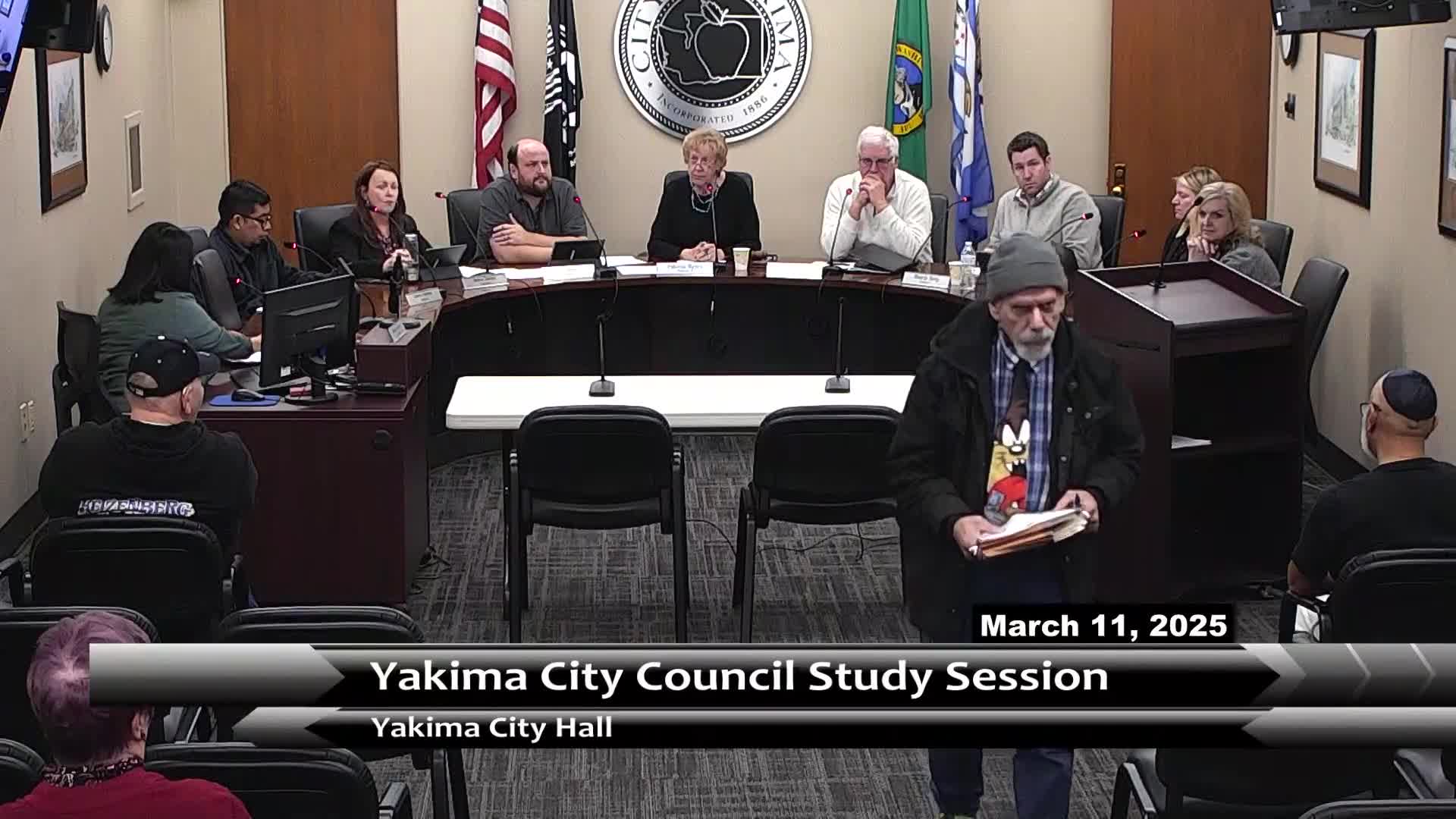
Yakima City Council tables study on impact fees after staff presentation
Summary
City staff presented options and cost estimates for an impact-fee program; council voted to table further action until a later date, citing budget and timing concerns tied to the comprehensive-plan update.
City staff presented background, cost estimates and options on a possible impact-fee program on March 11, 2025, and the Yakima City Council voted to table the idea pending later review.
Bill Preston, director of community development, and Trevor Martin, director of planning, briefed the council on what impact fees are and how the city might implement them. Preston described impact fees as “one-time charges assessed by local government against new development projects to help pay for new or expanded public capital facilities that will directly address the increased demand for services created by the development,” citing the Municipal Research and Services Center (MRSC) as a resource.
Staff outlined likely scopes (transportation, parks and fire), recommended excluding schools from the city-led program, and discussed options including a project-list or district approach. Staff estimated the cost to prepare an RFQ and conduct initial stakeholder engagement at about $10,000–$15,000 and estimated a full impact-fee study at about $75,000–$100,000. Staff also reported typical per-unit fees seen in peer cities ranging roughly $4,000–$8,000 per single-family unit. Using a simplified, flat-rate model based on Union Gap’s approach, staff said the city might have collected roughly $1.5 million in impact fees from recent development activity; staff cautioned such an estimate is hypothetical and depends on program design.
Staff noted the city’s periodic comprehensive-plan update must include the list of eligible projects for impact-fee funds; that update is expected to be completed in June 2026. Staff said the earliest the city could reasonably expect revenue from an adopted impact-fee program would be 2027–2028. Staff also said finance would need new accounting codes and administrative processes to track fee receipts and eligible projects, and that some portion of collected fees can cover administration (the city of Olympia collected $25,000 for traffic administration in one example cited by staff).
Council members discussed budget limits, staff capacity, the potential of large future developments (for example the mill site), and whether phasing implementation would reduce risk. Several council members said the city lacks current budget authority to fund the RFQ or study and that staff time would be required to manage the effort.
Councilman Glenn moved to table the proposal; Councilmember DCO seconded. The motion to table passed on a voice vote; the transcript records the motion as adopted without a recorded roll-call tally.
Staff said they would not proceed immediately; no specific follow-up date or assignment of additional staff resources is recorded in the transcript.