Get Full Government Meeting Transcripts, Videos, & Alerts Forever!
Get email alerts on the Public Safety Police Contracts topic
No spam. Unsubscribe anytime.
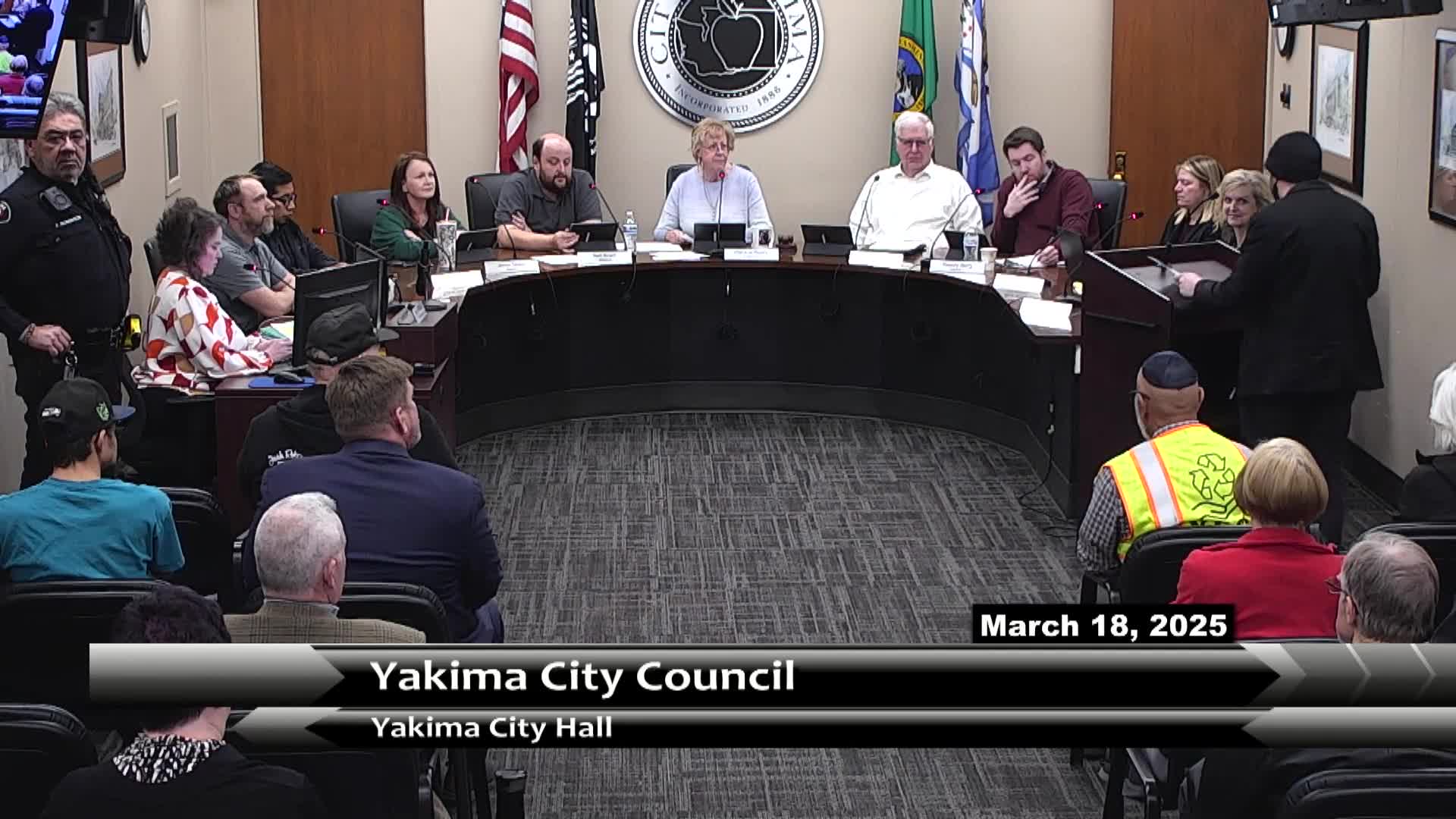
Yakima Council approves Axon contract after widespread public criticism, changes wording to 'community request'
Summary
After more than an hour of public comment criticizing a proposed $1 million-plus package for tasers and Axon software, the Yakima City Council adopted a resolution to execute a master services and purchasing agreement with Axon Enterprise Inc., amending the item language to specify “community request” software. Council approved the contract 6–1.
The Yakima City Council voted 6–1 Tuesday to adopt a resolution authorizing a master services and purchasing agreement with Axon Enterprise Inc. for tasers and a cloud-based media intake tool — amended on the floor to call the software “community request” rather than “community engagement.” The council’s vote followed more than 35 minutes of public comment opposing the purchase and a staff presentation by Yakima Police Department leaders.
The purchase approved for 2025 covers a first-phase package the department says will outfit frontline officers with up to 85 leased taser units and associated services; the Police Department estimated the 2025 expenditure at roughly $105,000, with possible follow‑on payments in later budget years if the department expands the rollout. Lieutenant Troy Adams, Yakima Police Department, said the department cannot obtain replacement parts for older Axon models and that the leased model ensures broken or obsolete units are replaced by the vendor.
Why it matters: speakers at the meeting called the contract an unnecessary use of scarce city resources and argued it would prioritize surveillance and weaponry over social services and senior- and youth-program funding that are under review in the city budget. Police leaders and several council members framed the purchase as a short-term capital solution to maintain a less-lethal option for officers; they said the broader long-term budget treatment of the devices will be considered in future budget cycles.
Public comment and concerns
Residents pressed the council to reject the contract and suggested the funds instead be directed to youth programs, senior centers and crisis outreach. Isaac Wheeler (public commenter) said the Axon evidence-hosting terms give the company broad license to use uploaded media, and warned about privacy risks; Wheeler read a passage he said came from “evidence.com” terms that grants the vendor a broad, royalty-free license to user-uploaded media. Priscilla Ortega and several others argued purchases listed as “community engagement” were misnamed because the package includes VR training headsets, taser cartridges at high annual quantities, and surveillance software.
Police response and training explanation
Lieutenant Troy Adams and Chief Sean Boyle presented the department’s rationale: the department has used Axon tasers since 2004 and now faces obsolescence and supply constraints for older models. Adams described the vendor’s current leasing model as ensuring replacements, battery maintenance and model upgrades are handled by Axon. He said the initial 2025 purchase would prioritize frontline patrol officers and be paid from the police capital fund; future funding decisions would be considered in the 2026–28 budget cycles. Chief Boyle said the tools are “less lethal” alternatives that reduce injuries to officers and subjects compared with some other force options.
Adams also described the software component, which he and others called “community request” during the meeting: the feature lets community members send media (phone video, DVR clips) to investigators through a secure upload link to reduce response and evidence-collection delays. Adams said uploaded files remain evidence under the city’s control and that public-records rules, not the vendor, determine disclosure when requests are made; city legal staff confirmed that evidentiary materials are subject to public-records law and related exemptions.
Council action and amendment
Councilman Decio moved adoption of the resolution; Councilman Berg seconded. Councilmember Herrera voted no; the remaining seven members voted to adopt the resolution as amended (vote recorded 6–1). Council amended the resolution on the floor to replace the phrase “community engagement software” with “community request software,” and the final motion authorized execution of a master services and purchasing agreement with Axon Enterprise Inc. for tasers and the community request software.
What the resolution does and next steps
The resolution authorizes the city to enter a services and purchase agreement under which Axon will provide taser devices on a managed-leasing model, training cartridges, VR training hardware and the community request upload system. The police chief and lieutenant said the 2025 cost is roughly $105,000; larger figures cited by public commenters reflect multi-year totals if the city elects to expand the program. Officials said 2025 spending will come from police capital reserves and that future budget requests will ask council to include ongoing operational funding if the department decides to continue the leased program beyond the current capital commitment.
The council-recorded motion and vote finalize the contract authorization; council did not adopt any ordinance or policy changes restricting the software’s use. Police commanders said they will continue community outreach and training and that the department’s use-of-force reviews and reporting processes remain in place.
Ending
Councilmembers and police officials urged residents to continue asking questions and to use public comment when the department requests further budget funding. The contract as authorized by the council takes effect under the terms read into the record; any later expansion of the program will return to council for budget approval if it requires general-fund support.