Get Full Government Meeting Transcripts, Videos, & Alerts Forever!
Get email alerts on the Pavement Management topic
No spam. Unsubscribe anytime.
Council accepts SEH pavement-management proposal and waives formal RFP process
Summary
The Lincoln City Council voted March 6 to accept a pavement‑management program proposal from engineering firm SEH as a noncompetitive professional services engagement and directed staff to draft contract terms. The program will inventory and rate local streets to inform multi‑year maintenance and capital planning.
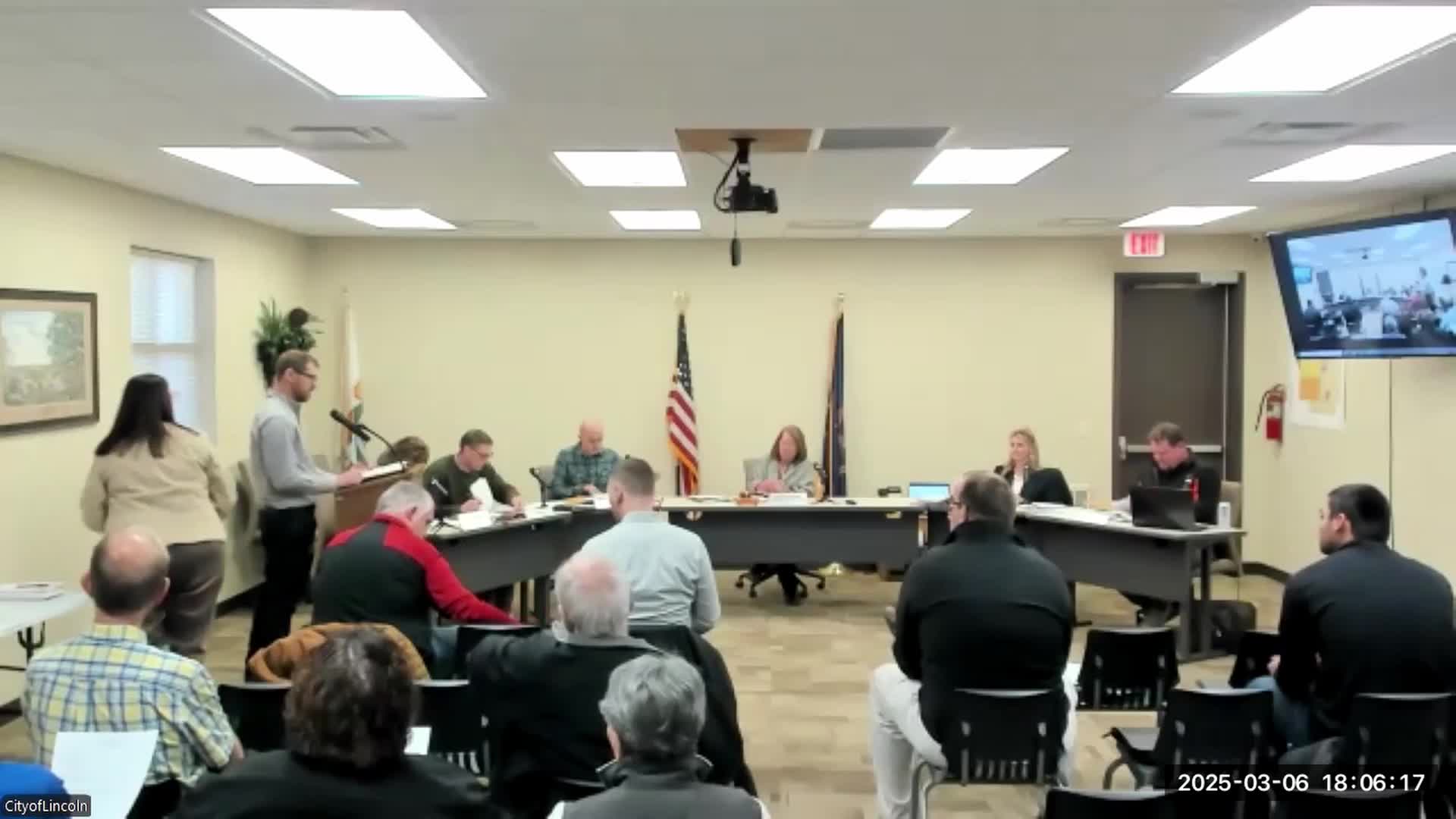
The Lincoln City Council on March 6, 2025 voted to accept a pavement‑management program proposal from engineering firm SEH and to pursue the work as a noncompetitive professional services engagement rather than issuing a full request for proposals.
The vote authorizes staff to work with SEH to finalize a contract and produce a program that will document street conditions, generate reports and scenario‑based capital improvement plans to help the city budget for maintenance and reconstruction.
SEH project manager Matt Schietel told the council the package before members summarizes expected data outputs and example reports from other cities that use the program. “We put this together in consideration,” Schietel said, describing the program as a way to help the city plan for future maintenance and capital work. He said SEH built its proposal to be flexible — from lower‑cost visual condition mapping to fuller asset‑management outputs — and estimated a not‑to‑exceed figure of about $45,000 as a ceiling, with final cost depending on the scope and how much data public works supplies.
Council members asked about cost and about whether the program would encompass utilities. Schietel said the pavement program is dedicated to streets; other asset‑management tools can include utilities but the SEH proposal presented to the council focused on roadway condition, deterioration curves and scenario planning.
City staff and the city attorney briefed the council on procurement rules. The attorney noted the city ordinance contains an exception that allows the council to select noncompetitive professional services when the council determines it appropriate; the council chose that route after discussion about the time and expense of an RFP. Councilman Ormstead moved to accept SEH’s proposal as a noncompetitive professional service; Councilman Shoemaker seconded. The motion passed on the floor and the council directed staff to return a draft contract for signature.
The council and SEH emphasized that public works will supply as much existing data as possible — pavement thickness, dates of past overlays and similar records — to reduce consultant hours and cost. Schietel said the program’s outputs include condition ratings, projected deterioration curves and capital improvement scenarios showing what the city would get for different annual funding levels.
Council members and staff said the program will be used to coordinate street projects with underground work so the city does not, for example, reconstruct a street only to have to reopen it later for utility work. Staff will bring a proposed contract back to council for final approval.
Several practical details remain to be finalized, including the final scope of scenarios to run, the number of capital outputs required and how much data public works will provide. The council’s acceptance places SEH in the lead to prepare the pavement management deliverables and contract documents.
The council also discussed whether to run a parallel RFP or rely on SEH’s prior work; members concluded the city would proceed under the noncompetitive exception and have the city attorney and staff develop a standalone contract or master services agreement as appropriate.