Get Full Government Meeting Transcripts, Videos, & Alerts Forever!
Get email alerts on the Utilities topic
No spam. Unsubscribe anytime.
Yakima council directs staff to study landlord liability for unpaid tenant utility bills
Summary
After public comment raised questions about state statute and municipal practice, the Yakima City Council directed staff to prepare a report and bring the matter back for discussion about whether property owners should be liable for unpaid tenant utility accounts.
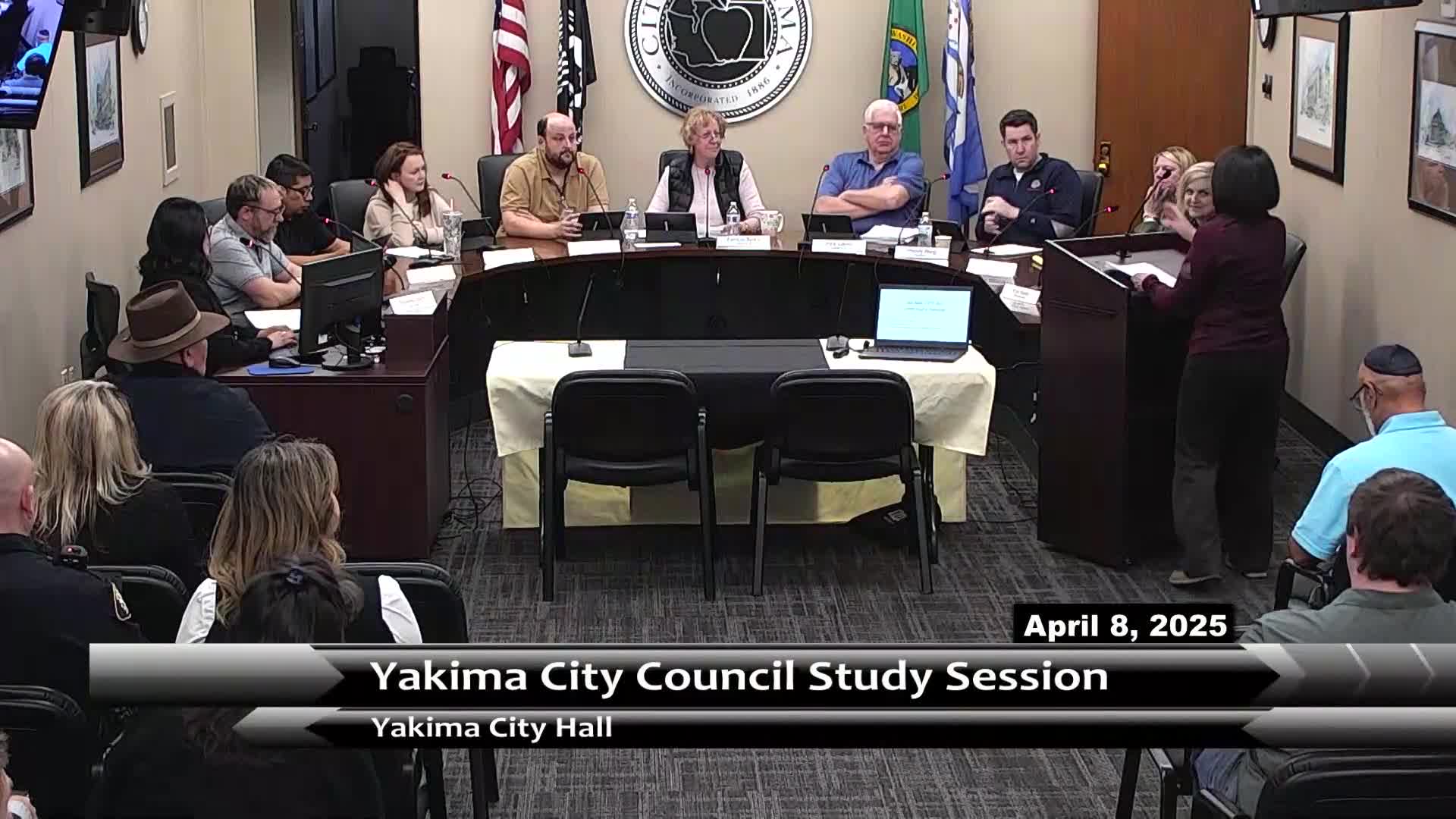
Public comment and a utilities presentation at the Yakima City Council study session in April 2025 led the council to ask staff to prepare detailed information on city practice and potential changes to Yakima Municipal Code regarding landlord liability for unpaid tenant utility accounts.
Ann Knapp, a Yakima resident speaking during the public-comment period, urged the city to review whether its lien and billing practices comply with state law. She cited a state statute in shorthand—“RCW 35 21 2 and 7 4” and “subsection 2”—and told the council she thought city practice might allow liens or charges beyond the four-month period she said the state allows. "The property owner is ultimately responsible," she said, arguing the city should ensure tenants receive timely notices and available payment-help information.
Municipal presentation and key numbers Utilities manager Annabelle Chavez gave the council a summary of the city’s utility-billing operations and collection stream. She said the city bills about 33,000 accounts on a bi-monthly schedule (26 cycles) and that the utilities billing group sends roughly 16,500 bills and receives about 16,000 payments each cycle. Chavez said roughly 860 accounts (about 2.7% of accounts) were eligible for shutoff at the time of her report, and that roughly 220 of those delinquencies were for the most recent bill only. She said the meter shutoff and shutoff-notice schedule in city practice results in shutoffs for accounts more than 41 days past due.
Chavez described rules for tenant accounts: the city will open a tenant account only after the owner or owner’s designee provides a written authorization form; that form can opt the owner in to receive late notices (and, optionally, full bills); and tenant accounts are subject to a security deposit (the transcript lists a deposit amount in unclear form, so that amount is not reported here). She also described payment-arrangement rules and said a customer who breaks two arrangements within a 12‑month period becomes ineligible for further arrangements.
Nob Hill and other complications Chavez and council members discussed accounts tied to private water providers such as Nob Hill Water. Chavez said Nob Hill customers’ water balances can grow large because the city cannot shut off water the private provider controls; Nob Hill bills water separately while the city bills sewer and refuse. The city manager noted that COVID-era moratoria and changes in customer behavior contributed to a backlog of delinquencies, a problem common to many utilities.
Council action After discussion, Councilman Glenn moved and Councilman Roy seconded a motion directing staff to prepare a report and bring the issue back for discussion at a later meeting. The council voted in favor 7–0. City staff said they will prepare a memo that outlines relevant state-law considerations, current municipal practice (YMC citations), collections impacts and comparative approaches used by other jurisdictions; staff proposed presenting that material before the council considers any resolution or ordinance.
Why it matters: the question cuts to how municipal utilities balance recoveries, tenant protections, and property-owner responsibilities. Council members asked for legal analysis and financial impact information before they proceed to draft any change.
Ending Staff committed to deliver the requested information in a memo ahead of a future business meeting (staff suggested the second business meeting in May so councilors would have time to review the materials).