Get Full Government Meeting Transcripts, Videos, & Alerts Forever!
Get email alerts on the Historic Preservation topic
No spam. Unsubscribe anytime.
Historic Preservation Commission urges closer coordination; Planning Commission adopts reporting memo language
Summary
Cindy Hall, chair of Yakima’s Historic Preservation Commission, briefed the Planning Commission about preservation work and the trolley restoration; commissioners voted to add bylaw language requiring the Planning Commission to send memos to City Council in response to committee requests for input or project support.
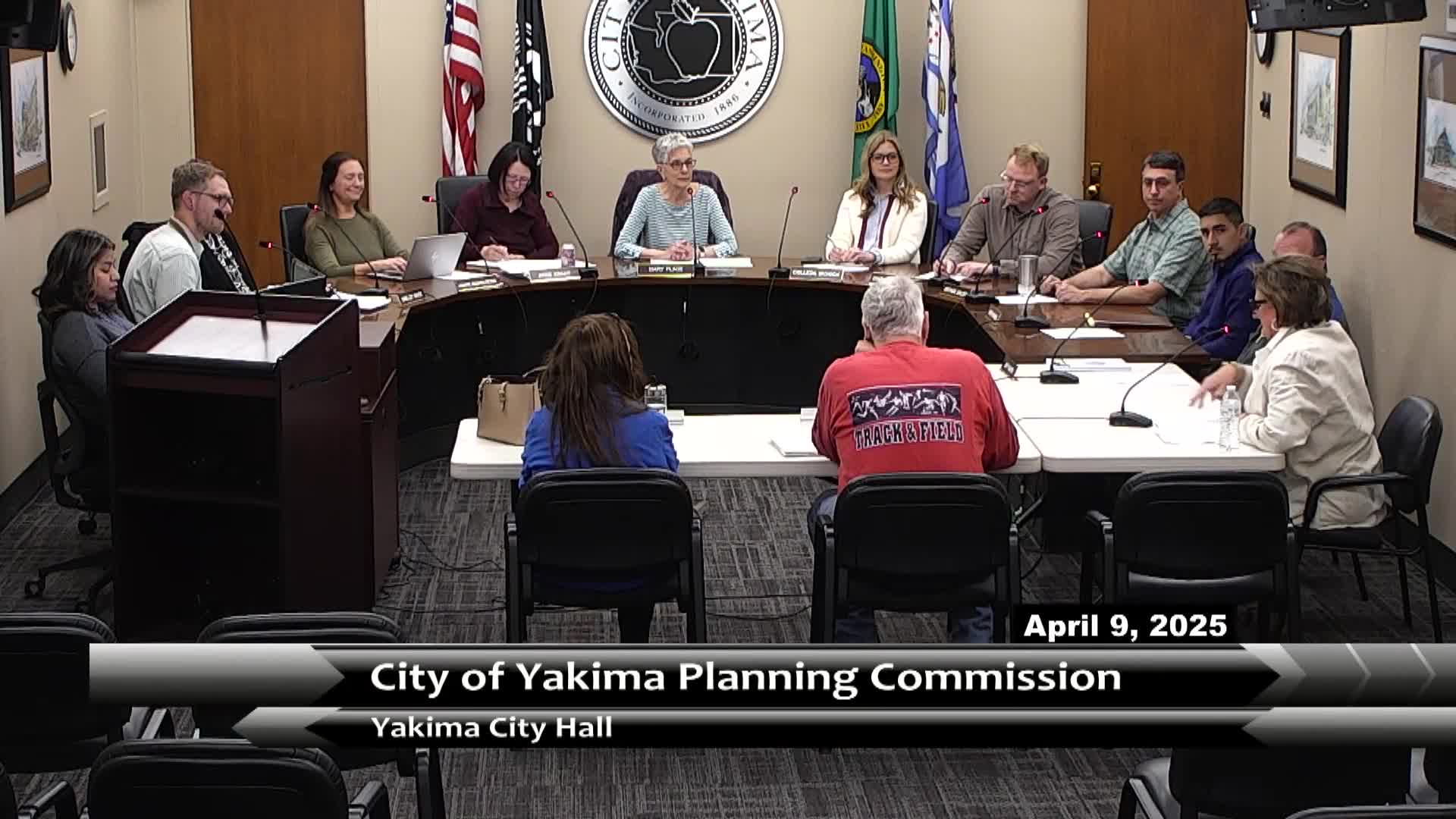
Cindy Hall, chair of the Yakima Historic Preservation Commission, told the Planning Commission on April 9 that the commission wants closer coordination with planning staff and the Planning Commission and described recent preservation work and outreach.
The Historic Preservation Commission (HPC) issues recommendations to City Council, verifies that proposed improvements meet Washington State standards, and helps secure grant funding for educational projects, Hall said. "My name is Cindy Hall, and I'm really happy to be here on behalf of Historic Preservation Commission in Yakima," she said. Hall also noted that "HPC does not operate with a budget" and that staff liaisons have historically prepared grant applications.
Why it matters: Planning commissioners agreed the committees that advise the commission should have a clear route to request input or support from the Planning Commission and then, if appropriate, onward to City Council. The commission voted to add bylaw language that would require the Planning Commission to submit a memo to City Council in response to requests for project support or input as necessary; staff will include that language in the bylaws package being forwarded to City Council.
During the discussion commissioners and staff reviewed two active preservation issues. Hall described ongoing work supporting the Yakima Valley Trolleys and said the group is seeking formal recognition and preservation assistance. "This trolley system is the only remaining intact original electric interurban railroad in The United States and is in the process of being named a National Historic Landmark," Hall said, noting volunteer efforts and the commission's letters of support to City Council.
Planning staff cautioned that preservation advocacy and requests for support often require a clear, fundable plan. Planning staff member Trevor Martin told commissioners that the HPC can provide a letter of support or similar documentation for the trolley group. "What we could get from historic preservation on something like that... is something like a letter of support," Martin said.
Commissioners discussed the financial and jurisdictional limits for large restoration efforts. One commissioner noted the city's current general-fund shortfall, saying building new track on Sixth Avenue would be expensive and "the only way that that can be funded is if the city takes it out of its general fund," which the speaker said is constrained by a roughly $9 million shortfall.
Other committee and process items: Staff described the upcoming community visioning special meeting at Henry Beauchamp Southeast Community Center (6 p.m.–8 p.m.), and said postcards in English and Spanish were mailed to nearby residents and social posts will follow. Staff said similar meetings are planned in other parts of town (Harmon Center, Washington Fruit Building) to reach neighborhood-varied opinions.
Commissioners also raised procedural topics: whether committee membership and committee reports should be listed on the city website, how and when the Planning Commission should present committee updates to City Council, and how the periodic comprehensive-plan update (led by consultant Burke with subconsultant Transpo) will use volunteer working groups. The Planning Commission asked staff to provide the comp-plan consultant's scope and deliverables before a scheduled community visioning meeting.
Tree City USA questions: Commissioners asked whether the city still met Tree City USA requirements, which include a community forestry program and an annual budget guideline (often cited as $2 per capita); staff said they would verify who currently completes the Tree City paperwork and where the funding line sits.
Procedural actions taken: the commission approved the March 26 minutes and formally added the bylaw language that "the commission shall submit a memo to council in response to a request for project support or input as necessary" to the materials to be forwarded toward City Council adoption. Staff said the bylaws packet is scheduled to go to City Council in May.
What’s next: Staff will (1) add the agreed memo-language to the bylaws packet for City Council, (2) verify whether the Barge Chestnut historic-overlay map and application guidance appear on the public website, (3) provide an outline of Burke's scope and deliverables before the community visioning meeting, and (4) confirm responsibility and funding for Tree City USA reporting.
Ending: Commissioners said they want clearer procedures so advisory committees know how to request Planning Commission input and how the Planning Commission will forward issues to City Council. Historic Preservation Commission members said they will continue to provide letters and outreach while pursuing grant opportunities and public education projects.