Get Full Government Meeting Transcripts, Videos, & Alerts Forever!
Get email alerts on the Bicycle Master Plan Update topic
No spam. Unsubscribe anytime.
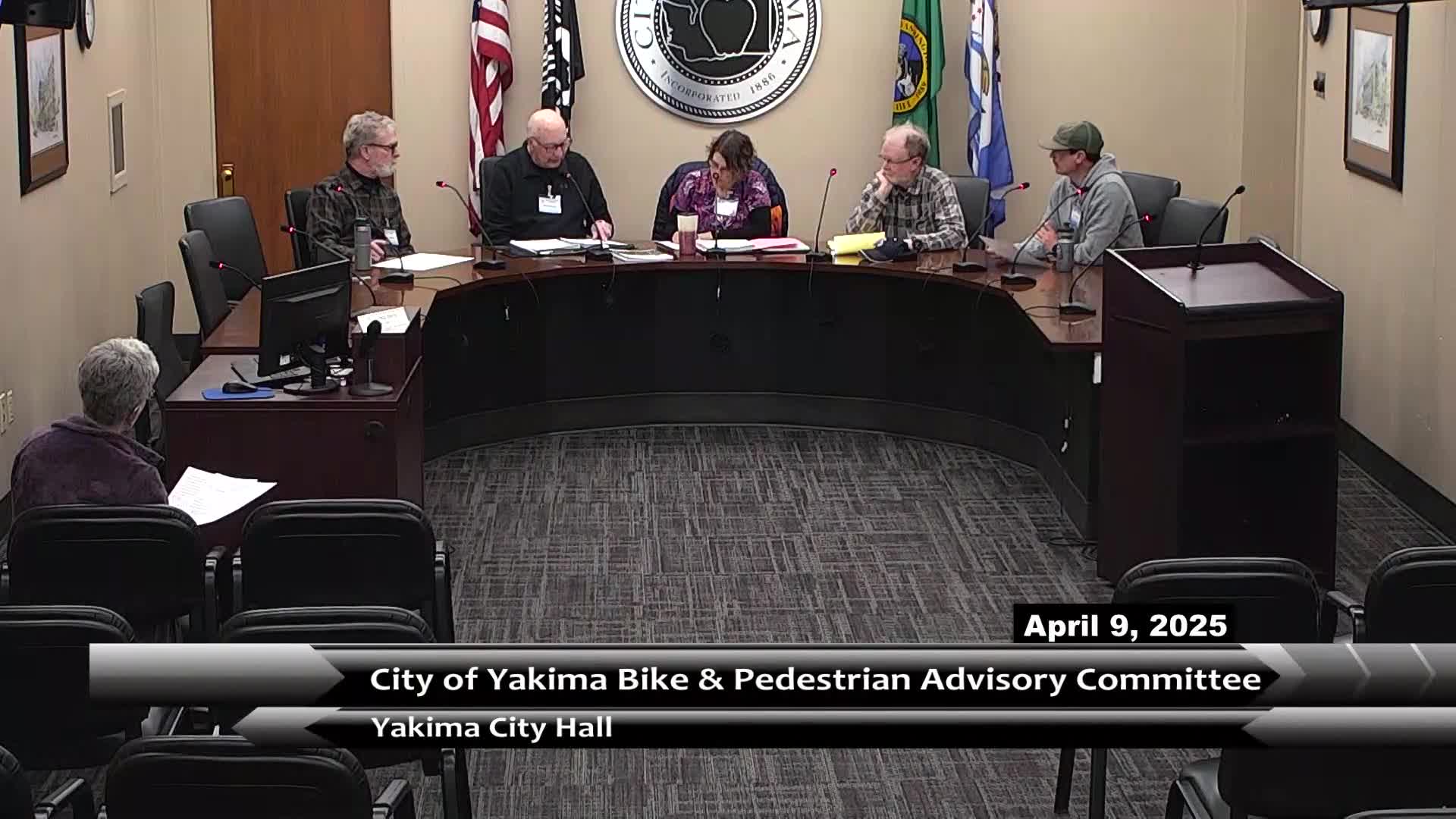
Yakima BPAC begins review of Bicycle Master Plan update, flags implementation gaps and short-term projects
Summary
At its April 9 meeting the Yakima Bicycle Pedestrian Advisory Committee reviewed the city Bicycle Master Plan, reiterated the plan's 10-year review guidance, noted recent stripe work on North First and a range of short‑term projects, and pressed for clearer implementation pathways with city engineering and planning.
The Yakima Bicycle Pedestrian Advisory Committee on April 9 reviewed the city Bicycle Master Plan and discussed priorities for an update timed with the city’s comprehensive plan process.
Committee member Phil (committee presenter) opened the discussion by noting the plan’s recommended review cycle: “Since the bicycle master plan is based on current concepts, it should be thoroughly reviewed every 10 years,” and said the current comprehensive‑plan update creates an opportunity to roll the bicycle plan review into that work.
The committee placed emphasis on a set of short‑term implementation items from the master plan. Members noted recent pavement striping on Phase 3 of North First Street that included a buffered bike lane and urged the city to standardize lane widths across earlier phases. The group also discussed continuing work on bike racks (a city survey was launched earlier but follow‑through was incomplete), annual trail access point goals, and instituting a regular bike‑count program to measure ridership trends and performance against plan targets.
Committee members reviewed planned short‑term projects on the master plan map, including: Chestnut Avenue as an east‑west cycling route with proposed crossing improvements at South Fortieth, Walnut Street bike lanes, and corridor improvements targeted at heavy traffic routes such as Yakima Avenue. The committee reiterated support for the East–West Corridor work and for making one trail access point per year where feasible.
Members raised implementation questions. They urged clearer lines of responsibility between BPAC, the city engineering department and the planning commission and asked for a formal channel so BPAC recommendations feed into council and planning processes. Mary Place, identifying herself as a Planning Commissioner, said the planning commission and BPAC must clarify how BPAC outputs are routed to council: “I’m Mary Place. I’m from the planning commission,” and asked whether BPAC should present quarterly updates or provide specific recommendations.
The committee also discussed the bicycle‑boulevard designation in the master plan and the need to add a corresponding street classification to Title 12 so design and marking guidance can be codified. Members described typical bicycle‑boulevard design elements (traffic circles, side‑street stop controls, traffic diverters and wayfinding signs) and debated whether low‑cost measures such as paint, speed cushions and targeted crossings could be advanced as “low‑hanging fruit.”
On safety and evaluation, the committee asked for pre‑ and post‑installation compliance counts for crossing enhancements (members said some crossings show low motorist compliance with existing flashing beacons) so BPAC can judge whether enhanced RRFBs or signalized crossings materially improve safety.
No formal vote was taken on policy changes during the meeting; BPAC members said staff and committee leads would continue coordinating with the planning commission and city engineering to identify concrete next steps for the master plan update and implementation.
Looking ahead, the committee identified several near‑term agenda items to carry forward: green paint and bike‑lane material choices, Chestnut/Fortieth crossing effectiveness, updating Title 12 to name bicycle boulevards, and closer coordination on the city’s ADA and pedestrian master plan updates.