Get Full Government Meeting Transcripts, Videos, & Alerts Forever!
Get email alerts on the Sustainability Grant And Programs topic
No spam. Unsubscribe anytime.
City and Kalamazoo County to implement $18.9 million EPA-funded climate program; local sustainability efforts expand
Summary
At the April 7 Committee of the Whole, City sustainability planner Justin Gish and Kalamazoo County climate sustainability coordinator Taylor Van Winkle described an $18.9 million EPA grant and a package of local initiatives including a Bee City resolution, pollinator programming, community composting pilots and solar projects.
Kalamazoo — Kalamazoo City sustainability planner Justin Gish and Kalamazoo County climate sustainability coordinator Taylor Van Winkle told the City Commission Committee of the Whole on April 7 that the county has received an $18,900,000 grant from the U.S. Environmental Protection Agency (funded through the Inflation Reduction Act) to run a three-year climate and community investment program focused inside the City of Kalamazoo.
The grant award, which Van Winkle said began its performance period in January 2025 and runs through the end of 2027, will fund activities the presenters said are intended to reduce greenhouse gas emissions, cut air pollution, strengthen local infrastructure resilience and support workforce development. Van Winkle said enrollment of participants into the program is expected to begin in April 2025 and that hiring to staff the program began in the first quarter of 2025.
Why it matters: The grant’s size and the presenters’ description of city-county coordination mean the funds could support multiple local projects and workforce pathways targeted to neighborhoods the EPA identifies as disadvantaged. City staff also described several near-term city programs that city leaders will see in coming weeks or months, including a proposed resolution, pilot projects and community outreach intended to expand pollinator habitat, composting access and rooftop and property-mounted solar.
Gish, describing near-term local steps, said the city will introduce a resolution to join Bee City USA and will launch a Bee City committee through the city’s ECC to advise on native plants and pollinator habitat on public and private land. He said the city will continue a program that began as “NoMo May,” allowing some relaxation of tall-grass enforcement in May to benefit pollinators while broadening outreach about the benefits of native plants through the summer and into fall.
Gish also described a community composting pilot. He said public services purchased two large tumblers — “65 gallons, I believe” — placed at community garden sites and that the city is preparing centralized drop-off bins that will be collected weekly and transported to a commercial composting facility in Grand Rapids. “These bins will be picked up weekly and taken to a composting facility in Grand Rapids,” Gish said.
The presenters discussed invasive-species removals in parks and along the riverfront, coordination with Kalamazoo Valley Community College (KVCC) and Kalamazoo College on compost education, and plans for a rain-barrel and composter sale in June. Gish said the city held a Solarize outreach event last November that resulted in 12 resident installs totaling about 54 kilowatts of rooftop solar; he said the city has achieved SolSmart bronze designation for streamlining solar permitting and code review and is working to reach silver.
Gish said the city and Public Services staff applied for a grant to install a 150-kilowatt solar carport at a Crosstown Parkway site; he said that project, if funded, would offset about 7% of that building’s annual energy use and provide covered parking for public-safety vehicles in winter.
Staff training and volunteer engagement were also part of the presentation. Gish said city staff training on sustainability and recycling will begin for the city’s roughly 600 employees, and that students from Western Michigan University and Kalamazoo College will assist public events and education. He said the city will increase recycling bins at parks and events and expand waste-reduction efforts.
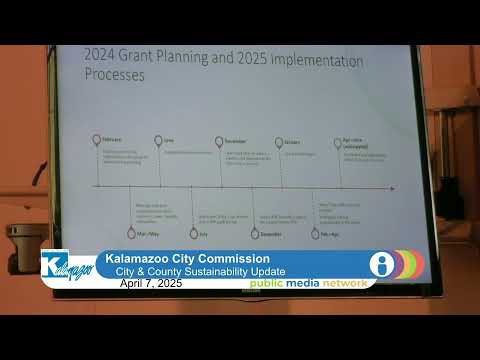
Van Winkle summarized the EPA grant application timeline and target area. He said the county began community outreach in February before submitting the application in July, learned of the award in December and began the award period in January. He said the EPA required that the grant’s qualifying target area be inside what the agency designates as disadvantaged communities, based on multiple exposure and health metrics.
No formal Commission vote or ordinance was recorded on the agenda item during the Committee of the Whole presentation; Gish said commissioners will see a resolution to join Bee City USA in the near future and staff described upcoming enrollment and program rollouts tied to the EPA grant.
Tallying details and next steps: Staff reported the EPA grant amount ($18,900,000) and an award period from January 2025 through December 2027, enrollment beginning in April 2025, and ongoing hiring to implement local programs. The Bee City resolution, a composting pilot with city-provided tumblers at neighborhood garden sites, and an application for a 150-kilowatt solar carport at Crosstown Parkway were cited as items commissioners would see or that remain contingent on grant awards and program development.
The Committee of the Whole discussion emphasized outreach and education alongside infrastructure investments, including invasive-species removals, compost access, pollinator habitat, small-scale community solar installations and staff training. No formal actions, votes or fiscal appropriations were adopted in the Committee of the Whole meeting excerpt provided.
Sources: Remarks by Justin Gish, City of Kalamazoo sustainability planner, and Taylor Van Winkle, Kalamazoo County climate sustainability coordinator, at the Kalamazoo City Commission Committee of the Whole meeting, April 7, 2025.