Get Full Government Meeting Transcripts, Videos, & Alerts Forever!
Get email alerts on the Public Meetings topic
No spam. Unsubscribe anytime.
Commissioners ask staff to redraft public-comment decorum resolution after privacy and enforcement concerns
Summary
After extended debate the Dickinson City Commission agreed to amend a draft resolution on public comment and decorum, asking staff to return a consolidated, edited version at the first April meeting that clarifies sign-in/address handling, the presiding officer's ability to extend speaker time and enforcement processes.
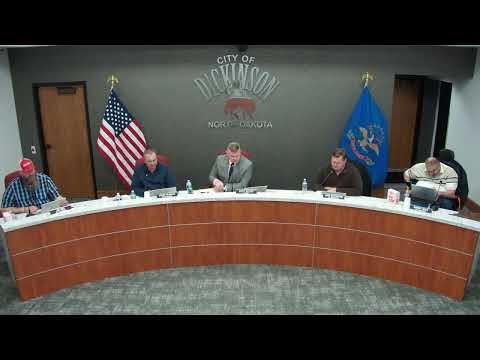
The Dickinson City Commission on March 18 discussed a staff-drafted resolution that would set rules for public comment and decorum at commission and board meetings. City Administrator Scott Dossinger presented the draft, which includes sections on who may speak, a five-minute time limit per speaker, sign-in requirements and a list of behaviors the city would deem disruptive.
Commissioners raised several concerns during discussion, including whether the presiding officer should be explicitly authorized to extend a speaker’s time, how the city should collect and handle sign-in addresses (and whether that information would be public record), and the subjectivity of some “disruptive” behavior examples.
“...I believe the presiding officer should have the ability to extend that time,” Commissioner Bair said when asking whether extensions were permitted in meaningful discussions. City Attorney Wenkel confirmed staff could incorporate explicit authority for the chair to extend a speaker’s time.
Privacy and statutory compliance
Commissioners also noted a pending state bill (referred to in discussion as Senate Bill 2180) that would require meeting attendees who provide comment to supply name and address in writing to the political subdivision; the commission asked staff to check the bill’s status and how it affects the draft resolution. Commissioners expressing privacy concerns said requiring speakers to announce a street address at the podium could endanger residents who have protection orders or who wish to keep a home address private. Several commissioners suggested a sign-in sheet collected by staff and verified internally as a compromise that would not force a speaker to state their address aloud.
Enforcement and subjectivity
Commissioner Oderman questioned wording that lists outbursts, booing, hissing and similar behaviors as “disruptive,” calling some examples subjective and asking how future presiding officers might apply the policy. Attorney Wenkel said the presiding officer would have discretion to warn and, if necessary, request removal by security or police for conduct that “disrupts or impedes the orderly and efficient conduct of the meeting.” Commissioners noted that a regular meeting includes an appeal mechanism for decisions of the chair.
Outcome
Commissioner Oderman moved and Commissioner Baer seconded to table the resolution so staff could consolidate edits and return a clean, revised draft at the first April meeting. The motion to table passed unanimously. Staff said it would prepare a draft that explicitly authorizes chair discretion to extend speaker time, offer a sign-in procedure that respects privacy, and reflect any statutory changes from pending state legislation.
Why it matters
Rules for public comment affect public access, safety and the conduct of local government meetings. Commissioners said they want the final resolution to balance orderly meetings and the public’s First Amendment rights while addressing privacy and safety concerns for vulnerable residents. The item will return for a vote after staff brings a revised draft and explains how the city will process sign-in records and redaction requests if required by open-records law.