Get Full Government Meeting Transcripts, Videos, & Alerts Forever!
Get email alerts on the Unarmed Crisis Response topic
No spam. Unsubscribe anytime.
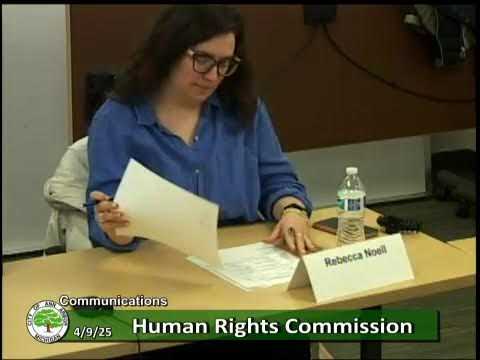
Students tell Ann Arbor Human Rights Commission city process stalled on unarmed crisis response
Summary
University of Michigan social-work students reported limited public information and stalled procurement after a 2021 council directive to create an unarmed crisis response program; they recommended funding community-led teams and clearer, transparent decision-making from city staff.
A group of University of Michigan School of Social Work students told the Ann Arbor Human Rights Commission on April that the city’s effort to stand up an unarmed crisis response team has produced little public clarity and that locally developed organizations have been sidelined by restrictive procurement processes.
The students said the city adopted a directive in 2021 to create an unarmed crisis response option for some 911 calls — for example, mental-health crises or calls involving people experiencing homelessness — and that an early respondent to a city request for proposals, Coalition for Reenvisioning Our Safety (CROWS) and a related team now known as Care Based Safety, did not win approval after the initial procurement. A subsequent narrower RFP issued in 2024 drew no applicants, the students said, and they described limited publicly available information about why the original proposal was rejected and what next steps the city has taken.
Why it matters: The students framed the topic as a public-safety and equity issue. They noted research and advocacy findings discussed in their project showing higher risks of use of force for people who are Black, Hispanic or living with mental illness and argued that a response model that relies on armed officers alongside social workers (a “co-response” model) can preserve the presence of weapons and undermine trust with people in crisis.
The students summarized interviews they conducted with local and near-local groups doing unarmed response work, including Care Based Safety (which operates primarily in Ypsilanti), Detroit Safety Team and other programs the students cataloged from national examples. They said Care Based Safety declined to apply to Ann Arbor’s narrower RFP because the requirements conflicted with the organization’s mission; Care Based Safety told the students it prefers consent-based responses, community involvement at every stage and separate dispatch pathways rather than being subordinated to standard 911 dispatch.
The presenters recommended the city consider funding a locally rooted organization to provide unarmed crisis response without municipal oversight that would undercut the provider’s mission, or at minimum training 911 operators to divert appropriate calls and station social workers in dispatch while separate response capacity is built. The students also urged transparency about what city staff have reviewed, citing community interest in the city administrator’s and other officials’ travel to study models in other jurisdictions.
City responses and related budgeting steps reported in the meeting: Commission and council members on hand said city staff have been studying national models; one council member reported the city has been setting aside portions of marijuana excise tax revenue and related rebate funds for mental-health and public-safety work, and the administration recently used a state grant to hire two social workers to serve supportive-connections downtown services. Presenters and commissioners discussed tradeoffs: some law-enforcement officials expressed interest in noncoresponse approaches, while students and presenters warned that co-response will continue to carry the signal of armed officers and risks that can escalate encounters.
Discussion highlights: Commissioners asked the students how existing community programs operate (funding sources, whether they have separate phone lines or rely on outreach), what calls still require police backup, and how community training and prevention can reduce demand for crisis response. Presenters said Care Based Safety currently relies heavily on private donors and community fundraising in Ypsilanti, runs outreach and community-training programs, and is building operations before seeking municipal contracts.
Next steps noted at the meeting: Commissioners urged further public information from the administration and encouraged the students and community groups to provide details to staff and the council as the budget is prepared. Commissioners also noted the city’s ongoing budget cycle and that larger, multi-year programs require stable revenue streams rather than single-year allocations.
Ending: Commissioners thanked the student presenters and asked staff to raise remaining questions with Care Based Safety and other local groups; the commission requested further updates during the budget season as staff work toward potential pilot funding and program design.