Get Full Government Meeting Transcripts, Videos, & Alerts Forever!
Get email alerts on the Annexation topic
No spam. Unsubscribe anytime.
City staff present four annexation scenarios; three would require subsidies, small option projects net positive
Summary
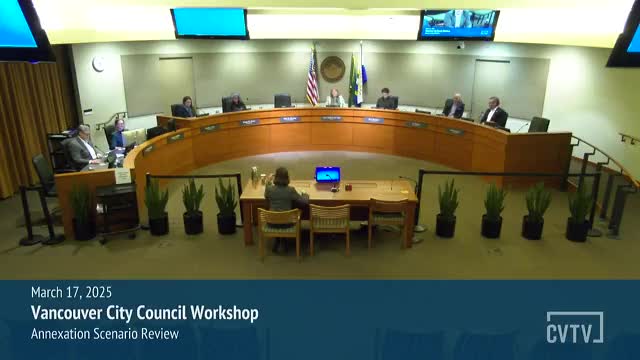
City staff presented four annexation scenarios to Vancouver City Council showing large area annexations would create ongoing annual deficits despite a 10‑year state sales‑tax credit; a small North Padden option of roughly 1,700 residents showed a net positive result but is too small to qualify for the sales‑tax credit without boundary adjustment.
City planning and finance staff presented four modeled annexation scenarios to the Vancouver City Council and said three of the four scenarios would likely require subsidy from current residents, while a small targeted annexation north of SR‑500 could be net positive under current assumptions.
At the workshop, a staff presenter identified the scenarios and their headline results: annexing up to the Fire District 5 boundary (about 95,000 new residents) showed an estimated ongoing deficit of about $42 million; annexing to the city’s water‑service areas (about 76,000 residents) produced an estimated ongoing deficit of roughly $50 million; annexing the full urban growth boundary (about 171,000 residents) showed an ongoing deficit in the ~$49 million range but applied to a much larger tax base; a smaller North Padden Parkway scenario (about 1,700 residents with commercial corridors) showed a net positive outcome on an ongoing basis.
The nut graf: Staff emphasized a key one‑time revenue tool that materially improves early years of larger annexations — a state sales‑tax credit the city could receive for up to 10 years — but that credit is temporary and conditional, and the underlying ongoing fiscal gaps remain large. Councilors asked for more detailed breakdowns of lane miles, park acreage, and other capital/maintenance liabilities before making policy choices.
Staff outlined principal assumptions. Property tax estimates used county assessor parcel data; sales tax figures came from Washington’s Department of Revenue. Staff assumed the city could access a limited, temporary sales‑tax credit in three of the four larger scenarios; the presenter noted the credit is a 10‑year, one‑time revenue stream and requires an interlocal agreement with the county and annexation completion by July 1, 2028. Utility revenue was adjusted because many unincorporated residents currently pay higher out‑of‑city utility rates; converting them to city service generally reduced projected utility revenue. Road and sidewalk costs were modeled with a roughly 30% higher per‑mile investment for newly annexed lane miles because county standards historically differ from city standards, and staff included estimates for added police officers, parks maintenance and debt service, and one‑time vehicle purchases.
Key numbers presented on expenditures and capital needs included: an estimated need for about 114–115 additional police officers in the Fire District 5 scenario and about 205 officers under the full UGA scenario; a potential ~$35 million debt service estimate tied to a parks/recreation facility in one scenario; and roughly $23 million estimated one‑time vehicle purchases in the largest scenario. Staff cautioned these are preliminary estimates that require department‑level validation.
Councilors probed scope and timing. Councilor Fox and others urged staff to prioritize annexing areas with growth potential and commercial/industrial revenue prospects rather than fully built single‑family neighborhoods. Councilor Hansen asked whether the small North Padden scenario could be expanded just above the 2,000‑resident threshold that would make the city eligible for the 10‑year sales‑tax credit; staff said boundary adjustments could be explored. Councilor Paulson, among others, urged modeling scenarios that incorporate projected growth and development over a 10–20 year horizon, not only an as‑is snapshot, and flagged the need to consider the comp‑plan and land‑use changes that would follow annexation.
Staff also described process and next steps: any large annexation that relies on the state sales‑tax credit will require interlocal negotiations with Clark County and more detailed asset inventories (lane miles, park acreage, utility infrastructure) and timing decisions about how quickly the city would upgrade infrastructure to urban standards. The presenter estimated initial procedural costs for a major annexation effort could be a few hundred thousand dollars; smaller annexations would cost less.
Ending: Councilors gave mixed initial reactions and asked staff to return with further analysis: more granular lane‑mile and park‑acreage counts, scenario modeling that includes projected growth and phased service upgrades, and options to expand the small North Padden boundary to test sales‑tax eligibility. No formal action or vote was taken at the workshop.