Get Full Government Meeting Transcripts, Videos, & Alerts Forever!
Get email alerts on the Districting topic
No spam. Unsubscribe anytime.
Survey finds cautious support for council voting districts; many residents undecided
Summary
A DHM Research poll of 400 Vancouver residents found 58% support for creating council voting districts after respondents were given basic information, though a large share remained undecided. The City’s districting committee and council members discussed next steps and timing for any ballot measure.
A majority of Vancouver residents who were given basic information said they would support creating voting districts to elect City Council members, but a large share of the public remained uncertain, the city’s consultant told council at a workshop.
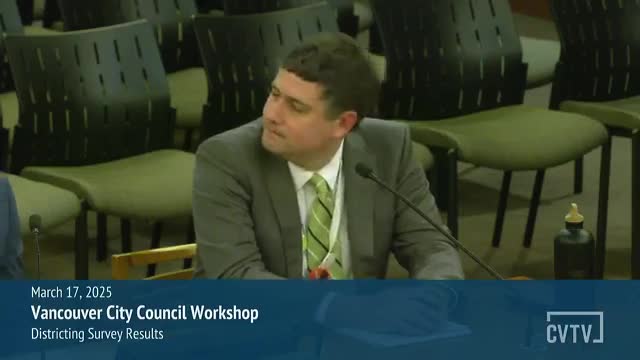
Devin Bales, director of research at DHM Research, told the council the firm surveyed 400 Vancouver residents by phone and text between Jan. 27 and Feb. 2 and set demographic quotas to match the city’s population. "With a sample size of 400, the margin of error is about 4.9 percent," Bales said.
The nut graf: In an initial, uninformed question 49% of respondents said they supported districts, 19% opposed and 32% said they did not know. When the survey provided a short explanation that councilors are currently elected at-large and that districts would elect council members to represent only part of the city, support rose to 58% and opposition to 29%, while 13% remained unsure. The result leaves the council with both measurable support and substantial uncertainty among residents — a factor councilors said will shape whether and how the city asks voters to decide.
DHM presented several other findings the council considered: the company asked about interest in a hybrid model (district council members plus some at-large seats). Among respondents who ultimately supported districting, 47% said they would support adding at-large members in addition to district representatives, 37% opposed that hybrid and 17% were unsure.
Bales summarized respondents’ reasons: among people who ended up supporting districts, many cited expectations that districts would add diversity of perspective or improve distribution of resources across the city. Among those who opposed, the most-cited concern was that district-elected officials might prioritize their neighborhood over the entire city. "A third of folks said it could make council members advocate only for their neighborhood," Bales said. DHM coded short open-ended answers to identify those themes.
Councilors asked technical and methodological questions. Councilor Kim asked whether the hybrid-question wording had reminded respondents that the mayor already serves at-large; DHM confirmed the survey question about adding at-large members did not explicitly mention the mayor. Councilor Perez and others asked about variations in sample sizes for sub-questions; DHM explained some questions only applied to subsets of respondents (for example, only those who said they supported districting).
Staff and committee members framed the presentation as a step in a larger process. Aaron Landy, policy program manager, reminded council the districting committee — which its members said includes Councilors Stover, Paulson and Fox — had spent many months working with DHM and that the survey grew from the 2024 charter review committee’s discussion of districting. Landy and DHM emphasized the survey was an initial test and that messaging and ballot language could change public opinion.
Council discussion focused on next steps and timing. Staff listed a practical deadline: materials for a potential ballot placement would need final direction in early to mid-June if the council intends to place a measure on the November 2025 ballot because the county requires ballot materials in August. Several councilors asked for more time to review the full cross-tabulation tables in the DHM report; several asked that the districting subcommittee and staff prepare clarifying options and precise ballot language before the council decides whether to take a measure to voters.
Ending: No formal vote or directive was recorded at the workshop. Councilors agreed to take additional time to review the full survey tables, and several members asked staff and the districting subcommittee to return with more detailed options — including refined hybrid models, term-limit scenarios and ballot language — before the council gives final direction on whether to place a measure before voters.