Get Full Government Meeting Transcripts, Videos, & Alerts Forever!
Get email alerts on the Climate Resilience topic
No spam. Unsubscribe anytime.
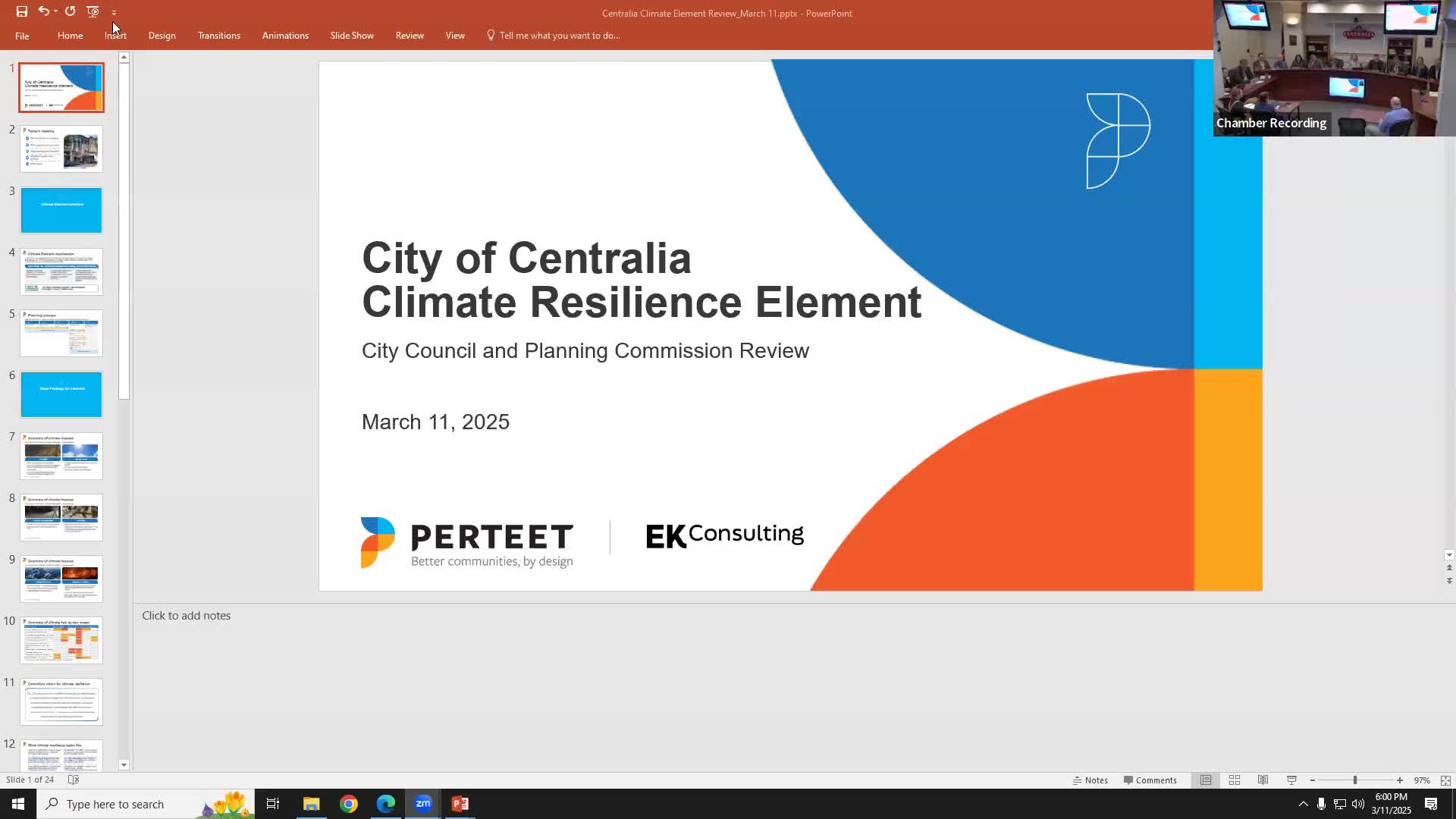
Centralia holds joint workshop on climate resiliency element; consultants outline flood, heat and drought risks
Summary
Consultants hired under a state grant presented a climate resiliency element for Centralia's comprehensive plan, identifying increased flooding, more extreme heat, and longer droughts as primary risks and recommending policies to guide land use, utilities, and capital facilities.
Centralia city staff and planning commissioners held a joint workshop Tuesday where consultants presented a draft climate resiliency element to be incorporated into the city’s comprehensive plan.
The presentation, funded by a state grant under the Climate Commitment Act, described a risk-based planning process consultants said follows Washington Commerce guidance and national standards. “Tonight, we’re going to be talking a little bit about our climate resilient element,” Emil said in opening remarks, turning the program over to consultants.
Consultant Christina Wollman of Pertit said the plan focuses on climate-exacerbated hazards through mid-century. “I am Christina Wollman with Pertit, and I am a planner, a floodplain manager,” she told the council and planning commissioners, outlining work the firm has done on hazard mitigation and flood modeling in the region. Mandy Maxwell of EK Consulting summarized projected impacts for Lewis County and Centralia, saying the analysis uses the University of Washington downscaled climate dataset and other federal sources.
The consultants told the joint body that mid-century projections include a decrease in summer precipitation and streamflow, more extreme heat (an average summer rise of roughly 3–3.5°F and an estimated 20 additional 90°F-plus days), an 11% rise in average storm precipitation per storm, and a projected doubling of the frequency of major floods. The presenters said Chehalis River–specific studies show larger peak-flow increases: “about a 15% increase in your peak stream flow by 2049 and then a 40% increase by 2080,” Wollman said, referencing basin modeling by the Office of the Chehalis Basin and the flood authority.
Consultants emphasized risks do not act alone: they flagged compound hazards such as heat exacerbating drought and drought increasing wildfire risk, and noted that wildfire smoke — while the city itself has a relatively low wildfire ignition risk — will likely increase as fires in the region grow. They also recommended increased tree canopy, low-impact stormwater practices, and considering a 2080 flood‑plain when siting capital facilities.
Council members and the public asked about update schedules, data sources and outreach. A council member asked how often climate data will be refreshed; staff said the climate element is part of the comprehensive plan and the comp plan is updated on a 10‑year cycle, but the plan can be refreshed more frequently as new data arrives. The consultants said the dataset used can be extended to mid‑ and end‑century horizons and they had also consulted FEMA and commercial packages such as FirstStreet.org to cross-check results. On equity and communication concerns, several members urged multilingual outreach; staff said goals and policies could be translated if the council chose to prioritize funding for broader translations.
The consultants said next steps include publishing an accessible climate resilience plan document and inserting climate-informed edits into other comprehensive-plan elements; they also noted the same consultants prepared Lewis County’s multijurisdictional hazard mitigation plan. Staff said the draft climate material will be included in the consolidated comprehensive plan update and will be followed by public outreach and formal adoption steps.
Why it matters: The council must adopt a climate element as required under state law; the policies being recommended would inform future land-use decisions, capital investments and utility planning. Consultants and staff repeatedly framed the work as preventive planning — identifying where development should be prioritized and where avoided, and proposing specific policies to protect natural resources and vulnerable neighborhoods.
The workshop ended with staff committing to publish the presentation materials online and continue public engagement. Consultants and staff urged broader community promotion so residents understand hazard projections and the policy choices the city will make when updating zoning, utilities and public facilities to reflect climate risks.