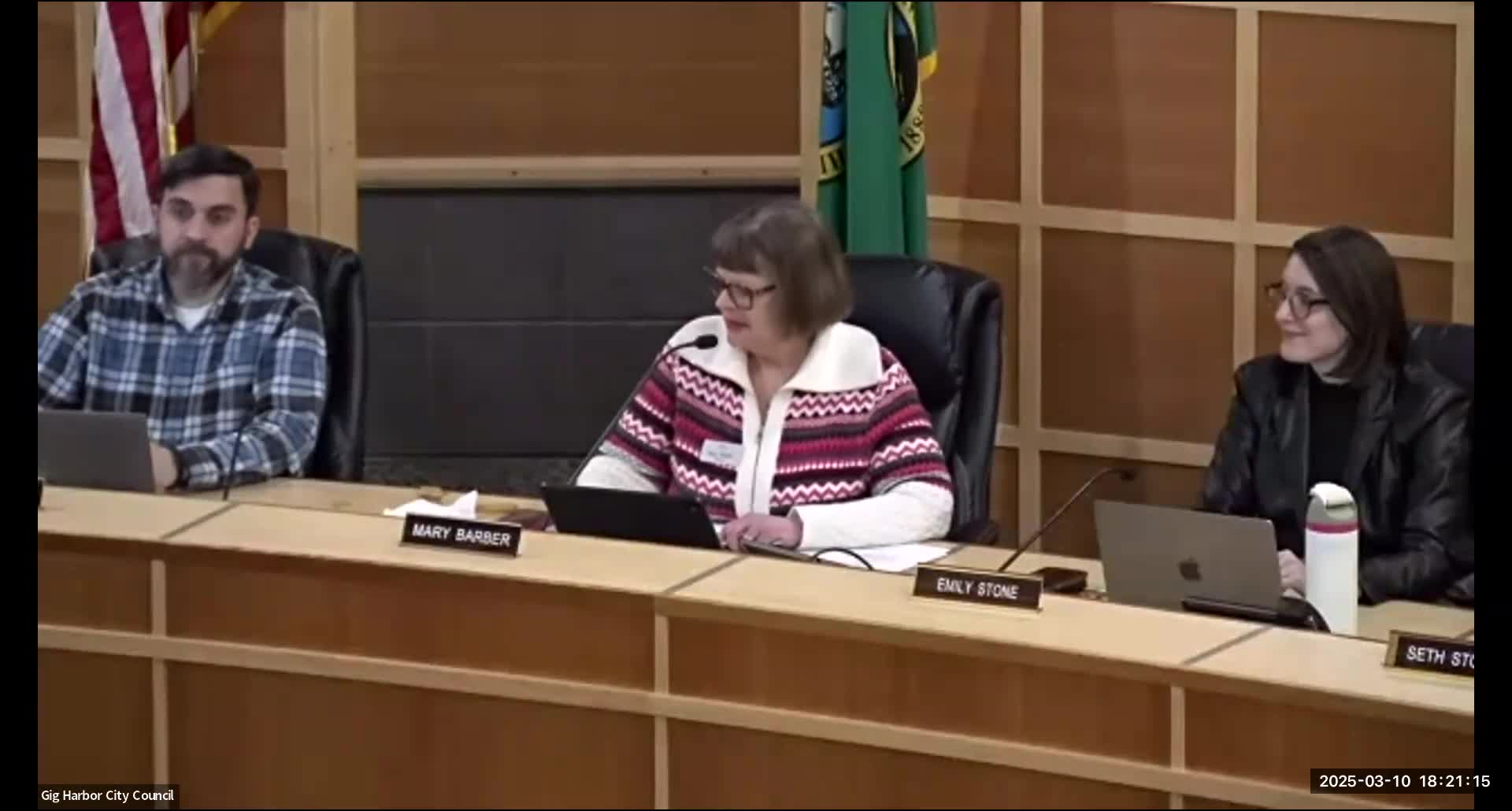
Gig Harbor council directs staff to put 0.1% cultural access sales tax on November ballot after wide public comment
Loading...
Summary
After extensive public testimony from local arts, science and history organizations, the Gig Harbor City Council voted 6–0 to ask staff to prepare an ordinance to establish a cultural access program funded by a 0.1% sales tax and require voter approval in November 2025.
The Gig Harbor City Council on March 10 directed staff to prepare an ordinance to establish a Cultural Access Program funded by a 0.1% sales tax, with the requirement that the tax be approved by city voters at the November 2025 election. The motion passed 6–0 after more than an hour of public testimony from museum, science and cultural organizations and extended council deliberation.
City Administrator Katrina Knudson told the council that the program, under state law, could be funded by a 0.1% sales tax that would generate about $1,000,000 annually within the city limits if imposed. She said the tax could be adopted by the council directly (councilmanic authority) or placed on the ballot for voter approval; the council asked staff to prepare an ordinance for a ballot measure in November. "This tax may be imposed directly by you, the city council, councilmanically, or placed on a ballot for the Gig Harbor voters to vote on and decide," Knudson said during the staff report.
Speakers representing local institutions urged the council to adopt the program to provide predictable, stable funding for arts, science and heritage groups and to restore school outreach programs cut since the pandemic. Stephanie Lyle, director of the Harbor History Museum, who said she helped instigate the local effort, described the program as a tool to provide reliable support for many small organizations: "What if everybody, every household, and maybe you divide that by two, gives $10 to every single organization that they love in town? We would all be funded," Lyle said. Lindsay Stover, executive director of Harbor Wild Watch, said cultural access would restore pre-pandemic K–12 STEM education and expand outreach, especially to low-income schools on the Key Peninsula.
Several speakers and some council members urged that the program include a clear plan for distribution and governance before any funds are collected. Robin Ovney, speaking as a citizen and former member of multiple arts commissions, said she favored the program but preferred a voter decision and asked the council to develop a distribution plan before asking voters to approve the tax. Council members expressed similar concerns during deliberation: Council member Storrsett proposed directing staff to prepare an ordinance requiring voter approval in November; Council member Henderson supported the measure but said he would prefer voter approval and a more fleshed-out distribution plan. Council member Wouk moved to direct staff to prepare an ordinance by councilmatic action, but that motion received no second. Ultimately Storrsett's motion—amended on the floor to target the November ballot—carried 6–0.
Under the council's direction staff will draft an ordinance and include a high-level program overview; more detailed program rules, distribution criteria, and governance structures are expected to be developed during the ordinance drafting process and in subsequent study sessions. Staff noted timing constraints for an August ballot and recommended November 2025 to allow for ordinance drafting, outreach and a program plan. Knudson said there is a one-year collection period after adoption before disbursements would begin; if the city acts by November, the first revenues would be collected the following year.
Article ending: Council action directs staff to prepare the ordinance and high-level program description for a November 2025 ballot measure; staff and council will hold additional meetings and public outreach to shape distribution rules, governance and implementation steps before funds are collected.