Get Full Government Meeting Transcripts, Videos, & Alerts Forever!
Get email alerts on the Energy Aggregation topic
No spam. Unsubscribe anytime.
Saint Bernard hears pitch for municipal energy aggregation; council members follow up
Summary
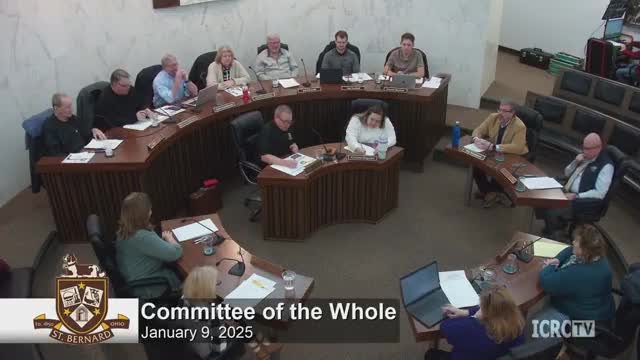
Rich Sarais, a representative of Energy Alliances, outlined an opt-out municipal energy aggregation program to the Village of Saint Bernard Committee of the Whole on Jan. 9, saying the program would let the village solicit bulk electricity and natural gas supply contracts on behalf of residents and eligible small businesses while Duke Energy would continue to deliver service and handle outages.
Rich Sarais, a representative of Energy Alliances, outlined an opt-out municipal energy aggregation program to the Village of Saint Bernard Committee of the Whole on Jan. 9, saying the program would let the village solicit bulk electricity and natural gas supply contracts on behalf of residents and eligible small businesses while Duke Energy would continue to deliver service and handle outages.
The presentation centered on how aggregation works, who would be eligible, consumer protections and the steps the village would need to take to get certified and place the question before voters. "The programs that we run never have a termination fee," Sarais said, adding that residents may enter or leave the program at any time at no cost. He also said, "It's not mandatory," stressing that participation would be optional for customers.
Why it matters: an aggregation program can create a single, village-negotiated supply price and — if council chooses to pursue certification and voters approve — could provide price certainty or renewable-energy options that individual residents might not secure on their own. Sarais said the Public Utilities Commission of Ohio (PUCO) governs aggregation programs and more than 400 Ohio communities are currently certified to run such programs.
Sarais told council that roughly 75% of Saint Bernard residents were still on Duke Energy's default generation service and that there were about 57 third-party offers visible on the PUCO website in the Duke footprint, which he said makes direct shopping confusing for many consumers. He explained typical exclusions and procedures: accounts already served by a third-party supplier and customers on Duke's low-income PIP program would be initially excluded from the automatic opt-in list; eligible households would receive an opt-out notice and could decline participation. Sarais also described operational features his firm provides: draft legislation and a plan of operations, two required public hearings, customer service (including a local phone line and community-specific website), quarterly performance reports and periodic "resweeps" to capture newly eligible accounts.
Council members asked specific operational and risk questions. Councilmember Morton asked whether Energy Alliances could estimate the share of accounts that would see higher bills under aggregation compared with Duke; Sarais replied that the answer depends on the locked contract price and Duke's rates at the time and that his firm calculates savings per account rather than using a single blanket number. Councilmember Brickway asked whether other companies in Ohio offer similar services; Sarais said yes and added he would recommend other vendors if the village chose to consider them.
Sarais discussed market risk differences between electricity and gas, noting gas prices can be more volatile (he described recent multi-week swings) and that some communities choose fixed-price gas contracts to provide a ceiling on what residents would pay. He said many of his clients include a renewable-energy component in the default offer or make renewable options available as opt-ins.
Timeline and next steps described by Sarais: certification with PUCO does not commit the village to run a program but enables it to solicit offers later; the firm estimated roughly four to five months from a successful ballot to program start if the community moves quickly, and said it would help prepare ballot language, draft the plan of operations and run the required public hearings. Sarais said suppliers bear enrollment risk (they set prices knowing some accounts will opt out or churn) and that the firm monitors program performance quarterly and can renegotiate with suppliers if results differ materially from expectations.
Votes at a glance: two brief council votes during the meeting were recorded. Motion to approve the written minutes of the Dec. 19 council meeting (motion by Schultmeyer; second by Estep) was approved with no opposition. Motion to place Resolution No. 1 (2025) on the table for the next council meeting (motion by Schultmeyer; second by Estep) was approved with no opposition. Resolution No. 1, 2025 was introduced earlier in the meeting as the annual authorization allowing limited use of public funds to purchase refreshments for official events (examples given: Boy Scout night). (Both motions were recorded as carried by voice vote; all seven members were present for the meeting.)
Next steps: Councilmember Morton signaled he would follow up with Sarais; no formal council action to pursue certification or to place an aggregation measure on the ballot was taken during the Jan. 9 meeting.