Get Full Government Meeting Transcripts, Videos, & Alerts Forever!
Get email alerts on the Affordable Housing Preservation topic
No spam. Unsubscribe anytime.
Rebuilding Together Nashville tells Industrial Development Board it preserved roughly $17 million in home value with targeted repairs
Summary
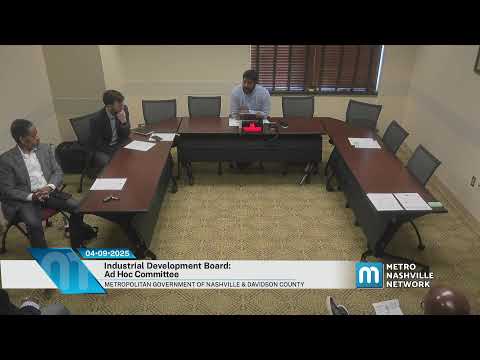
Anton Jackson of Rebuilding Together Nashville told the Industrial Development Board ad hoc committee on April 9 that the nonprofit has completed about 105 targeted home repairs since 2019, averages about $25,000 in repairs per house and aims to do roughly 40 homes a year as it seeks more funding and outreach partners.
Anton Jackson, director of mission advancement for Rebuilding Together Nashville, told the Industrial Development Board ad hoc committee on April 9 that his nonprofit has completed roughly 105 homes under a targeted-community initiative and estimates those repairs preserved about $17 million in property value.
Jackson said the organization, which focuses on repairs for low-income homeowners, veterans and people with disabilities, uses contractors for major work and corporate volunteers for aesthetic projects. “We always like to say we’re a small but mighty bunch,” Jackson said. “The most affordable house is the one you already own.”
Why it matters: Jackson framed the repairs as preservation that helps long-term residents stay in place as neighborhood values rise. He said repairs reduce the risk that homeowners will be forced to sell to cover remediation or major maintenance, and that preserving ownership keeps local social supports intact.
Jackson said the group pivoted in 2019 to concentrate work in target areas such as Greater Bordeaux and the Dickerson Pike corridor. Since launching that approach, the group has completed about 105 homes, he said; the organization estimates it has put roughly $25,000 into each home on average and values the preserved stock at about $17 million using assessor records. Two years ago the group completed 22 homes; last year it completed 39 and it is projecting a steady goal of about 40 homes a year going forward.
The repairs cover roofs, HVAC, electrical and other items Jackson described as tied to a 25-point safety-and-health checklist developed by Rebuilding Together’s national affiliate. Jackson said his team prioritizes safety and habitability and will scale spending per house when conditions require more extensive work.
Funding and partners: Jackson told the board the nonprofit has not historically received federal or state grants during his tenure, and that philanthropic and corporate grants have been critical. He gave special recognition to the Barnes Fund, calling it a near-essential source for the group’s survival, and listed corporate supporters including Amazon and local foundations. Jackson said the group wants sustained, long-term investment from a mix of philanthropic, corporate and government sources.
Outreach and operations: Jackson described two community advisory committees (one in Dickerson Pike and one in Bordeaux) that help identify homeowners and said much of the current client recruitment is trust-driven, paper-based and resource-intensive. He said Rebuilding Together recently posted for an outreach coordinator to expand marketing and intake and uses a Salesforce customer-relationship-management system to track applicants.
Jackson said Metro Water Services has been a helpful partner for cases involving utility or service-line issues and noted that some homeowners purchase service-line protection through their Metro water bills. He also described partnerships for wraparound services, including food support and mental health referrals, and said the group works with Vanderbilt University School of Nursing on outreach and assessments.
Programs beyond repairs: Jackson discussed a proposed “repair plus” model that bundles repairs with financial-literacy training, estate-planning clinics and one-on-one counseling through legal clinics and banks. He said the goal is to help homeowners capture property-value gains and pass assets to heirs rather than sell under duress.
What the group asked of the board: Jackson and board members discussed opportunities for coordination with local funding sources and for small grants or other targeted investments that could be used for specific repairs or outreach. Jackson said even modest gifts — for example, $5,000 to $10,000 — can be used for discrete repairs such as windows or minor HVAC improvements, while $25,000 is the average cost to bring a single home up to the group’s safety-and-health standard.
Upcoming event: Jackson invited board members to a Building Community breakfast at Harkin Hall in Madison scheduled for the coming Saturday to celebrate homeowners the nonprofit has served and to raise awareness. He provided a contact email (Anton@RTNashville.org) and the group’s website (www.rtnnashville.org).
Ending: Board members asked several operational questions about demand, eligibility (the program serves homeowners only), outreach and partnerships with Metro offices. Jackson emphasized the need for predictable funding and closer coordination with city programs to scale preservation work and reduce displacement risk in neighborhoods experiencing rising property values.