Get Full Government Meeting Transcripts, Videos, & Alerts Forever!
Get email alerts on the School Safety Funds topic
No spam. Unsubscribe anytime.
Macon-Bibb to use $2 million from school camera fund to boost starting pay for deputies; $1 million directed to schools
Summary
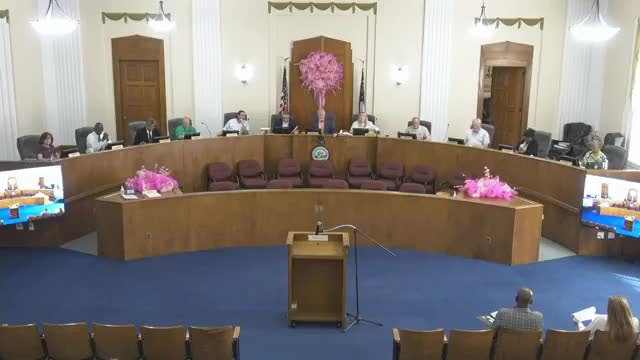
The Macon‑Bibb County Board of Commissioners on April 1 approved ordinances sending $2,000,000 from school camera revenue to the Bibb County Sheriff’s Office for recruitment and retention (including a planned $5,000 increase to starting pay for non‑certified deputies) and sending $1,000,000 to the Macon‑Bibb School System for SROs and crosswalk work; both measures were forwarded to the consent agenda.
The Macon‑Bibb County Board of Commissioners on April 1 approved ordinances sending two new appropriations from the county’s school public‑safety camera fund: $2,000,000 to recruit and retain public‑safety employees for the Bibb County Sheriff’s Office and $1,000,000 to the Macon‑Bibb County School System for school resource officers, crosswalk improvements and related safety measures. The measures were moved and passed during the pre‑commission meeting and will be placed on the consent agenda for the commission’s regular meeting.
Why it matters: The $2 million allocation is intended to raise the starting salary for non‑certified deputies by $5,000 to make Bibb County more competitive in recruiting entry‑level officers, officials said. County leaders described the $1 million for the school system as funding SROs, crossing‑guard support, crosswalk lighting and small infrastructure repairs the schools identify.
County leaders said the funds derive from a state‑authorized school public‑safety camera program that generated designated revenue for local public‑safety initiatives. Mayor Miller (speaking as the meeting’s sponsor) summarized the fund balance and prior appropriations during the meeting: he said the county had received $8,909,152.76 in camera revenue to date, had appropriated roughly $5,292,000 and had encumbered or spent about $4,000,726. He said prior appropriations included about $3,163,000 for cameras (identified by brand names during the meeting), about $1,562,000 for equipment such as school flashers and ATV vehicles, and other items including crossing‑guard funding and Knox boxes; after the two new appropriations the mayor said about $617,000 would remain in the program account. The mayor stressed the county was following state law and prior ordinances when allocating the money.
Sheriff R. L. Davis (identified in the meeting as Bibb County’s sheriff) told commissioners the pay increase is designed to make Bibb County competitive with neighboring agencies and to attract applicants who lack prior law‑enforcement certification. "This will really put us in a competitive nature," Sheriff Davis said, adding that the planned starting pay would be “right along there” at about $45,000 for non‑certified deputies; he noted certified deputies currently earn in the vicinity of $48,000. The mayor gave a numerical example that the starting pay would move from about $40,600 to roughly $45,700 after the increase.
Several commissioners asked to be added as co‑sponsors of the $2 million ordinance during the meeting. Mayor Pro Tem Clark described the proposal personally, saying the cameras and the resulting funds exist to keep children safe; he spoke of family members who walk to school and said he supported using the camera revenue for recruitment and retention. Commissioner remarks recorded in the transcript supported the measures and the mayor announced the $2 million motion "carries" and would be sent to the consent agenda. The $1 million school allocation vote was recorded as unanimous: "let the record reflect that all 9 members have voted to support that," the chair said.
Discussion vs. decision: Commissioners and the sheriff discussed staffing, certification pathways, and relative total employer cost of school resource officers (the mayor noted an SRO’s fully loaded cost including benefits is roughly $85,000 annually). The recorded formal actions were the ordinances to appropriate $2,000,000 for the sheriff’s recruitment and retention program and to authorize $1,000,000 for school safety purposes; both measures passed and were sent to the consent agenda. The transcript contains no implementation schedule or effective dates for the pay change; the action before the body at this meeting was an appropriation authorization.
Clarifying details recorded in the meeting: the camera program was described as a state program voted on in 2018; the mayor stated total camera revenue received $8,909,152.76; "appropriated" total presented as $5,292,000; encumbered/spent roughly $4,000,726; the mayor said prior equipment appropriations included approximately $3,163,000 for cameras and $1,562,000 for other equipment; after the new appropriations he estimated about $617,000 would remain in the school‑camera public safety fund. The sheriff gave approximate pay figures for non‑certified starting pay (~$45,000) and certified pay (~$48,000); the mayor gave approximate figures of $40,600 to $45,700 when describing the planned $5,000 increase.
What’s next: Both ordinances were forwarded to the regular meeting consent agenda for final action. The transcript does not record the effective date for any salary increase or the precise implementation steps; commissioners said they would coordinate with the sheriff’s office and the school system about allocations and deployment.
Ending: Commissioners also noted ongoing conversations with school‑system leaders (identified in the meeting as Superintendent Sims and Sam Kitchens) about crosswalk needs and SRO deployment. The transcript does not record detailed budget line items or a final pay implementation schedule; those details were not specified at this meeting and will be determined if and when the ordinances reach final adoption on the regular meeting agenda.