Get Full Government Meeting Transcripts, Videos, & Alerts Forever!
Get email alerts on the Camera Enforcement Traffic topic
No spam. Unsubscribe anytime.
Edmonds police report early results from school‑zone cameras, warn of high red‑light volumes; Flock camera rollout pending
Summary
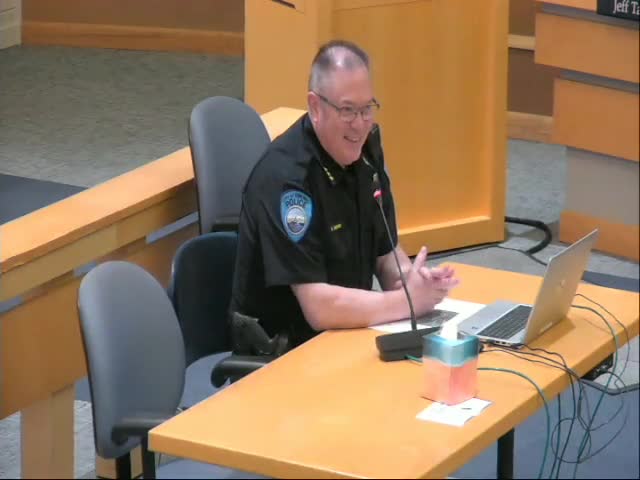
Acting Police Chief Rod Stefan told the council April 8 that Edmonds’ school‑zone cameras recorded 1,605 events in early 2025 and produced 1,006 tickets; newly enabled red‑light cameras produced large volumes of events during their warning period.
Acting Police Chief Rod Stefan updated the council on April 8 about Edmonds’ three automated camera programs: school‑zone speed cameras, a newly activated set of red‑light cameras, and planned Flock license‑plate readers for investigative use.
School‑zone cameras: Stefan said the city operates five school‑zone camera systems at four school locations; the cameras run for roughly one hour per school day at peak arrival/departure times. Stefan reported that for 2025 the cameras recorded 1,605 events and resulted in 1,006 tickets (January–March data). The city increased the school‑zone fine to $145 by ordinance change in 2025. Stefan described the vendor review and internal verification process: events are reviewed by the vendor (Vera Mobility), registration information is attached and then a trained reviewer in the police department accepts or rejects a violation before a notice or citation is issued.
Red‑light cameras: The red‑light systems operate 24/7 and early operation during a warning period produced a large volume of events; Stefan said the system recorded about 665 violations in the first 28 hours it was active. He noted the practical limit on in‑person enforcement: the volume and pace of violations at some intersections are too high for officers to observe and document without automated tools. The council was told warning letters for red‑light events would be mailed as staff completes verification.
Flock license‑plate readers: Stefan described a planned Flock deployment of up to 19 cameras to help identify vehicles involved in crime. He said the cameras are solar‑powered and that some pole locations are PUD‑owned — requiring further negotiation — so the department is seeking city‑owned mounting sites where possible. Stefan said Flock is used by many jurisdictions and its networked data can be queried across participating agencies; he also noted that data in the Flock cloud are retained for 30 days.
Data sharing and civil‑liberties questions: Councilmember Nann raised concerns about whether third‑party vendors could share plate data with federal agencies such as ICE; she cited press reports about other jurisdictions. Stefan said Edmonds does not share its data except for legitimate law‑enforcement purposes and that the city’s policies restrict use; he also said staff would follow up on vendor practices and the city’s contract terms.
Operational impacts: Stefan said three trained staff currently perform reviews for school‑zone and red‑light violations; when red‑light volumes rise (hundreds per day) the city expects a heavier administrative load and staff may use overtime or add trained reviewers. The department has used contract grants to purchase Flock cameras and said the grant funding covers initial deployment for 24 months once activated.
Ending: Stefan said the red‑light systems were still in a warning period and the department planned to begin sending warning notices within days; staff promised ongoing updates to council on system performance, costs and enforcement outcomes.