Get Full Government Meeting Transcripts, Videos, & Alerts Forever!
Get email alerts on the Municipal Court Community Court topic
No spam. Unsubscribe anytime.
Edmonds Municipal Court outlines community court expansion, Blake administrative vacates and prisoner-cost trends
Summary
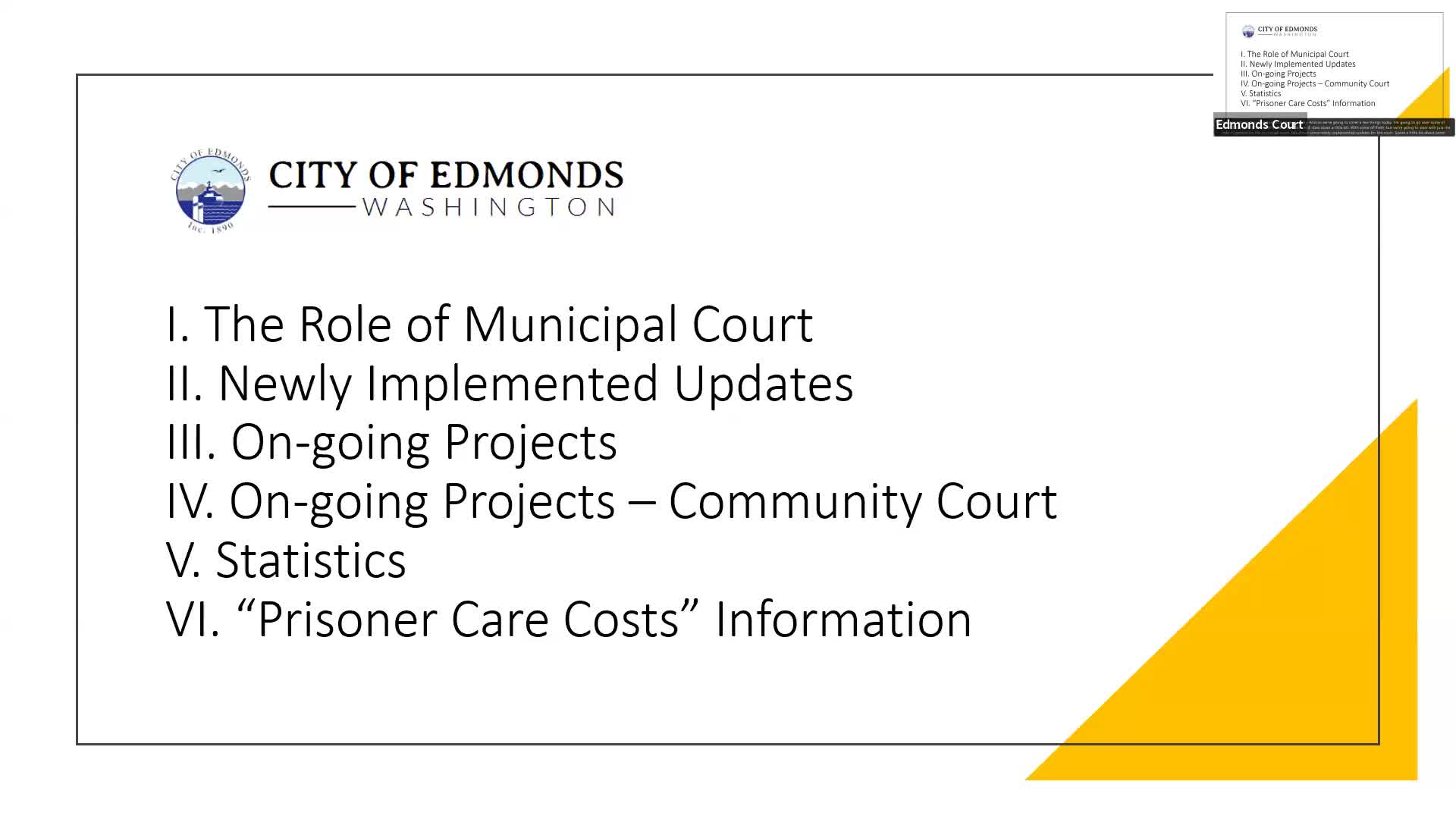
Judge Weiss and court staff described efforts to expand the community court model, begin administrative vacates following State v. Blake, implement text/email hearing reminders and flagged rising "prisoner care" costs as normal operations resumed after COVID.
Edmonds Municipal Court officials briefed the City Council on March 20 about an expanding community court program, the administrative process for vacating convictions affected by the Washington Supreme Court's State v. Blake decision, new text-and-email notification pilots and recent trends in jail-related costs as court operations returned to pre-pandemic norms.
Judge Weiss (identified in council remarks as the presiding judge at Edmonds Municipal Court) told the council that the court has launched two complementary community-court paths: a therapeutic community court (team-based, opt-in, risk/need assessment and phased accountability) and a monthly "community court resource day" to connect people directly with social-service providers. "The community court still exists. It's a method of court interaction. It is not about a specific location," Weiss said, noting the loss of a neighborhood space but stressing the court's ability to operate the program in different venues.
The court described its ongoing Blake administrative-vacate work. After the Washington Supreme Court's 2021 decision in State v. Blake, the court said it has been identifying eligible simple-possession cases and using AOC (Administrative Office of the Courts) technical assistance and grant funds to prepare and process motions and orders to vacate convictions and notify affected people. Judge Weiss said the court began an initial vacate calendar about four weeks before the March 20 meeting and will continue processing cases while AOC grant funds remain available.
The court has added a financial-screening form (required by recent state law changes for new photo-enforcement cameras) and is launching a pilot that will send text and email reminders for court dates, funded via an AOC grant. The intention is to reduce failures to appear and downstream costs such as bench warrants and arrests. "What this is, it's relatively low cost... and gives out text, email notifications to people based on court dates, that results in better outcomes for the litigants," Weiss said.
On jail and prisoner-related costs, the court presented a 2014'to'2024 chart showing large swings tied to COVID-era court and booking policies. The court explained that March 2020 Supreme Court guidance restricted bench-warrant issuance and that booking policies and limited jail intake reduced usual incarceration costs in 2020'2021. When administrative warrants were reissued in October 2022, the number of active warrants and related jail costs began returning toward pre-pandemic levels. "If you don't look at the COVID years, you'd have to go to 2015 to get an actual cost lower than 2024," Weiss said.
Judge Weiss emphasized that the court wants to reduce avoidable pretrial custody, noting the CRRLJ 3.2 rule that presumes release unless court finds appearance risk, danger to the public, or interference with justice. He described options judges can use short of booking, such as designated custodial arrangements, travel restrictions, or electronic monitoring where available.
Council members asked operational questions about jail sentence lengths, how credit for time served is applied when other jurisdictions hold an arrestee, and whether changes to public-defender caseloads would require deprioritization of certain charges; Weiss explained such prosecutorial priorities fall to the executive branch and prosecutors.
The court also announced an inaugural Law Day (May 2025) to bring students to learn about the three branches of government, and noted web updates including a simplified virtual-hearing button, FAQ pages and speed-device certification records for photo enforcement. The court administrator, Miss Mailer, was singled out by Weiss for project implementation and grant administration.
Ending: The court asked for continued council engagement as it implements the Blake vacates, launches text-and-email reminders, and expands community-court services; council members acknowledged the workload and asked for follow-up data on non-appearances and prisoner-cost impacts.