Get Full Government Meeting Transcripts, Videos, & Alerts Forever!
Get email alerts on the Fire Emergency Medical Services topic
No spam. Unsubscribe anytime.
South County Fire reports high cardiac survival, outlines benefit charge, staffing and station planning
Summary
South County Fire officials briefed the Edmonds City Council on annual operations, highlighting a 71.4% cardiac-arrest survival rate, the district's benefit charge and ongoing station and staffing planning, including use of volunteers and cross-trained crews.
South County Fire District officials told the Edmonds City Council on March 20 that the regional fire authority's 2024 cardiac-arrest survival rate reached 71.4%, and outlined ongoing budgeting and staffing issues, including a voter-authorized benefit charge, cross-staffing decisions, and plans for future station siting.
The survival-rate announcement came from Chief Bob Eastman during the South County Fire Board's annual presentation to council. "I'm proud to say that, in South County, our survival rate was 71.4 percent," Eastman said, noting the district's whole-blood program and community-resource paramedic services as contributors to improved outcomes.
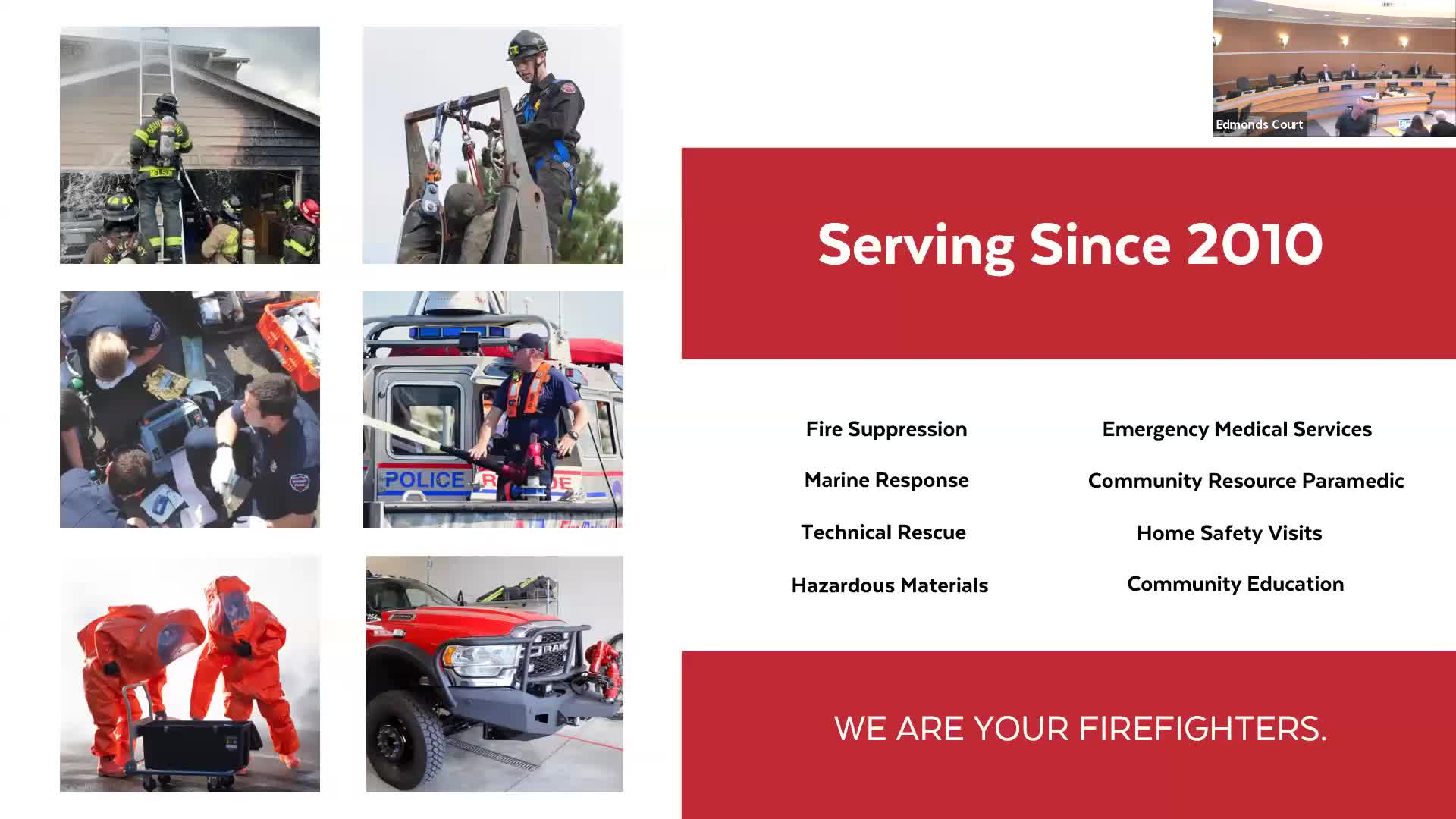
The board and staff emphasized the district's scale and services: South County operates 15 fire stations across its response area, three of which are inside Edmonds; the district employs roughly 350 uniformed personnel and responded to just under 40,000 calls in 2024. Chief Eastman described a range of services beyond fire suppression, including marine response, technical rescue, hazmat, a whole-blood program, community resource paramedics and opioid outreach in partnership with the University of Washington.
Why it matters: Council members pressed the board on the implications of those numbers for Edmonds residents and budgets. Council member Heck flagged the community's median age and said high-quality cardiac response is particularly important for Edmonds. Council member Dasch questioned outlier incidents and large outside responses after a multi-alarm apartment fire, and whether rare large incidents were inflating utilization statistics.
On revenue and rates, board members described the fire-benefit charge as a voter-authorized fee, not a tax, which the board plans to reevaluate in annual budgets and again in the fall for the 2026 budget. "We have generally had it be about a 2% increase per year," said Commissioner Mark Lawrence, and the board said the benefit charge currently accounts for about 7% of overall revenue. The board acknowledged community sensitivity and said appeals of the benefit charge have been very low to date.
Council members also pressed the commissioners on operational metrics. Chief Eastman and board members explained how response-time measures vary depending on which metric is used: drive-time once a unit is en route versus total response time from 911 call pickup to arrival. The district provides an annual RFA report that aggregates data for participating cities; Edmonds-specific breakdowns can be produced on request, the chief said.
Staffing and station planning were another focus. Commissioners cited retention and an aging workforce as recruitment challenges and discussed expanding the volunteer program and infill stations to improve response times in growing areas. Commissioner Michael Fernhof said the volunteer program will approach roughly 30 volunteers. Commissioner Whitis said the district is pursuing property acquisitions, including the Verdant site, to support an infill-station strategy.
On ambulance transports and cross-staffing, the board described regional differences in transport arrangements and clarified that Swedish Hospital uses private ambulance services for interfacility transports; those transports are not part of South County's reported metrics. The district reported having about 100 paramedics and that cross-training remains standard: firefighter personnel are also trained EMTs or paramedics. The board said it routinely evaluates models that separate transport from fire-based EMS but that extended hospital "wall times" and limited hospital bed capacity are regional issues that affect local operations.
Council members asked about metrics reporting and asked staff to continue providing city-specific data when possible so Edmonds can evaluate whether service levels meet local needs. Commissioners said the RFA will continue to provide full-RFA annual reports and will respond to city requests for more focused metrics.
Ending: Board members asked the council to treat the benefit charge as a stabilizing tool for future downturns and underscored a desire to remain prudent and transparent in its use. Chief Eastman and the commissioners invited further questions by email and scheduled outreach as the 2026 budget year approaches.