Get Full Government Meeting Transcripts, Videos, & Alerts Forever!
Get email alerts on the Step Housing topic
No spam. Unsubscribe anytime.
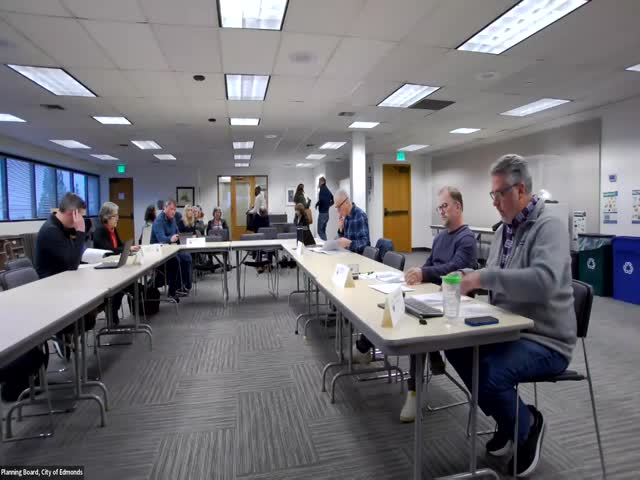
Edmonds Planning Board reviews STEP housing draft, agrees to recommend core model language with further design and enforcement study
Summary
Planning staff reviewed the interim STEP (supportive and transitional) housing code and mapped it against existing shelter and emergency housing rules; the board generally favored adopting the model ordinance language but asked staff and city attorneys to clarify enforcement, public-safety measures and design standards before sending a formal rec
The Edmonds Planning Board spent its March 12 meeting reviewing the draft permanent ordinance for STEP housing — the state-defined categories that include transitional housing, permanent supportive housing and similar lower-barrier housing types — and discussing where the draft conflicts or overlaps with existing city code on emergency shelters and public-safety requirements.
Staff review and recommendation
Planning staff (Mike, identified in packet materials as Michael Clungston) told the board staff compared the interim STEP-language against existing Edmonds code chapters. Staff found limited overlap with temporary homeless-encampment provisions and community-facility rules but identified a possible conflict between the draft STEP chapter (packet: 17.125) and the city’s longstanding emergency indoor-shelter chapter (17.105). Staff proposed a narrow wording change: add a sentence that indoor emergency shelters operated by religious organizations or located in public facilities will remain subject to the process and conditions in 17.105 so the two chapters won’t conflict.
The board also considered other elements the state model ordinance lists as optional or "additional considerations," including waiving municipal utility connection fees for STEP projects, parking waivers, and operational expectations. Staff noted Washington law allows but does not require cities to waive certain fees; any waiver would need an identified revenue source (general-fund dollars or grants) to replace those fees.
Discussion highlights
- Enforcement and safety: Several board members raised recent news from Kirkland and asked whether Edmonds should adopt explicit operational requirements (fencing, cameras, no-weapons rules, intake screening) for supportive-housing operators. Staff and several board members cautioned that some operational controls may be preempted by state law and that enforcement of criminal activity or public-nuisance behavior is handled by police and other existing codes; the board asked city attorneys to review which operational or spacing rules would be legally allowable.
- Overlap with other code sections: Staff recommended the single-sentence reconciliation between 17.125 and 17.105 to avoid conflicting rules for religious organizations and public facilities used as emergency shelters. Board members supported reconciling the chapters but debated whether the STEP chapter should include the "expectations" language that describes operational best practices; some members favored removing the expectations paragraph from the ordinance and instead asking the council/legal staff to study operational standards separately.
- Design standards and siting: Board members voiced interest in stronger design guidance (lighting, "eyes on the street," pedestrian access, transparency, parking placement) to reduce perceived community impacts of new housing types. Staff said design standards for hotels and other multiunit uses already exist in Edmonds' commercial code and that the review process could cross-reference or extend those standards to STEP projects where legal. Several members favored a phased approach: adopt the necessary STEP rules to comply with state law now, then follow with design-and-site standards in a later phase.
Board sentiment and next steps
A number of board members said they were comfortable with the model ordinance’s baseline language — i.e., allow STEP housing in the zones identified for hotels/multifamily — but wanted the board’s recommendation to council to: (1) remove or rework the nonbinding "expectations" paragraph from the ordinance text; (2) ask the city attorney to clarify which operational and spacing requirements are legally permissible; and (3) direct staff to draft clearer design-standards language or cross-references to existing design standards so that STEP projects are held to consistent site and building design expectations.
Staff told the board a formal recommendation is due to the council by March 26 and reiterated that the interim ordinance in effect must be replaced by a permanent code within the statutory timeline. Staff also said co-living language and other middle-housing items remain on a later track with a December state deadline for some elements.
Why this matters
The state’s STEP-related rules require local governments to allow certain housing types; how Edmonds frames the implementing ordinance will determine where supportive and transitional housing can locate and how much local discretion the city retains over siting, operational requirements and design conditions. Board members stressed they do not want to add operational rules that the city cannot legally enforce but do want to make clear the design, safety and neighborhood-integration expectations for projects.
Ending: staff will draft recommended language that reconciles the shelter chapters, remove or rework the expectations language for the board’s review, and return with draft design standards and legal guidance before the board finalizes its recommendation to council.