Get Full Government Meeting Transcripts, Videos, & Alerts Forever!
Get email alerts on the Neighborhood Rezoning topic
No spam. Unsubscribe anytime.
Edmonds residents urge planning board to reconsider North Bowl hub rezoning, cite process and home-expansion limits
Summary
Residents from the neighborhood labeled the North Bowl told the Edmonds Planning Board they oppose the city's proposed centers-and-hubs rezoning and an interim ordinance that limits home expansions.
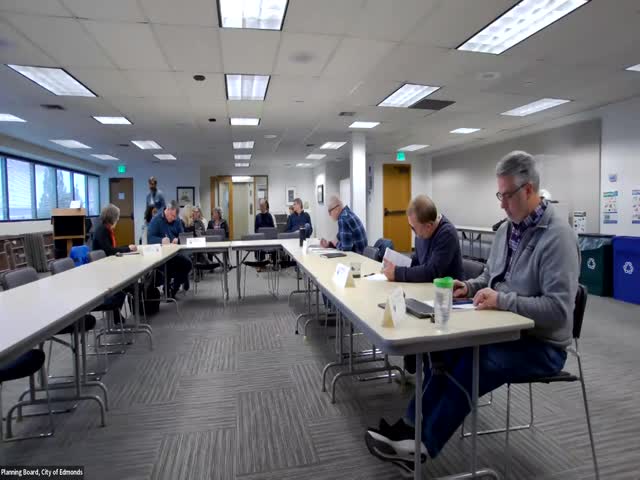
Residents from the neighborhood the planning staff has labeled the "North Bowl" (also referred to in public comments as the "North Bull Hub") pressed the Edmonds Planning Board on March 12, urging the board to slow or revise proposed zoning changes that would designate parts of the neighborhood as a center or hub and impose an interim ordinance limiting expansions of existing single-family homes.
The comments, delivered during the meeting's public-comment period, raised three linked concerns: process and notice to affected homeowners; limits the interim ordinance places on homeowners' ability to expand or remodel; and neighborhood impacts including traffic, school access and property taxes. "We're a diverse group of people...and we're opposed to the proposed changes to building code in our neighborhood," said Connor Cart, a Grandview Street resident representing the neighborhood, who told the board residents had reviewed the planning-board recommendations and wanted the board to "reconsider the proposal for that area in particular."
Why it matters: the draft centers-and-hubs designations are part of Edmonds' implementation of state-mandated housing growth; if the council and city adopt code changes, parcels inside a center or hub will be subject to different development rules than they face today. Residents at the March 12 meeting said those changes were introduced without adequate notice and that an interim ordinance in effect now — which staff said was adopted in mid-January and remains in place while a permanent code is drafted — has already limited homeowners' options.
What residents said
- Several speakers described narrow streets and small dead-end blocks near proposed rezones and warned that demolition and redevelopment would harm safety for children and disrupt access. Linda Hood said Grandview Street is less than 20 feet wide, requiring trash trucks to back down the block; she asked who would pay to rebuild or widen the street to accommodate construction traffic.
- Multiple residents said they had not been notified before the city began work identifying centers and hubs, and several said small recent meetings or surveys did not reach the wider neighborhood. Rebecca Henderson, who said she owns two properties within the proposed hub, told the board she and neighbors had no memory of being asked to participate in the December 2023 meetings that informed the draft. "It feels rushed," she said.
- Home-expansion limits and ADU rules were a recurring theme. Tara Allen and other speakers said the interim ordinance effectively prevents some homeowners from expanding their primary residence now; Allen described a scenario in which a 10% increase in footprint would not meet the needs of a growing family and called for existing homeowners to be prioritized in the process. Larry Williamson, on the phone, urged the board to reconsider a restriction that he said precludes reasonable home additions and warned of potential legal challenges if property rights are curtailed without clear justification.
- Several speakers raised fiscal and appraisal concerns. John Redlanger cited the comprehensive-plan capacity-assumptions section and a consultant footnote that parcels over a threshold value were screened from capacity calculations; he argued many North Bowl parcels exceed that threshold and therefore are unlikely redevelopment candidates. He and others said rezoning could trigger higher property-tax assessments under a "best and highest use" appraisal.
Staff response and next steps
Planning staff and board members repeatedly emphasized that the board is collecting information and that final decisions rest with the city council. At the meeting staff reiterated that the interim ordinance is a temporary measure and that the permanent code will be developed through additional public hearings and council review; staff described a "walk-and-talk" on March 31 for the neighborhood and said additional public hearings, an in-person open house and subsequent community engagement are planned.
Staff also clarified parts of the interim package cited by residents: the interim language currently limits parts of some projects that lie within a 20-foot band of adjacent single-family property lines to a maximum 30-foot height; staff said the limits were applied uniformly across centers and hubs but that more detailed design work and examples would return to the board. Planning staff said the interim ordinance is valid for a defined period while the permanent code is drafted and that the board's recommendations will inform council action.
What the board heard about scale and infrastructure
Speakers described Grandview Street as about 500 feet long with seven homes and said several homes are newer or recently remodeled. Residents expressed concern about potential five-story or multi-level buildings downhill from existing homes, commercial ground-floor uses adjacent to small residential streets, increased curb cuts or drive-through traffic, and light and noise from new commercial uses. Parents and school stakeholders said children walk to Edmonds Elementary and nearby preschools and asked that pedestrian safety and circulation be part of any change.
Ending: the board heard extended public comment and committed to carrying community feedback into the drafting process. Staff asked residents to provide photographs and written materials to planning staff and said planners will post revised draft language and graphics for review in coming weeks. The board said it expects to further refine transition standards and design guidance as the process advances; the permanent ordinance is due to be adopted after public hearings later this spring and summer.