Get Full Government Meeting Transcripts, Videos, & Alerts Forever!
Get email alerts on the Civic Campus Finance topic
No spam. Unsubscribe anytime.
SeaTac studies financing and delivery options for proposed civic campus
Summary
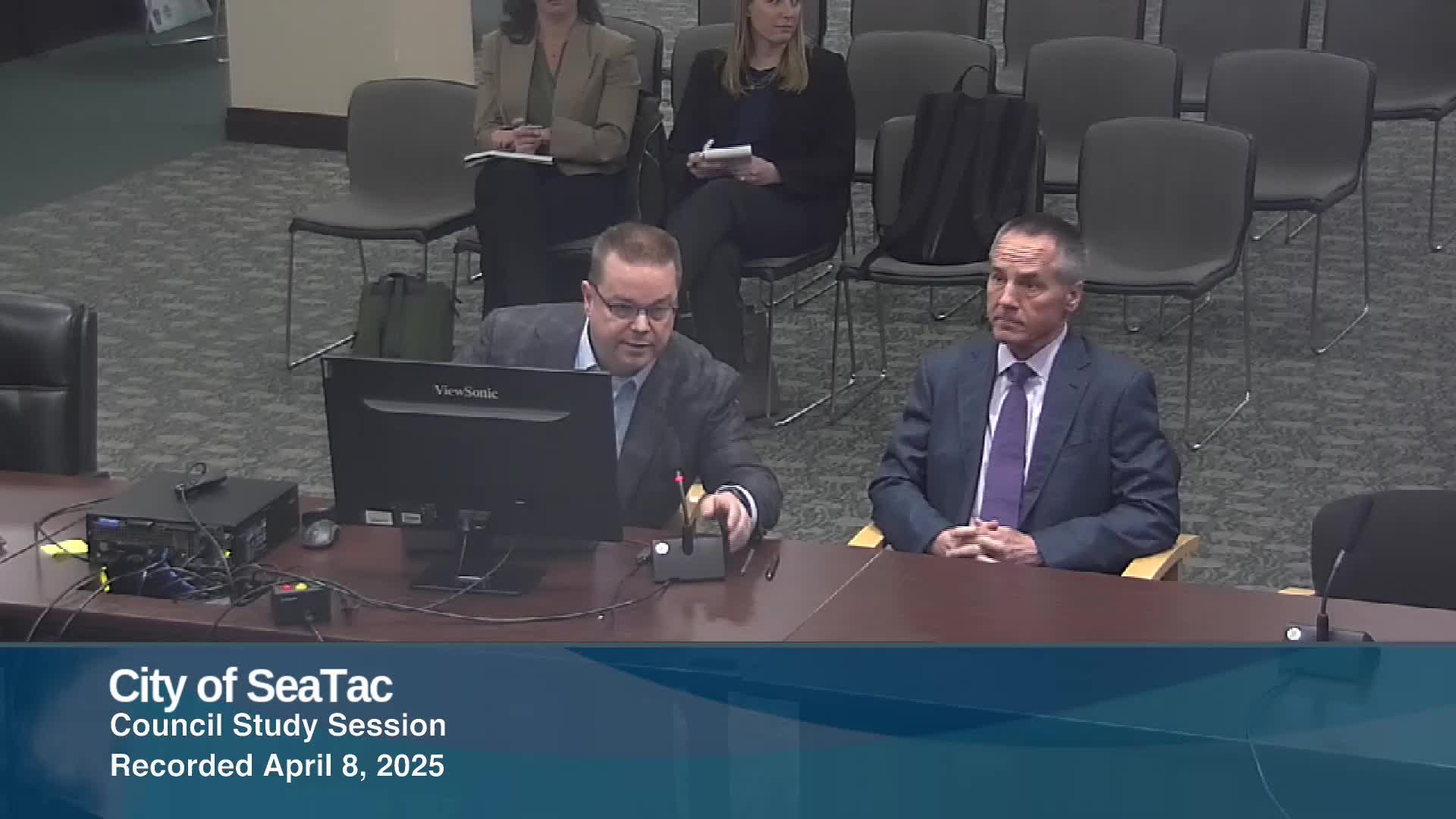
SeaTac City Council met in a study session to review project‑delivery and finance options for a proposed civic campus, receiving a 90‑minute presentation from financial advisers Piper Sandler and city staff outlining tax‑exempt bonds, 63‑20 nonprofit lease financing, TIFIA transit‑oriented loans and public‑private partnership structures.
SeaTac City Council met in a study session to review project‑delivery and finance options for a proposed civic campus, receiving a 90‑minute presentation from financial advisers Piper Sandler and city staff outlining tax‑exempt bonds, 63‑20 nonprofit lease financing, TIFIA transit‑oriented loans and public‑private partnership structures.
The options matter because they change who controls new buildings, how much the city would borrow, what portion of the campus could be leased to private tenants and how quickly construction funds could be secured, Piper Sandler and city staff said.
Piper Sandler managing director Schober and adviser Justin Monway described the tradeoffs among traditional municipal funding, quasi‑public 63‑20 lease structures, public‑private partnerships and federal transit‑oriented loans. Schober said a 63‑20 approach can transfer construction and some delivery risk to a developer but can raise up‑front and capitalized costs: “a 3 year construction period would be about $20,000,000 in capitalized interest,” he said, citing an illustrative $120–130 million project example. Monway explained limits on tax‑exempt financing, including private‑use rules: “Private use cannot exceed 10% of the funding,” he said, and added that bond counsel must make the final eligibility determination.
On tax‑exempt debt, Monway noted the practical borrowing difference versus taxable financing and said typical municipal processes are faster: general obligation or revenue bonds generally close in about three months after the issuer has planned the issue and prepared rating materials. He cautioned that a project with more commercial or market‑rate housing components may require taxable financing or separate carve‑outs for those portions.
Piper Sandler presented the 63‑20 lease model through a conduit issuer as a technique used by some jurisdictions in which a nonprofit or conduit issues the debt, leases the finished asset to the city and then transfers ownership to the public after the debt is repaid. The consultants reviewed a Redmond case study and emphasized higher transaction fees and more complex documentation for 63‑20 structures compared with traditional municipal bonds.
Presenters also described the U.S. Department of Transportation transit‑oriented financing program (TIFIA/TOD) administered by the Build America Bureau. The presenters said the TIFIA TOD product can offer attractive taxable rates and drawdown flexibility for projects within roughly a half‑mile of a fixed transit station; it typically requires an investment‑grade rating, NEPA review, Buy America compliance and Davis‑Bacon prevailing‑wage adherence. Monway and Schober warned the program’s pipeline is busy and that TIFIA loans take longer to execute—presenters cited approximately 18 months in prior projects.
Council members raised policy preferences and implementation questions. Council Member Peter Kwan supported a staged approach and said that “each 1 of these phases could be funded differently,” noting the city could prioritize a city hall and justice functions first and pursue other financing or private development later. Council Member Pynchon said she favored the TIFIA structure and general‑obligation bonds and added that it is important the city own the asset and ensure union labor and prevailing wages. Mayor (name not specified) said he preferred “traditional government delivery, public owned, outright owned the building.”
Staff provided preliminary fiscal context: the consultants reported current SeaTac debt capacity in the range cited in staff updates (presenters referenced a current capacity figure around $134 million and a projected increase to roughly $142 million under recent assessed‑value growth assumptions). Presenters said those capacity figures, combined with the city’s cash position, influence whether the council can use direct municipal borrowing (lowest cost and fastest execution) or needs alternative structures to spread cost or bring private capital in.
No motions, votes or formal decisions were taken; the session was advisory. Staff said the intent of tonight’s study session was to build council awareness, gather council “guardrails” on ownership and private‑sector involvement, and return with financial modeling and site‑specific options. The city’s finance staff and consultants will prepare follow‑up analyses on affordability, phased delivery, tax‑exempt eligibility and bond counsel opinions before council is asked for any formal direction.
The council’s discussion emphasized keeping multiple options on the table, clarifying program specifications (for example, what a “justice center” must include), and identifying funding sources that preserve city control when desired. Presenters and council members repeatedly recommended consulting bond counsel early to confirm tax‑exempt eligibility when private commercial uses or condominiumized parcels are contemplated.
Staff signaled next steps will include site selection work, tighter program specifications, and financial modeling that shows how each component could be funded and staged; a return presentation will be scheduled after those analyses are complete.