Get Full Government Meeting Transcripts, Videos, & Alerts Forever!
Get email alerts on the Overdose Prevention topic
No spam. Unsubscribe anytime.
Committee approves $111,915 for overdose-prevention work; health director outlines data limits, needle-box pilot idea
Summary
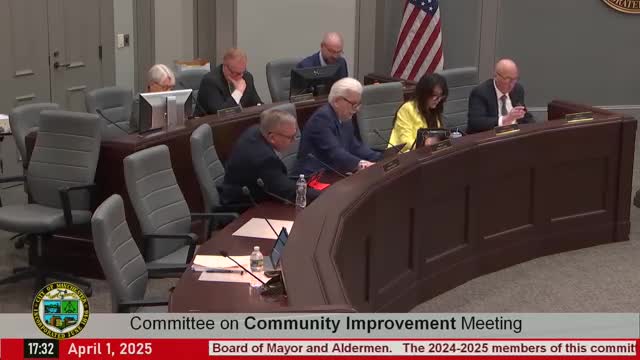
The Manchester Board of Mayor and Aldermen's Committee on Community Improvement voted to approve an amending resolution transferring $111,915 for CIP 211325, designated for overdose-prevention funding.
The Manchester Board of Mayor and Aldermen's Committee on Community Improvement voted to approve an amending resolution transferring $111,915 for CIP 211325, designated for overdose-prevention funding.
Public Health Director Anna Thomas told the committee the city's local numbers are compiled primarily from American Medical Response calls and from police and fire reports, and that the data represent events recorded by first responders rather than every instance of an overdose in the community. "Keep in mind, these are only people who end up in the first responder system, so there's a lot of community overdosing happening, people self administering Narcan, or others administering Narcan, that never get counted in these numbers," Thomas said.
Thomas and aldermen discussed how the locally compiled figures differ from finalized medical-examiner determinations because toxicology confirmation can take months. Thomas said the counts are "suspected overdoses" until confirmed and that event counts can be inflated when the same individual is treated multiple times: "If somebody overdoses multiple times, like we've had 1 individual I think overdose 20 times in a weekend, all 20 of those overdoses get counted in these numbers." She said March may be the first month in a long time without an overdose fatality, pending confirmation.
The discussion also covered harm-reduction services, Narcan distribution and syringe disposal. Thomas said many outreach clients and outreach teams already know how to use nasal Narcan and that the health department has been trying to shift work "upstream to treatment and recovery" and away from some in-field harm-reduction services the department had provided earlier. On syringe disposal, Thomas described an existing Stericycle contract that covers needles generated at city clinics and said that community groups such as Queen City Exchange maintain publicly placed syringe boxes at their own expense in some locations. "They've put in boxes in various locations ... and they take on the cost of maintaining those boxes," she said.
Aldermen asked whether the city should install lockboxes for needles. Thomas recommended piloting receptacles in limited locations and noted they require ongoing monitoring and maintenance: "If we wanted to test it, it's, I would, if, my recommendation would be just to pilot it somewhere ... they have to be well monitored, they have to, you know, somebody's gotta go and clean them out." She also reminded the committee that an ordinance passed by the Board gives the health department authority to oversee and, if needed, enforce requirements for such programs.
The committee approved the transfer after discussion; Alderman Birkisch moved the motion and Alderman Long seconded. The chair announced the ayes carried.
Thomas said the department will continue to monitor syringe litter closely as warmer weather approaches, when needles are more visible in parks and rights-of-way, and report back to the committee.
Votes at the meeting were recorded by voice; an explicit roll-call tally for this item was not stated on the record.
Ending: Committee members and the health director framed the approved funding as part of a broader shift toward treatment and recovery referrals while acknowledging ongoing community-level needle activity and the need for monitoring and enforcement under the city ordinance.