Get Full Government Meeting Transcripts, Videos, & Alerts Forever!
Get email alerts on the Zoning Utilities Annistown topic
No spam. Unsubscribe anytime.
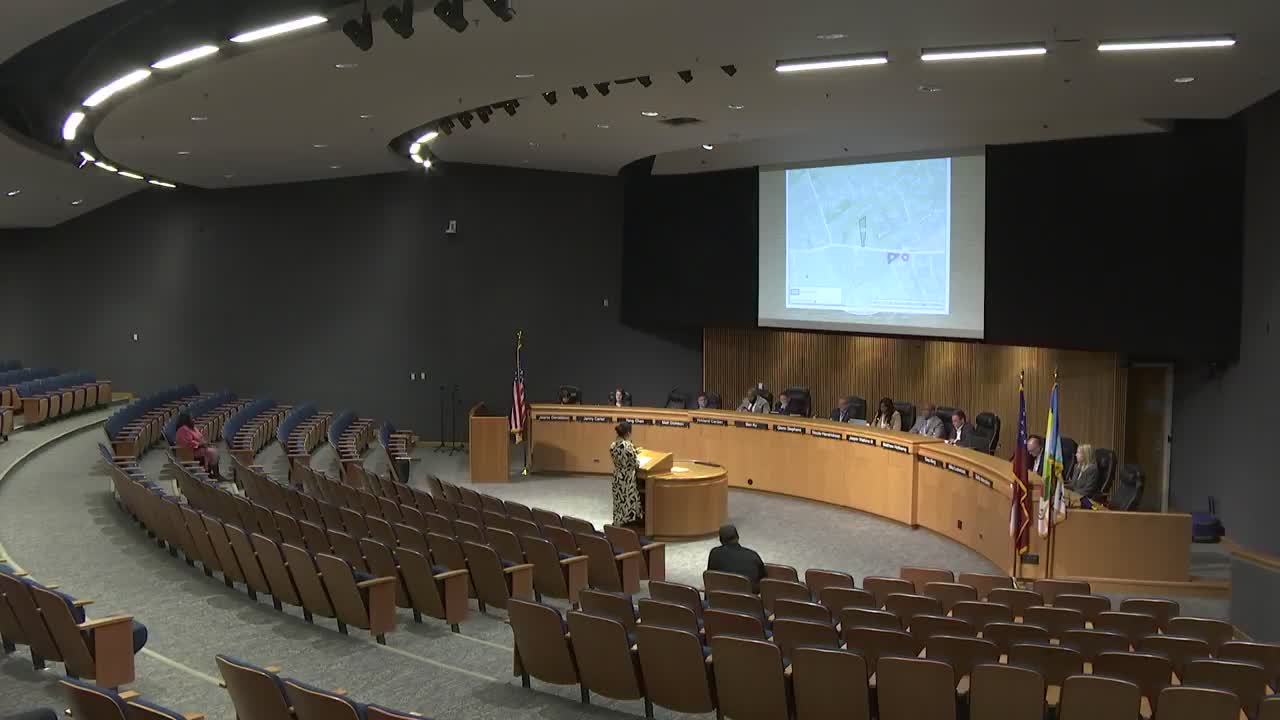
Gwinnett commissioners unanimously deny request for second utility shelter on Annistown Road
Summary
The Gwinnett County Board of Commissioners on March 25 denied a request to revise conditions of an existing special-use site at 4317 Annistown Road to allow a second inline amplification (ILA) utility shelter, following staff and planning commission recommendations citing residential impacts and proximity to homes.
The Gwinnett County Board of Commissioners unanimously denied a request on March 25 to change zoning conditions to permit a second utility transmission facility — an inline amplification (ILA) shelter — at 4317 Annistown Road.
Planning staff told the commission the proposal would "further commercialize the subject site and alter the residential character of the area." Michelle McCartell, speaking for the planning department, said the site is surrounded by single-family homes and that the unified plan designates the area as "neighborhood traditional," which envisions single-family detached residences.
Applicant Dustin Walters Poff, a civil engineer with AECOM, described the proposal as a roughly 95-by-95-foot gravel pad to host a precast concrete ILA shelter and an emergency backup generator. He said the facility would "pick up that signal, reboost it, amplify it, and then send it on back down the line" along an existing fiber route on Annistown Road. Poff said regular access would be limited to maintenance trucks "on a quarterly basis" and that the project includes a concrete masonry (CMU) wall to replace chain-link fencing to reduce noise.
Poff also summarized a noise study his team conducted. He said a typical operation, with HVAC units running, would increase noise at neighboring properties by about 2 to 3 decibels — "indistinguishable" in normal conditions — while the generator would add about a 14–15 decibel increase but only during emergency power outages when it automatically starts.
Commissioners followed the planning commission and staff recommendation and denied the change in conditions. Commissioner David Koo moved to deny the request; the motion was seconded and carried unanimously.
The denial leaves the previously approved special-use condition in place and prevents the addition of a second utility transmission facility at the residential parcel. No opposition speakers registered during the public hearing.
Looking ahead, the applicant may pursue other options permitted under the existing zoning or seek different locations and permitting paths consistent with county policy.