Get Full Government Meeting Transcripts, Videos, & Alerts Forever!
Get email alerts on the Community Events Policy topic
No spam. Unsubscribe anytime.
Longview staff propose streamlined permitting, tiered fees and new beer‑garden rules for community events
Summary
City staff presented a plan to streamline special-event permitting, add tiered application fees and security deposits, expand where alcohol can be served at sanctioned events and change how lodging-tax money is used; council directed staff to work with event organizers and return with formal recommendations in March.
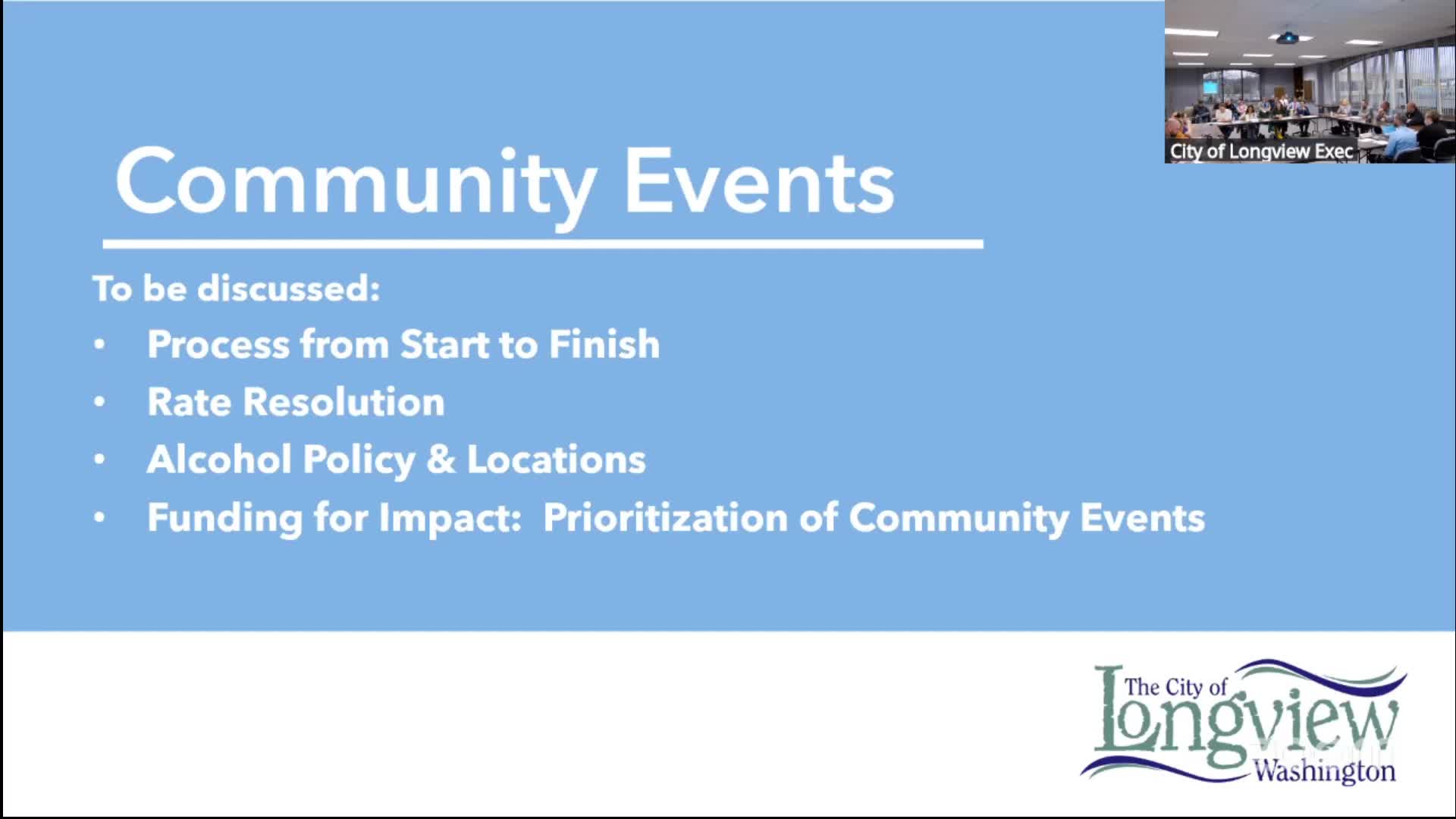
Longview City staff on during a council workshop proposed a modernized process for community events that would centralize permitting, add tiered application fees and security deposits, expand where alcohol can be served at approved events and use lodging-tax (LTAC) funds more deliberately to support legacy events and staff costs.
The changes are intended to simplify a currently fragmented permitting process, give applicants earlier “conditional” approvals, and recover some city costs for overtime and facility repairs, officials said.
Nancy (Parks staff member) opened the presentation by tracing the discussion back to a Rotary Club request in January and said city staff want one master application routed to a single coordinator and an initial conditional approval so organizers “can get across the line” while final contract items are completed. She told council, “This conditional permit will be — you at least have the things in place that we know that can get you across the line, and then we can go through and see if fire needs to have tent permits or community development needs to have, you know, whatever that is.”
Nut graf: The package on the table would affect volunteer groups, small nonprofits and large, recurring festivals. Staff emphasized speed and predictability — applicants often begin marketing before a final contract is issued — while council members and event organizers raised concerns about affordability for small, school‑led and community projects.
What staff proposed
- Centralized application and conditional permitting: Staff said they will use the city’s existing PermitTrax system to open a single module for special events and route one “master” application to all reviewers. The goal is to give conditional approval earlier than the current 30 days (recurring events) / 60 days (new events) timetable when feasible.
- Tiered application fees: Staff proposed a tiered application fee tied to event size: $150 for events of 1–499 attendees, $500 for 500–1,000 attendees and $1,000 for events with more than 1,000 attendees. Those figures were presented as a starting point for council discussion.
- Security deposits and insurance: Staff recommended security deposits to cover turf, irrigation or infrastructure damage; examples cited during the workshop put repair costs from a single sprinkler head at $100–$300 and simple turf repairs at $100–$1,000. City staff said deposits would be refundable if no damage is found and that organizers with applicable event insurance could seek relief; staff noted insurance deductibles can leave organizers exposed to substantial out‑of‑pocket costs.
- Expedited fees: Staff also raised the option of charging an expedited processing fee for last‑minute applications to cover staff overtime, but cautioned against creating a routine shortcut that lets applicants repeatedly bypass deadlines.
Alcohol policy and fencing
Staff reviewed the city’s current alcohol rules and brought options for council direction. The city’s insurer (WCIA) recommends a double 42‑inch fence spaced 6 feet apart; staff proposed allowing either a single 72‑inch fence or a 42‑inch fence paired with a readily available 36‑inch self‑fence spaced 6 feet apart to make temporary beer‑garden setups more practical in tight downtown spaces. Staff also proposed expanding the list of parks or park areas where alcohol can be permitted at sanctioned events beyond the current single approved park to include the library lawn (including the Rose Garden), Hemlock Plaza, Martin’s Dock/boat launch area at Lake Sacagawea, Louisiana Lawns, Glen Morris Park and the Sunken/Grotto garden areas — with event‑specific limits.
Police Chief (title given in the meeting) described police roles at alcohol‑served events as “presence and appearance” and said the city relies on event organizers, trained servers and security to manage alcohol; the chief told the council, “The police are there as a presence in case there’s an emergency.” Several council members said very large events such as Go Forth should remain without alcohol as a strong recommendation and asked staff to treat requests for alcohol at events expected to draw 5,000 or more people as case‑by‑case and to bring those back to council.
LTAC funding and legacy events
Staff asked whether the lodging‑tax advisory (LTAC) funds should be used more flexibly for park improvements, staff time and targeted marketing rather than only one‑time grants to event organizers. Nancy described options including an annual (rather than biennial) application cycle for new events, a revolving fund to support marketing or a line item that pays city staff overtime tied to event support. “We can actually put some people towards, and we can actually have it marked off on timing,” she said, describing a desire to track city costs for legacy events such as Go Forth, the Fourth‑of‑July parade and other long‑running festivals.
Organizers push back on costs
Several event organizers spoke during the workshop and during public comment that followed. Kevin Renner, representing the Longview Early Edition Rotary and the Catalyst Valley Runners Club, said some longstanding events operate on very tight margins — “our budget is, like, a hundred and 40 to a hundred and $50,000” for a multi‑day festival — and warned higher fees or large deposits could strain small volunteer groups. Other organizers argued for tiering or exemptions for student and community groups and asked the city to consider season‑long permitting or holding deposits in trust for recurring annual events.
Council direction and next steps
Council members generally supported staff continuing to develop the modernized permitting workflow and asked staff to: (a) work directly with event organizers to refine fee tiers and deposit rules; (b) follow up with the city insurer on fencing height/arrangement risk; and (c) return to council with a formal recommendation on alcohol policy and fee structure (staff indicated a March return). No formal ordinance or fee resolution was adopted at the workshop; the council provided direction for staff follow‑up.
Why it matters
The package under discussion would change how the city handles dozens of recurring events that bring visitors, business and traffic into Longview. For event organizers it could mean earlier certainty about whether an event may proceed, but also new upfront costs. For taxpayers and department budgets it could mean clearer cost recovery and better tracking of who pays for city overtime and repairs.
What staff will do next
Staff said they will convene follow‑up conversations with event organizers, reach back to insurers on risk recommendations, refine proposed fee and deposit levels and draft a recommended ordinance or resolution for council consideration. The city asked organizers to continue submitting permit applications under the current rules while staff finishes the proposal.
Ending: Council members and organizers agreed to keep working in collaboration; staff will return with refined language and a recommendation to the council in March. No council votes were taken at the workshop.