Get Full Government Meeting Transcripts, Videos, & Alerts Forever!
Get email alerts on the Downtown Parking topic
No spam. Unsubscribe anytime.
Longview council workshop adopts phased parking plan, directs staff to return with safety, signage and permit proposals
Summary
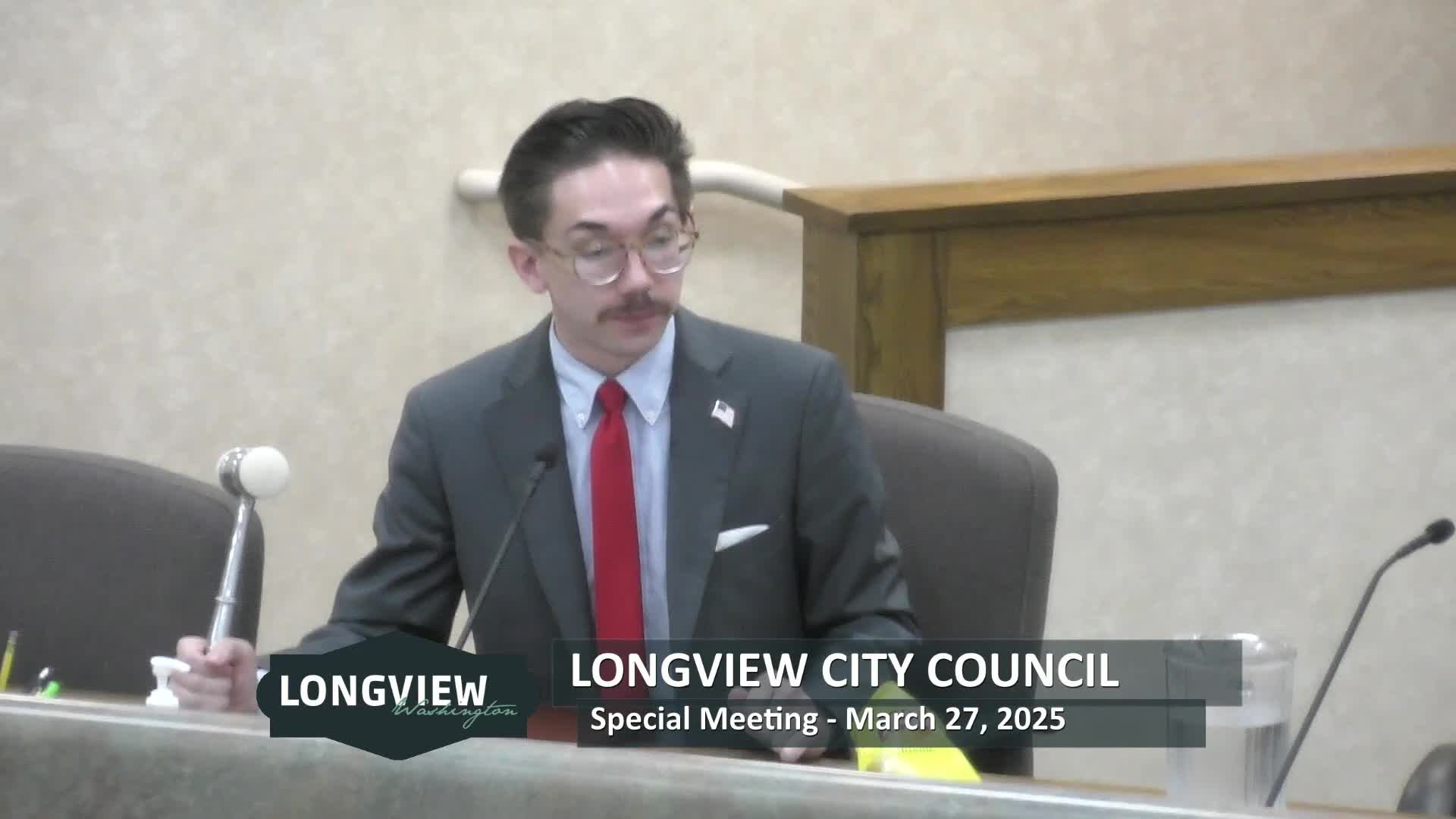
At a March 27 Longview City Council special meeting workshop, consultant Rick Williams presented a phased downtown parking management plan and the council directed staff to return with proposals for signage, lighting, simplified time limits and options for resident and employee permits.
LONGVIEW — At a March 27 Longview City Council special meeting workshop, consultant Rick Williams presented a final draft downtown parking management plan and the council gave staff direction to return with proposals for safety and signage improvements, simplified time limits and options for resident and employee parking permits.
The plan, prepared by Rick Williams Consulting with input from a Stakeholder Advisory Committee (SAC) and the Downtown Advisory Committee (DAC), lays out immediate, midterm and long-term actions. Williams told the council the city’s downtown currently has roughly 1,300 on-street stalls and about 3,300 off-street stalls; public control is limited to 11 lots with about 753 stalls. He said peak occupancy across the public system is low (about 47%), but there are concentrated constraints on Commerce Street and parts of Broadway where block-face occupancies reach about 85 percent or higher.
Why it matters: Council members said the plan gives a path to relieve perceived parking constraints without large immediate capital outlays, while addressing public-safety perceptions that discourage downtown visits. Councilors asked staff to return with specific proposals that could be implemented quickly (signage, lighting, basic lot repairs and outreach), and with options for phased enforcement and permit programs to move employees off on-street stalls and prioritize customer access.
Williams summarized the plan’s guiding principles: prioritize short-term on-street access for visitors and customers on commercial block faces, provide resident access in city-controlled off-street lots, and then accommodate employees and longer-stay visitors. He recommended simplifying the current nine time-limit categories to three (for example, 2 hours, 3 hours and 10 hours), using signage and mapping to reduce confusion, and creating a single point of contact or part-time parking coordinator to oversee routine operations and stakeholder engagement.
Key findings Williams cited included a high rate of time-limit violations—about 19 percent in 2-hour zones and roughly 30 percent in 1-hour zones—plus many examples of long (five-plus hour) stays on short-term stalls, which the consultant and SAC linked in part to employees parking on-street. Williams also described a large private off-street supply (about 2,600 stalls) that the city does not control and recommended pursuing partnerships to make portions of that supply available for employees.
Council direction and next steps - Staff was asked to return with a proposal for signage, wayfinding and basic lighting and lot-surface repairs to improve safety and public awareness of underused public lots; council members described these as near-term priorities that could be implemented before heavy enforcement. - Council asked staff to bring back a proposal to simplify time limits downtown and to outline a phased enforcement approach tied to providing employees with off-street options (permits or placards, with a virtual/license-plate option discussed as a lower-cost path). - Several councilors expressed support for extending an existing downtown development moratorium while staff develops and implements parking changes; no formal vote was recorded at the workshop, but members signaled majority support for pursuing an extension and asked staff to return with options. - Council asked staff to explore temporary street closures and special-event uses for sections of Broadway during summer months (for example, farmers markets, concerts or weekly activations) and to report likely costs and operational needs; a vendor estimate of about $3,600 for seasonal closures was cited as an example. - Council discussed, but did not decide, exploring the potential sale or redevelopment of the Schneider lot as a revenue source to help fund lot repairs. Assistant City Manager Collins offered a ballpark market estimate of $200,000–$400,000 for that parcel; staff noted total deferred maintenance across city lots is approximately $800,000–$1,000,000.
Discussion and public input Williams stressed the plan is intended to be tailored and phased: immediate management and communication steps, midterm specialty tools (residential permits, quick-stop loading stalls, ADA on-street accommodations), and longer-term capital work to raise the presentation and safety of city-owned lots. He noted that the federal government in 2024 adopted new on-street ADA parking standards and that about 4 percent of commercial on-street spaces would need to be ADA-accessible under those standards (no federal timeline was specified in the presentation).
Councilors raised a mix of operational and placemaking ideas: improving lighting in partnership with the public utility, identifying underused lots that could house resident permits, testing “quick stop” 5–10 minute stalls for drop-offs, and studying whether one-way couplets should be reconverted to two-way streets to increase visibility of businesses. One councilor proposed blocking off Commerce Avenue in summer for community events to activate the corridor and help residents learn where lots are located.
A member of the public who addressed the council at the end of the workshop asked for an additional public workshop to increase outreach, particularly to private owners of off-street lots who were not directly engaged; the council acknowledged the request and directed staff to include public involvement in next steps.
What was not decided: The council did not adopt any ordinances, resolutions, or formal permit programs at the workshop, nor was there a formal recorded vote to extend the moratorium or change time limits. Council direction was provided as a set of follow-up items for staff to return with specific proposals, cost estimates and timelines.
Ending: Staff will prepare return materials that outline near-term safety/signage work, options to simplify time limits and phased enforcement tied to employee and resident parking solutions, and the fiscal implications of lot repairs and potential lot sale. The council asked that the proposals include engagement with private lot owners and the SAC, and that staff identify implementation timelines (immediate 0–2 years, midterm ~3 years, and longer-term capital needs).