Get Full Government Meeting Transcripts, Videos, & Alerts Forever!
Get email alerts on the Emergency Response Transportation topic
No spam. Unsubscribe anytime.
DOT officials describe emergency-response role, drones and new remote tools to House committee
Summary
DOT officials told the House Transportation Committee about their role in emergencies, interagency incident command work, contracting speed, and new remote tools including drone-in-a-box programs, SOAR/ARRW initiatives and an underwater ROV called "Archimedes." Committee members asked about availability, costs and interagency use.
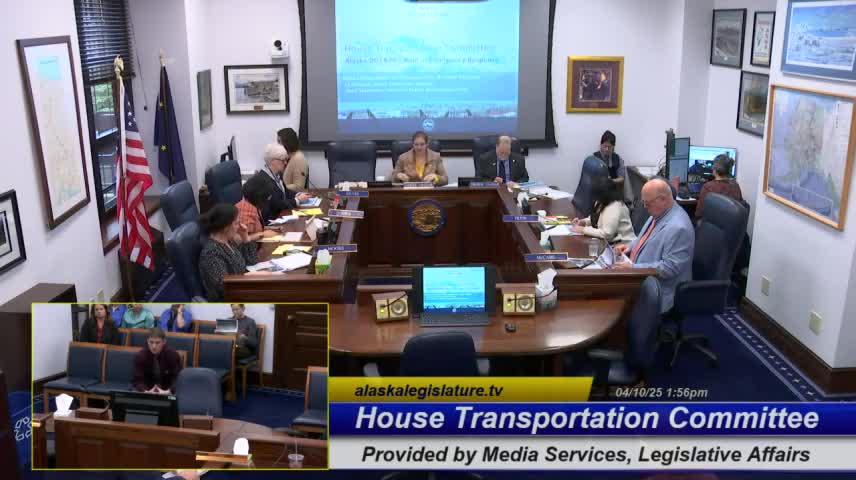
Department of Transportation and Public Facilities (DOT) officials told the House Transportation Committee on April 10 that DOT often is among the first responders in transportation emergencies, that its contracting capability multiplies response resources, and that new remote technologies are expanding what DOT can do without putting people in harm's way.
Christopher Goins, South Coast region director for DOT, said the agency's role is "to restore and maintain safe emergency access to and through critical assets, such as medical, fire, police," and to protect infrastructure and, where feasible, increase resiliency rather than just replace damaged assets. "Our superpower as DOT is our contracting arm," Goins said, explaining that DOT can rapidly scale contracts to bring crews and equipment into the field during declared emergencies.
Jason Sakhalaskis, Northern Region maintenance and operations chief, described DOT's multi-modal emergency tasks — land, sea and air — and how the department adapts airport operations or road openings based on community need. He said DOT performs rapid initial damage assessments and coordinates with local incident command structures and the statewide emergency operations center.
New tools and programs: Goins and Sakhalaskis described two grant-backed drone programs and other remote capabilities. ARRW (Alaska Remote/Role Remote Operations Work plan) and SOAR (Scalable Operations and Advanced Remote Technology) provide uncrewed aerial systems (UAS), long-range drone operations and shared GIS for remote communities; SOAR was funded by a federal SMART grant of about $12.4 million. "Drone-in-a-box" systems that can be powered and operated remotely allow beyond-visual-line-of-sight missions for mapping, change detection and search operations, officials said. Goins described a recent Wrangell landslide response in which drone mapping and thermal imaging supported search-and-recovery activities that would otherwise have required manned aircraft or diver teams.
Underwater capability: DOT has an ROV (remotely operated underwater vehicle) named Archimedes used for inspections and emerging emergency missions. Andy Mills said the ROV unit cost is in the $70,000–$100,000 range and that DOT is exploring broader deployment; committee members discussed possibilities such as placing units on Alaska Marine Highway System ferries for rapid use. Officials said the ROV is tethered and currently unique in DOT's inventory but that the department expects more use cases and potential additional purchases.
Interactions with forestry and other agencies: committee members asked who manages roadside clearing and fire-break decisions. DOT officials said routine clear zones are set and maintained by DOT for transportation safety, but during wildfires and declared emergencies DOT coordinates with Division of Forestry and incident command to take additional measures such as larger setbacks or contractor work when needed.
Examples: presenters reviewed recent incidents — a landslide that required search-and-recovery and staged debris removal; the Ketchikan slide that split parts of the community and required a bypass; the Merbok storm impacts in Nome, where DOT expedited runway and road repairs ahead of winter; and the Sag River flooding on the Dalton Highway, where the department adjusted long-term design to raise the roadway after repeated interruptions.
Committee response: members asked about text alerts (DOT said they are available through 511), availability of drone and ROV assets for multiple simultaneous incidents, costs and the tethered nature of Archimedes, and the use of DOT and AMHS assets in rescue missions. Several committee members praised DOT's responsiveness and interagency coordination.