Get Full Government Meeting Transcripts, Videos, & Alerts Forever!
Get email alerts on the Aquaculture topic
No spam. Unsubscribe anytime.
Alaska committee hears bill to authorize onshore finfish farms; adopts committee substitute as working draft
Summary
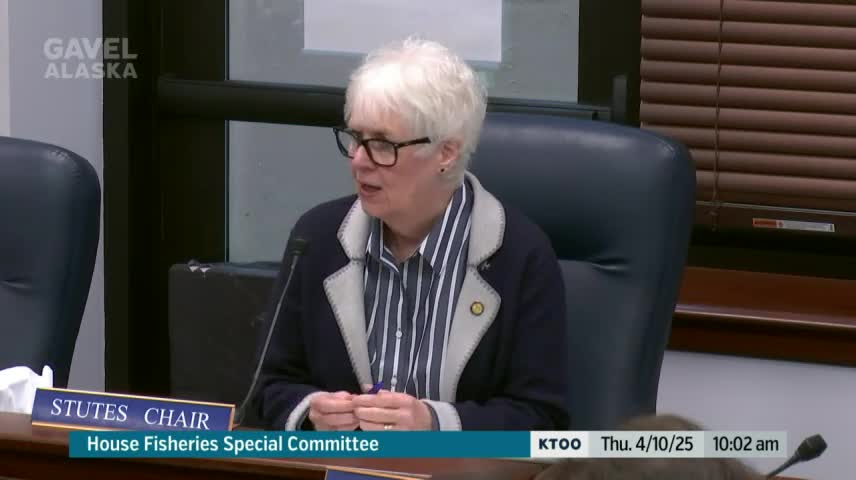
The House Special Committee on Fisheries on April 15 considered House Bill 111, a governor‑sponsored proposal to authorize commercial onshore finfish farming in Alaska under a new permitting framework.
The House Special Committee on Fisheries on April 15 considered House Bill 111, a governor‑sponsored proposal to authorize commercial onshore finfish farming in Alaska under a new permitting framework. Chair Stutes opened the special meeting and the committee adopted the proposed committee substitute as its working draft by unanimous consent.
Why it matters: HB 111 would lift the long‑standing statutory ban on commercial finfish farming in Alaska for certain species and create a permitting program administered by the Department of Fish and Game (ADF&G) and coordinated with the Department of Environmental Conservation (DEC). Proponents say tightly regulated, inland, closed systems could create new, year‑round jobs and local food supply; opponents say any change would undermine the Alaska wild‑caught brand and risk genetics, disease, and market harm to commercial and subsistence fisheries.
Commissioner Doug Vincent Lang, commissioner for the Alaska Department of Fish and Game, presented the bill and said the measure as drafted limits farming to inland, closed‑system facilities with an ‘‘escape‑proof barrier’’ and requires that fish produced or sold from a finfish farm be triploid (sterile). He described modern recirculating aquaculture system technology and cited an existing indoor Arctic char operation in Whitehorse as an example of onshore production. ‘‘All fish kept or sold from a finfish farm must be triploid. That means they’re sterile,’’ Lang said. He added, ‘‘This legislation is a starting point to begin these discussions.’’
Legislative liaison Joe Felkel summarized the bill’s statutory changes. Key provisions described in the sectional analysis include: amending definitions to add finfish farms; authorizing permitting and regulation of finfish farms and related exemptions consistent with existing aquatic farm and hatchery statutes; specifying that the Board of Fisheries would not regulate finfish farm permitting; requiring consultation with DEC on regulations; limiting the activity to bony finfish (excluding salmon) raised in inland closed systems within an escape‑proof barrier; and an immediate effective date in section 17.
Committee members pressed the department on disease monitoring, genetic safeguards, and fiscal impact. Commissioners’ staff said triploidy would be generated at the facility and verified by subsampling, and ADF&G would set permit conditions, including eligible species and disease‑control requirements. The department acknowledged that if industry adoption expanded, it could require additional pathology and permitting resources; early implementation was described as likely gradual. Commissioner Lang said existing hatchery and aquatic farm statutes and DEC permitting requirements would apply to farm operations.
The committee then opened public testimony. Testifiers speaking in opposition included Mary McDowell, a fisheries staffer involved in the 1990 legislative ban; John Fishmager, a commercial fisherman from King Salmon; outfitter Adam Cuthrell; and Jill Weitz, government affairs liaison who testified on behalf of the Central Council of the Tlingit and Haida Indian Tribes of Alaska. Common concerns raised were protection of the Alaska wild‑caught brand, potential disease and genetic impacts if fish escaped, feed sourcing for carnivorous farmed species, the possibility that limited onshore farms could lead to statutory requests to expand farming methods in the future, and skepticism about the bill’s stated zero fiscal impact for state agencies.
Speakers and the department offered several quantitative details during the hearing: Commissioner Lang said the Whitehorse Arctic char facility produces about 6,000 market fish per month and ships roughly 40% to Vancouver; he said the Anchorage hatchery’s cost to produce a catchable rainbow trout is about $4.50 per fish. The bill text described by the liaison requires farmed fish to be triploid, limits farmed species to bony finfish except salmon, and requires permitting and regulation covering site eligibility, operations, disease control, stock and product handling, and related matters.
Outcome: The committee adopted the proposed committee substitute for HB 111 as its working draft by unanimous consent and heard public testimony. No roll‑call vote on the bill itself occurred at the hearing.
What’s next: The committee did not advance the bill beyond adoption of the working draft at this session. Committee members and the commissioner indicated they expect further discussion, and some members urged caution given strong public opposition and potential market effects on the Alaska wild‑caught seafood brand. The committee’s next scheduled meeting was announced as April 15 (board appointment business); no final action on HB 111 was reported at this hearing.