Get Full Government Meeting Transcripts, Videos, & Alerts Forever!
Get email alerts on the Public Safety Forensics topic
No spam. Unsubscribe anytime.
Committee hears SB 69 to codify sexual-assault exam kit tracking and shorten testing timelines
Summary
Senate Bill 69 would codify a statewide sexual-assault kit (SAK) tracking system, set deadlines for medical providers, law enforcement and the crime lab to move kits, require survivor notifications if they opt in, and allocate funding for a lab position and software.
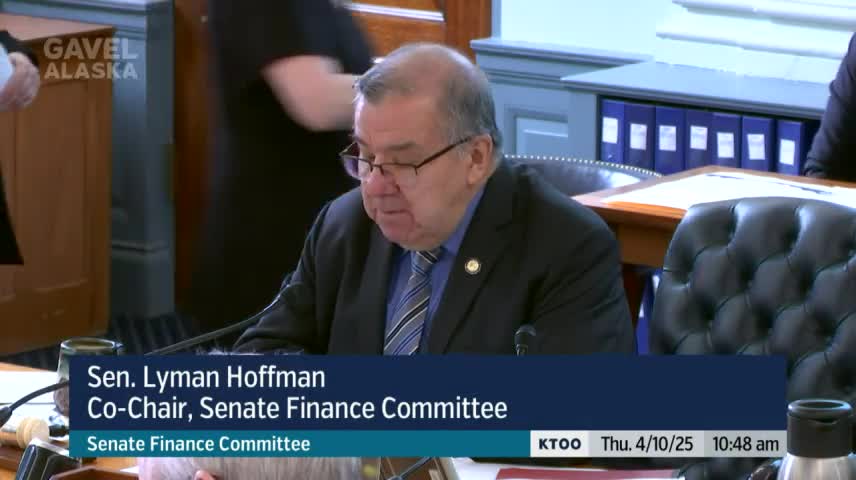
Senate Bill 69 would codify Alaska’s sexual-assault exam kit tracking system, shorten statutory processing timelines and require survivor notifications for tested kits, the Senate Finance Committee heard on April 10.
"The bill does three main things. Firstly, it codifies the sexual assault kit tracking system," Susie Frenzel, director of the Victim Assistance and Forensic Science Division, told the committee. The draft sets a 14-day timeline for medical providers to submit kits to law enforcement, reduces law enforcement turnaround to 20 days, and shortens the crime-lab testing statutory deadline from 180 to 120 days. Survivors who opt in to the tracking system must be notified within 14 days after testing is completed.
David Canaris, chief of the state forensic lab, described backlog and capacity. He said the lab stores a large number of kits spanning many years and handles roughly 500–600 sexual-assault submissions annually. "This is our kit storage room, I believe we have around 14,000 kits that are in the system over time," Canaris said. He said the lab processed kits in an average of 133 days in 2024 and expects to reduce that time.
Committee members asked about minors; Canaris said kits involving minors are entered into the system and prioritized. Senators also asked about replacing a federally grant-funded position with state funding in the bill’s fiscal plan; lab staff said continuing the program without a dedicated funded position would require reallocating thin existing capacity across multiple staff roles, which would reduce efficiency.
The Department of Public Safety’s fiscal note for Laboratory Services shows an FY26 cost of $197,500, of which about $148,000 is for a position and $49,000 for software. The bill specifies that data in the system remain private and that tracking is barcode-based with no personal-identifying information stored in the system.
Sponsors and agency witnesses said codifying the tracking system is intended to ensure continuity across administrations and to provide survivors the option to follow their kits’ status without repeated inquiries to law enforcement.
The committee set the bill aside for further review following testimony and fiscal note review.