Get Full Government Meeting Transcripts, Videos, & Alerts Forever!
Get email alerts on the Missing And Murdered Indigenous People topic
No spam. Unsubscribe anytime.
Alaska advocates outline data, law-enforcement and community steps to address missing and murdered Indigenous people
Summary
Co‑directors of an Alaska working group on missing and murdered Indigenous people told the Tribal Affairs Committee the group has documented more than 1,000 cases, is pushing for better data reporting to federal systems, and supports mandatory cultural training and investigators focused on MMIP cases.
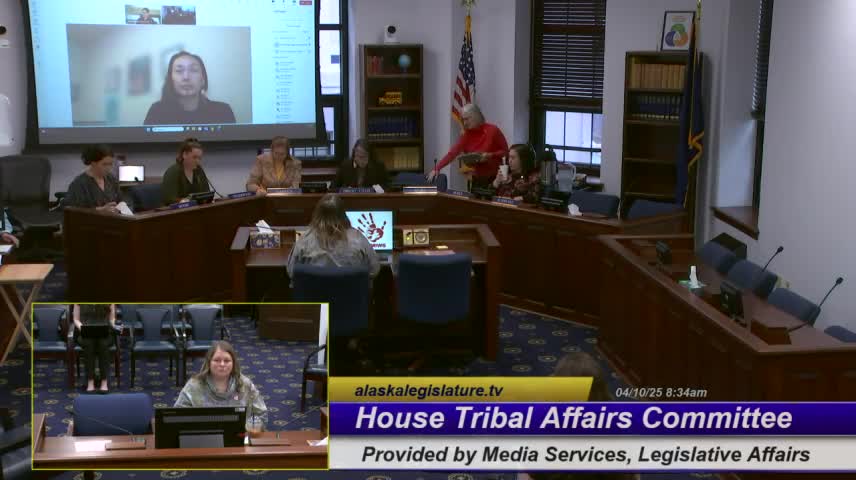
Co‑directors of the Missing and Murdered Indigenous Women, Girls and Two‑Spirit (MMIWG2S) Alaska working group told the Tribal Affairs Committee on April 10 that better data systems, expanded law‑enforcement capacity and community resources are central to addressing the state’s long‑standing MMIP crisis.
"Every number is a person," said Kendra Closter, co‑director of the working group and director of government relations for the Alaska Federation of Natives, as she reviewed the group’s statistics and outreach. "We don't want to become numb to hearing stats all the time. This is a reminder that these are real people in our community." Dr. Charlene Apok, executive director of Data for Indigenous Justice and co‑founder of the working group, described the group’s role in compiling and stewarding a database of cases that the presenters said now contains over 1,000 entries.
The working group described three linked priorities: missing in life (search and response), missing in data (improving how cases are recorded and shared) and missing in media ( how stories are reported and framed). The presenters credited community organizing and a series of policy steps for recent changes, including state efforts to require reporting into federal databases and the placement of dedicated MMIP investigators at the Department of Public Safety (DPS).
Closter and Apok noted that Data for Indigenous Justice published an early report titled We Are Calling to You that documented 229 cases when it was released and that later community and organizational efforts increased the documented case count substantially. "That first report was the first time we actually had figures to point to the truth of what our people have been experiencing," Apok said.
The presenters described specific, recent changes and ongoing gaps: - Data. Passage of SB 151 (referred to by presenters as the state MMIP bill passed last year) requires mandatory reporting into the federal National Missing and Unidentified Persons System (NamUs) and has prompted DPS to publish quarterly reports and reclassify “missing” cases into four separate categories (the presenters named "environmental," "suspicious" and "nonsuspicious" and said a fourth category exists but was not specified during the hearing). Presenters said the state’s earlier lack of consistent race/ethnicity fields and differing definitions across local police departments made it difficult to compile comprehensive statewide figures. - Investigations and training. The presenters said there are now four MMIP investigators at DPS. SB 151 also directed mandatory cultural training for law‑enforcement personnel; Closter said the training has been incorporated into initial and continuing training at DPS and that the working group and Indigenous organizations reviewed and advised on the curriculum. - Local response and 9‑1‑1. Presenters emphasized that rural communities often rely first on village public safety officers (VPSOs) or tribal safety resources and said improvements to the statewide 9‑1‑1 system and expanded VPSO staffing remain priorities. - Media and community outreach. The working group has produced a media guide (created with IllumiNative) advising journalists to prioritize Indigenous voices and avoid harmful or sensational descriptions. The group also maintains resources and toolkits for families, runs an annual Heartbeat of the Drum remembrance and organizes a week of action around May 5.
Committee members asked for more detail about data systems, how suspicious versus environmental designations are assigned, and what happens when a case initially logged as "nonsuspicious" later becomes suspicious. Apok and Closter said the new categories are an improvement but imperfect, and they recommended the committee invite DPS Commissioner Ben Cockrell (identified by members as the agency official who will appear to brief the committee) for technical follow‑up on classification rules, evidence testing capacity and timelines.
Several legislators commended the working group’s work and noted concrete policy steps. Representative Burke said the Legislature recently restored $1.6 million in FY25 supplemental funds for VPSOs in the Northwest Arctic, a budget action she said resulted from advocacy on these issues. Representative Kerrick and others urged continued emphasis on law‑enforcement training and community response plans.
Presenters also urged the committee to seek restoration of the Not Invisible Act Commission report that they said had been removed from a federal website; Closter said members of Alaska’s congressional delegation were aware and following up. Apok said she had preserved a copy and could share it with the committee.
The working group described how its database is built: community reporting, social media, freedom‑of‑information requests and family submissions. They said their stewardship of the data allows communities to self‑determine responses and to measure progress. Closter said the group is organizing training on NamUs usage so local authorities and families can enter and maintain records.
Committee Chair Diver closed the discussion by thanking the presenters and noting the committee’s upcoming agenda items on tribal contracting and tribal courts. The presenters said they planned to continue working with state agencies and tribes and expressed a hope that policy changes and improved practice will eventually make the working group’s role unnecessary.
If the committee wants written materials the working group offered to share them; presenters said they could provide the one‑page update shared in the meeting packet and the media guide on request.