Get Full Government Meeting Transcripts, Videos, & Alerts Forever!
Get email alerts on the Public Transit Planning topic
No spam. Unsubscribe anytime.
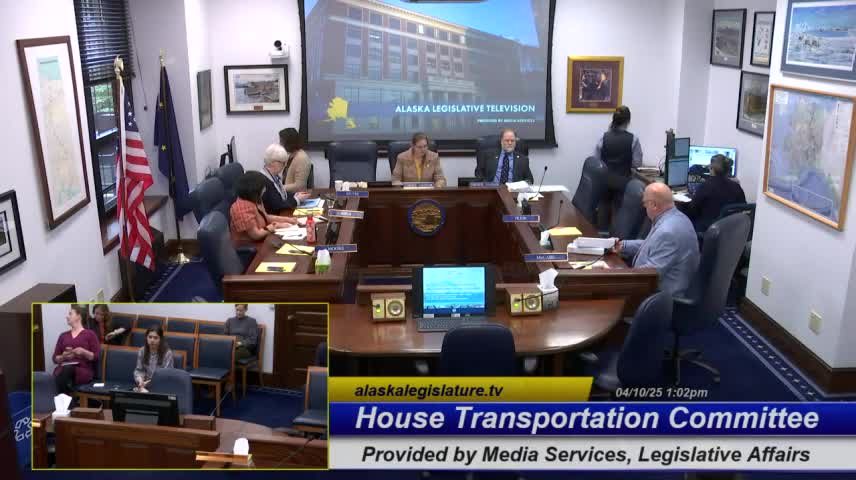
House committee advances statewide public and community transit planning bill after amendments
Summary
The Alaska House Transportation Committee adopted three amendments to House Bill 26 to standardize stakeholder language and add metropolitan planning organizations, then voted 5-2 to move the bill from committee with attached fiscal notes.
The Alaska House Transportation Committee on April 10 adopted three technical amendments to House Bill 26, a bill to create a statewide public and community transit plan, then voted 5-2 to move the bill from committee with individual recommendations and attached fiscal notes.
The bill sponsor, Representative Mina, said the amendments make language consistent across sections and add metropolitan planning organizations to the list of stakeholders. "The reason why we are replacing the word cooperation with coordination is to have the work with stakeholders be similar to what's currently on page 2," Representative Mina said as she described amendment n.2.
Committee Co-chair Eisheide moved the bill out of committee "as amended with individual recommendations and attached fiscal notes." Representative Kevin McCabe objected during the motion, saying the proposal duplicates work DOT says it already does and that it is focused on Anchorage. "This is an Anchorage bill," McCabe said, adding that many communities in his district would not benefit under current statute. After the roll call, the clerk recorded five yeas and two nays; House Bill 26 was moved from the Transportation Committee.
Why it matters: supporters said the bill removes a statutory bias toward urban areas by broadening DOT's planning responsibilities beyond the current "urban" focus in subsection 5, and ensures tribal entities, ferry operators and metropolitan planning organizations are part of statewide coordination. Opponents warned the bill could create unfunded obligations if leadership or federal funding priorities change.
Debate and amendments: the committee adopted three amendments (n.1–n.3). Amendment n.1 inserted metropolitan planning organizations into the stakeholder list; n.2 replaced the word "cooperation" with "coordination" in one subsection to mirror language elsewhere; n.3 harmonized stakeholder lists across subsections 5 and 17 so the same groups are named where DOT is directed to coordinate.
Fiscal and implementation questions: members cited the bill's fiscal note and DOT commentary. Representative Tilton and others noted the fiscal note listed "0," and questioned whether future requirements would create costs if DOT's responsibilities or funding changed. Andy Mills, legislative liaison and special assistant at the Department of Transportation and Public Facilities, told the committee that planning can cover statewide communities but without additional funding planning alone may not yield new service. "Without sort of additional resourcing, there is not, I don't envision a path to how to provide additional or new service beyond the operators that received the existing funding," Mills said.
Votes at a glance: the committee roll call recorded Yes votes from Representatives Moore, Stutes, Mina, Co-chair Eisheide and Co-chair Kerrick; No votes from Representatives Tilton and McCabe. The clerk announced the result as "5 yeas, 2 nays." The bill will proceed from committee with the adopted amendments and attached fiscal notes.
Next steps: the committee filed the paperwork after the vote and moved on to other agenda items. The bill will follow the Legislature's normal floor and committee process for further consideration.