Get Full Government Meeting Transcripts, Videos, & Alerts Forever!
Get email alerts on the Airport Feasibility topic
No spam. Unsubscribe anytime.
Port of Bremerton approves phase 2 of airport feasibility study; authorizes professional services agreement with Mead & Hunt
Summary
The Port of Bremerton commission voted to approve a professional services agreement with Mead & Hunt to begin phase 2 of an airport feasibility and master‑planning effort, including airline outreach, infrastructure analysis and community impact studies; commissioners noted financial risk if state or federal grants are not awarded.
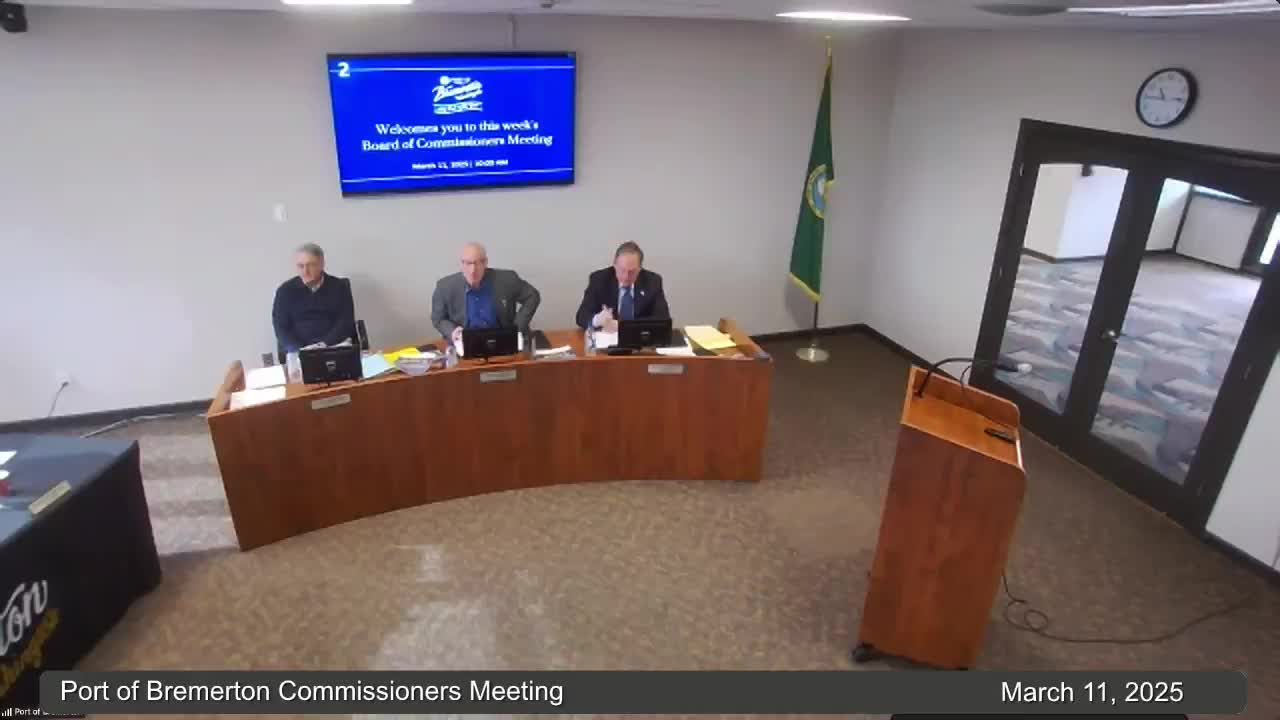
The Port of Bremerton commission voted to authorize the CEO to execute a professional services agreement with Mead & Hunt to begin phase 2 of an airport feasibility study and to align that work with an airport master plan.
Commissioners heard presentations from Mead & Hunt team members Kevin, Joseph and Nicholas summarizing phase 1 results and outlining phase 2. The consultants said the freight/cargo analysis did not recommend pursuing cargo service now, but an air service market exists: roughly 3% of the Seattle area market (about 1,100 passengers per day) could translate into demand for regional jets if a sufficient share is captured. ‘‘There are no guarantees in this business,’’ Joseph said, adding that airline recruitment and service development can be a multiyear effort.
Phase 2, as described by the consultants, will include: targeted airline outreach and customized business cases for interested carriers; risk‑mitigation and incentive planning commonly used to recruit service; an inventory and cost estimate for airfield and terminal infrastructure improvements; traffic and noise modeling tied to community outreach; and initial coordination steps with the Federal Aviation Administration (FAA) regarding eligibility for Airport Improvement Program grants.
Consultants and staff told commissioners the typical schedule for a master plan and associated phase‑2 work is about 18 months under normal FAA processing timelines; they cautioned that any federal staffing or budget changes could extend that timeline. Staff also told the commission that, if state or federal grant funding were not secured, the Port could be exposed to local costs; staff described the Port’s unrestricted reserves as roughly $8 million and characterized the fallback exposure as a limited risk that commissioners should weigh before proceeding.
Commissioner (motion maker) moved to approve the professional services agreement with Mead & Hunt for phase 2 of the airport study and to authorize the CEO to execute the agreement; Commissioner Ginger seconded. The motion passed on roll call: Commissioner Bozeman — yes; Commissioner Anderson — yes; Commissioner Strickland — yes.
Why it matters: Phase 2 will produce airline business cases and infrastructure cost estimates that the Port and potential airline partners can use to evaluate whether to pursue commercial passenger service. The work also will document community impacts (noise, traffic) and funding eligibility so the Port can make a data‑driven decision about next steps.
Next steps: Staff and Mead & Hunt will begin airline outreach and detailed technical studies. Consultants said they will coordinate phase 2 deliverables with an ongoing airport master plan effort and report progress to the commission.