Get Full Government Meeting Transcripts, Videos, & Alerts Forever!
Get email alerts on the Behavioral Health topic
No spam. Unsubscribe anytime.
Senate hears first testimony on SB 76 to create 'complex care residential homes' for Alaskans with high medical and behavioral needs
Summary
Senate Bill 76 would create a statutory license for 'complex care residential homes' to serve people with overlapping medical, behavioral and other needs who do not qualify for existing waivers; the committee heard agency presentations, provider support, and fiscal notes split between federal receipts and GF match.
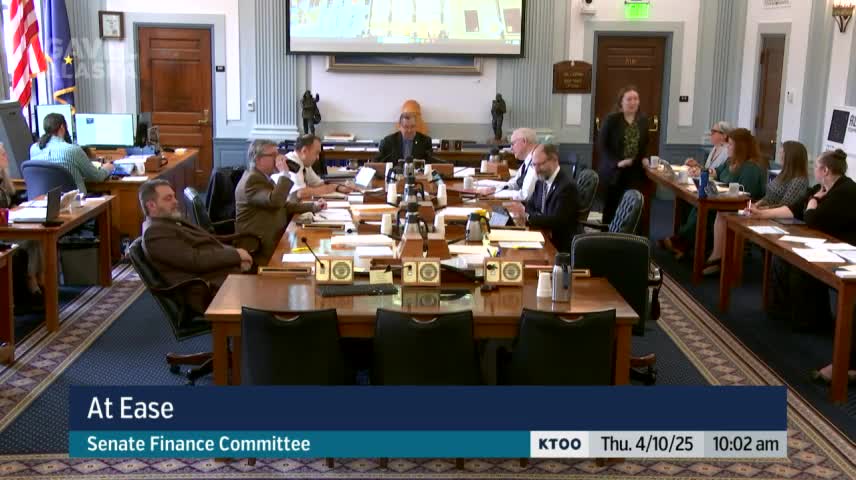
The Senate Finance Committee held the first hearing on Senate Bill 76 on April 10, a bill that would create a new license type called "complex care residential homes" for Alaskans with overlapping behavioral, medical and support needs who do not fit into existing waiver categories.
"Senate Bill 76 is a proposal to address a critical gap in care that was identified through our complex care initiative," Dr. Robert Lawrence, chief medical officer for the Department of Health, told the committee. He described complex care as the combination of behavioral, medical and other co-occurring needs that require multidisciplinary teams and, for a small group, a specialized residential setting.
Deputy Commissioner Emily Ricci, Department of Health, said the homes would be "home-like settings" that provide multidisciplinary support and consistent monitoring. She told senators the bill would provide a statutory framework to license and regulate these settings and would specifically allow the department to seek Medicaid approval in the future for services provided there. The draft includes language modeled after the conditional implementation used for adult host homes passed last year.
Panelists described the population the homes would serve: youth returning from out-of-state residential treatment who struggle to transition, adults with severe eating disorders, and elders with dementia whose behaviors exceed the capacity of existing memory-care or assisted-living settings. "Without access to that particular setting, these individuals are at high risk for cycling through various agencies in our community, like the emergency departments, like the hospitals, like our correctional care settings," Dr. Lawrence said.
Multiple providers and health systems testified in support. Michelle Baker, executive vice president of Southcentral Foundation Behavioral Services, gave two hospital discharge examples in which patients remained in acute settings for months while a community placement was sought and recommended removing a patient-census cap in statute to allow regulators to manage program size through rulemaking rather than a fixed statutory bed limit.
David Wilson of Mat-Su Health Foundation and Jared Cosen of the Alaska Hospital and Healthcare Association also testified in favor, urging flexibility on bed counts and stressing the potential to keep patients closer to family and lower costs by moving patients from hospitals to appropriate residential settings.
Committee staff summarized three fiscal notes: the Department of Health Behavioral Health Administration estimated $153,200 and one full-time position in FY26 (funding split between federal receipts and GF match); the Health Facilities Licensing and Certification component showed an initial FY27 cost of $197,100 and one nurse consultant position (split nearly fifty-fifty); and Medicaid Services reported a net-zero fiscal note. Deputy Commissioner Ricci and Dr. Lawrence said they expect work with consultants, stakeholders and federal waiver rules to identify appropriate funding streams and aim for budget neutrality where possible.
The committee received recommendations from providers that statutory limits on facility census be removed or left to regulation. Members questioned the fiscal assumptions and whether federal funding could be temporary; Ricci said the department will identify the most appropriate Medicaid waiver or funding stream for different populations over the next year.
The committee set SB 76 aside for further review after public testimony and fiscal review.