Get Full Government Meeting Transcripts, Videos, & Alerts Forever!
Get email alerts on the Housing And Community Development topic
No spam. Unsubscribe anytime.
Manchester holds public hearing on HUD consolidated plan, seeks community input on housing and services
Summary
City staff outlined the draft five-year HUD Consolidated Plan and FY2025–26 annual action plan, described CDBG/ESG/HOME and lead-hazard grants, and solicited public priorities including affordable housing, accessibility and walkability.
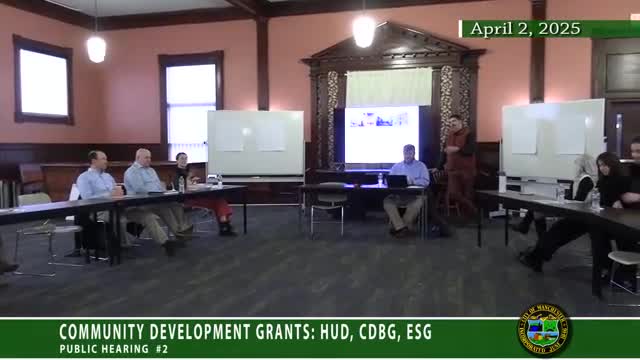
Manchester city staff held a public hearing at the Manchester Community Resource Center to solicit community input on the city’s draft U.S. Department of Housing and Urban Development (HUD) Consolidated Plan for 2025–2029 and the FY2025–26 annual action plan.
Todd Fleming, Grants Administration Manager for the Planning and Community Development Department, told attendees the two-part process is “we're holding this public hearing for two reasons. The first, we're soliciting input, for our HUD consolidated plan, which is a 5 year, 5 year plan.” The consolidated plan, he said, is a five-year blueprint for how HUD funding will be allocated to housing, public services and neighborhood infrastructure.
The nut graf: the public hearing explained how federal HUD programs—Community Development Block Grant (CDBG), Emergency Solutions Grant (ESG), HOME Investment Partnerships Program (HOME) and lead-hazard/Healthy Homes grants—are used in Manchester and asked residents to rank local priorities such as affordable housing, accessibility for elderly or disabled residents, homelessness services, and neighborhood walkability.
City staff described how each funding source is typically used. Fleming said the city receives roughly $2,500,000 annually in HUD-related funding overall and that about $1,616,000 of that typically comes from CDBG, which the city uses for nonprofit public services, neighborhood infrastructure (sidewalks, curbing, street improvements) and demolition of abandoned or fire-damaged buildings. Fleming said the Emergency Solutions Grant is “around $150,000” for homelessness-related services such as rapid rehousing and prevention, and that HOME funds are approximately $700,750 and may be used for affordable housing development or tenant-based rental assistance.
Fleming also described the city’s lead-hazard work. “We’ve brought in upward around $18,000,000 to support making housing for low to moderate income individuals lead safe,” he said, and noted current grant targets: a four-year grant to support roughly 200 housing units with about $5,600,000, and an additional Healthy Homes award of about $1,900,000. Chelsea Pinsonell introduced herself as the city’s lead program manager: “My name is Chelsea Pinsonell. I'm the Lead Hazard Control Program Manager for the city of Manchester.”
Consultant Trent Muldrow of Arnett Muldrow and Associates, who is assisting with plan preparation, emphasized that numbers and analysis tell only part of the story. “The story is why we're here tonight, and that's really to have people provide their own thoughts, and kind of on the ground experience,” Muldrow said, and led an exercise that asked participants to prioritize needs in four areas: housing, neighborhood conditions, economic opportunity, and support services.
Staff outlined a timeline and public-participation process: multiple public hearings at different city locations, targeted focus groups with nonprofit partners, an advertised public comment period in April, and a plan submission scheduled for mid-May. Fleming explained how the city’s capital-improvement (CIP) and budget processes intersect with the Consolidated Plan: projects recommended during the CIP review are incorporated into the mayor’s proposed budget and then forwarded to the Board of Mayor and Aldermen for final approval.
Residents who introduced themselves during the meeting raised priorities consistent with the city’s materials: affordable ownership options, walkability and bikeability, accessibility for aging residents, and services for people experiencing homelessness. One attendee asked whether the outreach was reaching a broad cross-section of residents; Fleming replied the city had issued press releases, posted to the city’s social media and scheduled hearings in three different locations to geographically disperse meetings.
No formal votes or decisions were recorded at the hearing; staff said they will compile written and survey feedback into the Consolidated Plan and the FY2025–26 annual action plan for later review through the city’s formal budget and public-comment processes.
Ending: Staff left printed materials and a QR code for an active public survey, said copies of the draft plan will be posted online and available at the library and the resource center, and announced the next hearing location and time.