Get Full Government Meeting Transcripts, Videos, & Alerts Forever!
Get email alerts on the Drainage Infrastructure topic
No spam. Unsubscribe anytime.
Conservation commission backs Cohass Avenue drainage fix; city seeks NHDES wetlands permit
Summary
City of Manchester staff described plans to replace degraded culverts near Cohass Avenue and requested a letter of support for a New Hampshire Department of Environmental Services dredge-and-fill wetlands permit. The commission voted to issue the letter.
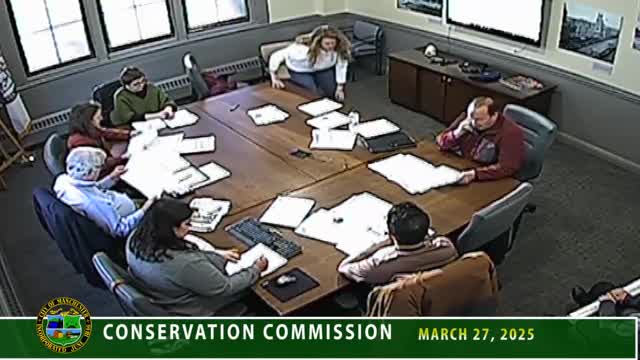
At its March 27, 2025 meeting, the Manchester Conservation Commission voted to issue a letter of support for a City of Manchester drainage project on and near Cohass Avenue that will require a New Hampshire Department of Environmental Services (NHDES) dredge-and-fill wetlands permit.
City Environmental Protection Division staff described the project as a targeted replacement of degraded corrugated metal pipe (CMP) culverts and related headwalls, plus additional catch basins, intended to address recurring sinkholes and localized flooding where water jumps curbs and flows into nearby driveways. Rebecca Baldy, who presented the project for the City of Manchester Environmental Protection Division, said the culvert running under a driveway has deteriorated, washing away soil and repeatedly creating sinkholes.
Baldy told commissioners the work will replace several CMP sections with reinforced concrete pipe (RCP) sized to increase capacity in flood-prone spots. She said some street sections will go from 12-inch to 15-inch drainage lines, one culvert will be increased from 24 inches to 36 inches, and elsewhere the design uses a pair of 24-inch pipes where a 36-inch pipe could not be placed because of utilities. Baldy said there are both temporary and small permanent wetland impacts at the inlet and outlet headwalls; one permanent impact described in the presentation was roughly 90 square feet at a relocated headwall. She said staff held a pre-application meeting with NHDES and that, because the wetland impacts are small, NHDES indicated mitigation would not be required for this project.
Baldy gave the commission a schedule constraint: NHDES’s review timeline would put the deadline for the agency’s response at about May 2, 2025, and she asked whether the commission would provide a letter of support for the NHDES application. After brief discussion, a commissioner moved to issue a letter of support; the motion was seconded and the commission approved it by voice vote. The meeting record does not show a roll-call tally; the outcome was recorded as approved by the Conservation Commission.
The commission discussion included questions about whether the replacement would change flow volume or slope. Baldy said the work would not increase total runoff to downstream wetlands but would allow a greater instantaneous flow through the culvert (that is, greater conveyance capacity during storms). She also explained the team will realign an inlet so the culvert is fully within the city right-of-way and will replace headwalls at both ends of the culvert run.
A city staff liaison, Kristen Bixby, confirmed the commission could craft a short letter of support and asked whether the commission wanted additional specificity in the text; commissioners said a general letter noting support for the permit application would be acceptable. Baldy said bids were scheduled to open soon and DPW intended to begin construction soon after the contract was awarded.
The commission’s letter of support will be routed through staff for signature and submission to NHDES; the presenter noted the city expected an agency response around May 2, 2025.