Get Full Government Meeting Transcripts, Videos, & Alerts Forever!
Get email alerts on the Economic Development Infrastructure topic
No spam. Unsubscribe anytime.
Henry County presents SR 109 corridor guidance, warns state tax changes could stall housing and infrastructure projects
Summary
County staff summarized the State Road 109 corridor guidance document and Ready 1 infrastructure projects, and warned that proposed state tax changes and Senate Bill 1 could jeopardize tax-increment-financing–backed housing projects and infrastructure funding.
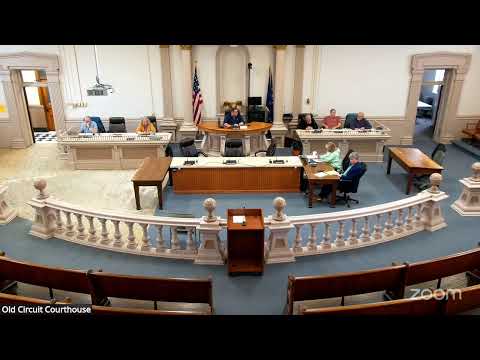
Henry County staff presented the State Road 109 corridor guidance and updates on Ready 1 infrastructure projects at the April 9 Henry County Council meeting, and said proposed changes at the state legislature could make it difficult or impossible to fund future infrastructure and housing developments.
Mr. Murphy (staff member) told the council the draft corridor plan is a guidance document intended to manage growth along State Road 109 and that it does not change zoning maps. “This is a guidance document, to help the county and the town manage growth,” he said, adding the plan references voluntary annexation but that “there’s no plans for that.” He urged commissioners and residents to use the draft plan as a reference and to provide feedback before the steering committee finishes its meetings and the plan returns to the commissioners for comment.
Murphy also reviewed Ready 1-funded projects in Henry County, including a New Castle State Road 3 sewer and water improvement project with construction bids opened April 7 and completion expected by the end of 2025; that project was described as a Ready 1 infrastructure award of $975,000 with local Redevelopment Commission match. He said a second DuBinger-site sewer phase is in design with plans expected complete in third quarter 2025, and that the intent is to have “shelf ready” utility plans and easements so land is serviced when development occurs. Murphy said four Ready 1 projects in the county total about $1.6 million and that one Ready 1 allocation of $190,000 toward YMCA expansion (before- and after-school care) is at risk if the region does not demonstrate “sufficient movement” by September 2025 under the state contract timeline.
On business attraction, Murphy said the county has pursued 15 projects since January and conducted three site visits; he also noted the county has an available shell building that helps qualify sites for certain prospects.
Council members and county staff raised state-level funding concerns. Murphy said if Senate Bill 1 (as then drafted) passes in its current form, the county could lose or find it “very, very difficult to fund infrastructure,” particularly projects financed through tax increment financing (TIF) and bonding. He said the likely reduction to business personal property tax and other amendments would shift tax burdens and reduce the revenue streams that support bonds for infrastructure tied to new housing development. “If the increment or the property taxes…[are] insufficient to pay the bonds, the developer has to pay them,” Murphy said, explaining how developer guarantees are used in the county’s housing-bond structure. He added that several housing projects relying on increment financing could be jeopardized if revenue assumptions change.
Kennan (council member) summarized recent legislative action affecting the business personal property tax and other amendments (referred to in the meeting as Amendment 36). He said the state-level package has been changing quickly and that some provisions in Amendment 36 increase the personal property exemption to $1 million for certain installations, a change that could have uneven impacts across counties. Kennan and other council members said rural counties like Henry County are more vulnerable than larger jurisdictions because the revenue shifts would reduce local bonding capacity and TIF effectiveness.
Why it matters: the corridor guidance and Ready 1 projects are intended to direct and enable development in growing parts of the county; simultaneous legislative changes that reduce business personal property tax and curb bonding capacity could remove the financing tools the county uses to build roads, sewers and other public infrastructure needed for housing and commercial sites.
Council members were asked to review the corridor draft (the staff folder included a link to the draft plan) and prepare feedback for the steering committee and the commissioners. Staff said they will return for further comment before finalizing the plan.
Ending: County staff and council members said they will track the state legislature’s revenue forecast and the final form of SB1/Amendment 36 closely and will ask Baker Tilly to rerun local bond and TIF projections once state actions are finalized.