Get Full Government Meeting Transcripts, Videos, & Alerts Forever!
Get email alerts on the Search Warrants Curtilage topic
No spam. Unsubscribe anytime.
Appeals court hears argument over scope of warrant in Commonwealth v. Hansen
Summary
The panel considered whether police exceeded a search warrant when they entered and searched a second-floor apartment alleged to be a separate unit; advocates disputed whether the apartments were distinct or treated as a single dwelling and whether information developed during a search can expand a warrant’s boundary.
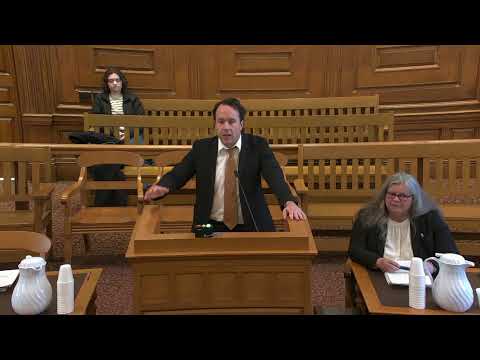
The Massachusetts Appeals Court heard April 10 argument in Commonwealth v. Barry A. Hansen over whether a search warrant for a first-floor apartment permitted police to search an upstairs second-floor apartment.
Anne Kennedy, arguing for the Commonwealth, told the panel the evidence the officers saw when they entered — a back hall treated as continuous living space and statements from occupants that the two units were rented and used as one — supported searching the upstairs area as part and parcel of the first-floor unit. Kennedy said officers also observed a video thumbnail and evidence they relied on to authenticate emails and other materials in the record.
Charles McGinty, arguing for Hansen, urged the court to affirm suppression, stressing that the warrant was particularized and identified the First Floor apartment; he relied on Massachusetts precedent including Hall, Kensington (Cannington), and Scala (record cites) to argue courts have rejected treating a distinct apartment as within a warrant for another apartment because evidence discovered during a search does not expand probable cause or the warrant’s boundary.
The panel queried both sides about factual details the record contains: whether there were separate front entrances and staircases, whether an exterior back door was blocked or locked, whether a padlock was opened with a key, whether the owner had access to other floors for renovation, and why police did not seek a second warrant before using keys to unlock the second-floor entry. Counsel differed on how photographs and transcript findings support each side’s factual account.
Both sides cited Hall and related authority at length; Kennedy argued the facts here more closely resemble cases in which courts allowed searches of contiguous or functionally continuous living space, while McGinty emphasized cases that hold that an officer’s observations during a search do not legally expand a warrant’s scope.
After argument the panel took the matter under submission. No decision was announced from the bench.