Get Full Government Meeting Transcripts, Videos, & Alerts Forever!
Get email alerts on the Criminal Harassment Free Speech topic
No spam. Unsubscribe anytime.
Appeals court hears free-speech, mens rea arguments in Commonwealth v. Ecker
Summary
At the Massachusetts Appeals Court on April 10, defense and the Commonwealth argued whether Counterman/Cruz require a subjective mens rea to sustain a criminal harassment-based probation revocation for defendant John Ecker; the panel heard conflicting views and took the case under submission.
The Massachusetts Appeals Court heard arguments April 10 in Commonwealth v. John Ecker over whether recent First Amendment case law requires the Commonwealth to prove a subjective mens rea before criminal harassment can support a probation revocation.
The issue matters because the defendant, John Ecker, sent repeated emails that a judge below found caused objective alarm and revoked his probation; defense counsel argued that after Counterman and Cruz, the Commonwealth must also prove that Ecker subjectively understood his communications’ threatening character.
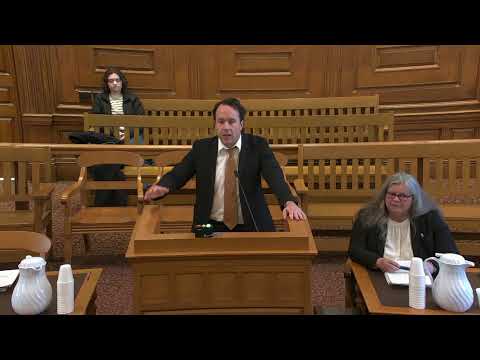
The three-justice panel — presiding judge Catherine Hand and Justices Marguerite Grama and Chauncey Wood — questioned counsel closely about waiver and the record. Kevin D’Mello, arguing for Ecker, told the court the defense did not make the Counterman-based subjective-intent argument in the initial brief because Cruz was decided after filing; he said the challenge is “that the Commonwealth has to prove…subjectively, [the defendant] had to have intended or had to have at least had a reckless intent, a conscious disregard for a known risk.” Assistant District Attorney Sean Buxton countered that Counterman’s recklessness requirement applies to true threats but that the criminal harassment statute contains a separate malice standard with a higher mens rea, citing O’Neil and arguing the judge below credited the victim’s testimony and found the requisite intent.
The panel repeatedly pressed both sides on what evidence was in the record. Grama observed that an earlier hearing — a Zoom probation hearing about 11 days before the contested conduct — made the case difficult for the defense to explain, saying the proximity of prior testimony made it “very, very difficult to understand how anybody…wouldn’t” perceive the conduct as knowingly threatening. D’Mello pointed to Ecker’s background, including prior competency proceedings and a long institutionalization, as context he contends bears on subjective understanding; the panel noted the defense did not press a competency claim at trial.
The court also considered evidentiary and authentication issues the Commonwealth raised, including email content and a YouTube video the probation officer identified, but the argument focused primarily on whether the law now requires a subjective intent element for criminal harassment convictions when Counterman and related decisions are read together.
After oral argument the panel took the case under submission. No decision was announced from the bench.
The arguments centered on legal interpretation and on what evidence was in the trial record; the justices asked whether the trial judge instructed properly under Counterman and whether remand would be appropriate if the record lacked evidence of subjective intent.
The court session proceeded under the Appeals Court’s usual oral-argument rules: 15 minutes per side and no rebuttal.