Get Full Government Meeting Transcripts, Videos, & Alerts Forever!
Get email alerts on the Inland Wetlands Restoration 284 New Canaan Ave topic
No spam. Unsubscribe anytime.
Norwalk commission continues hearing on restoration plan for 284 New Canaan Ave; applicant to revert yard to 2018 limits
Summary
Applicant will restore yard at 284 New Canaan Avenue to limits approved under a February 2018 inland wetlands permit, remove a proposed berm/sound barrier and replace a planned above‑ground detention basin with a subsurface infiltration system; public hearing continued to March 25 for staff and engineering review.
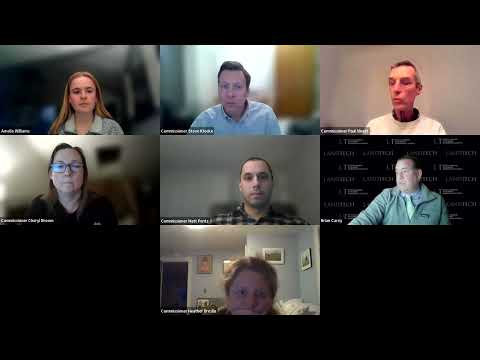
NORWALK, Conn. — The Conservation Commission and Inland Wetland Agency of Norwalk continued a public hearing on a corrective action and site modification at 284 New Canaan Avenue, where the applicant agreed to restore areas that exceeded the limits of a February 2018 inland wetlands approval and to replace a proposed above‑ground detention basin with a subsurface infiltration system.
The matter, logged as application S16‑499B and tied to an enforcement notice, was the focus of the special March meeting. Brian Carey, director of environmental services for LandTech and a professional soil scientist, told the commission the property owner will “restore all the disturbed areas back to the limits” of the 02/2018 permit and is withdrawing a request to legalize the yard expansion that prompted the violation. Carey said the applicant instead seeks a modification limited to drainage: a subterranean detention/infiltration system with a hydrodynamic separator to manage on‑site stormwater runoff.
The change removes an acoustical berm that had been shown on earlier plans, and Carey said the updated plans submitted the same day address the acoustical barrier issue, corrective planting, and stormwater details. Carey told commissioners the planting schedule under the prior approval gives the applicant four months from issuance of a restoration approval to complete replanting and that “the planting season begins April 15, generally, for the trees,” meaning crews plan to move quickly once the modification is approved.
Why it matters: The property crosses wetland review area boundaries and was subject to a notice of violation for yard expansion into regulated areas. The commission must determine whether the proposed restoration and the revised underground stormwater approach adequately protect the inland wetland and meet conditions of prior permits.
Commission and staff members asked for clarifications. Commissioners requested a more robust shrub or tree layer in the restored area after aerial imagery and overlays showed tree removal in the hashed/expanded area. Amelia (identified in the record as conservation staff) told the panel the plans received that day had not yet been reviewed by staff or the town engineer and recommended keeping the public hearing open so staff could complete their review and the applicant could submit a revised planting plan.
Nearby residents who identified themselves as abutters asked about the scope and timing of corrective work. Peter Wilson of 178 Poconoque Trail (New Canaan) asked whether the restoration covers all areas cited in the enforcement notice (V241067/V241066 were referenced during the meeting) and pressed for timing so planting would occur before summer. Alicia Chabir of 166 Poconoque Trail echoed concerns about visibility and noise and asked about timing as well. Carey replied the applicant must address all disturbed areas identified in the notice of violation and that work will be coordinated with conservation staff, including an on‑site pre‑work meeting and photographic site monitoring.
Commissioners also asked about erosion control and temporary stockpile details; Carey and staff pointed to a stockpile detail and silt fence/silt sock notes in the materials submitted that afternoon and said conservation staff will inspect installation or require photographic documentation in a monitoring report. Commissioners asked whether existing underground stormwater structures on the site have been inspected; staff said inspection records and prior inspection reports are maintained by the conservation office and Alexis (staff) could provide them.
On regulatory scope, staff clarified that zoning does not regulate subterranean features, so there is no zoning setback for underground drainage components; the commission’s review is limited to wetland and upland review area impacts. The proposed subsurface system lies at least partly within the 100‑foot upland review area measured from the flagged wetland line, and commission members voiced no immediate “red flags” about the filtration system shown in the updated submission, while reserving review pending the town engineer and staff comments.
The public hearing was left open and formally continued to Tuesday, March 25 at 7 p.m. via Zoom to allow staff and the town engineer to review materials and to give the applicant time to submit a revised planting plan with clearer erosion‑control and planting details. Carey said he would provide an updated planting plan the following day and that any additional materials received would be placed in the record.
Separately, the commission accepted minutes from its Feb. 25 meeting. A motion to accept the minutes as written was made, seconded and carried with one abstention by Commissioner Mattigan.
Additional procedural and record items flagged during the meeting included: inspection records and documentation for previously installed concrete gallery/cistern stormwater components (staff to check files); clarification in writing whether the current magenta boundary shown on the plan matches the 2018 approval boundary; and confirmation that corrective work underway under a separate enforcement action addresses other disturbed strips on the site.
The commission had no further substantive business that evening and adjourned after routine items.