Get Full Government Meeting Transcripts, Videos, & Alerts Forever!
Get email alerts on the Department Reports topic
No spam. Unsubscribe anytime.
Norwalk police report: crimes down in February; CALEA assessment passed, distracted-driving grant will fund April enforcement
Summary
The Norwalk Police Department reported lower crime in February, passed a midyear CALEA assessment, and described staffing, budget and grant activity — including a restricted distracted-driving grant that the department must spend during April.
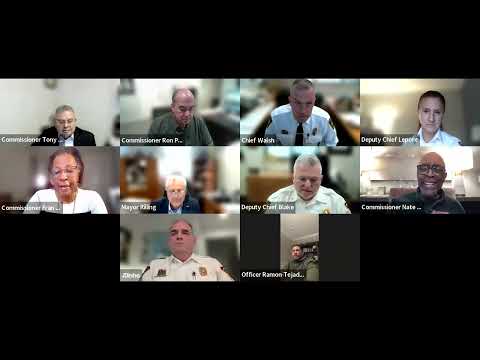
Chief Walsh and department deputies reported to the Norwalk Board of Police Commissioners on March 17 that February crime reports showed declines and that several administrative initiatives are underway.
The department reported 182 sworn personnel with one open sworn position, one officer on administrative leave pending an internal affairs investigation and three officers on extended workers’ compensation. Sick days and workers’ compensation usage were reported in the administrative packet. The department said it completed a midyear CALEA (Commission on Accreditation for Law Enforcement Agencies) assessment and that the on-site CALEA inspection went well; the department expects a full on-site assessment later this year.
Connecticut state crime statistics released for February and cited by the department showed crimes against persons down 15.8%, crimes against property down 17.5% and "crimes against society" down 25% compared with the prior reporting period. The department said the state will move to quarterly NIBRS data releases.
On budgeting, the department reported a 2.52% operational budget increase compared with last year and said salary and overtime accounts are tracking below budget so far this fiscal year. Reported overtime declines included uniform patrol overtime down 41%, special services down 51% and other unit decreases that contributed to an overall reduction in overtime spending compared with the prior year.
The department described school-security deployments and overtime accounting: roughly 40 hours of school security are deployed per day, with Norwalk Public Schools covering about four hours; officers are assigned geographically and one officer is assigned full time at each high school, with other officers covering middle and elementary schools to provide pro-active patrol and security.
Deputy Chief Blake reported operational activity: the detective bureau opened 19 cases in February and made arrests including an arrest related to a 2024 homicide investigation; special services opened 34 cases, executed search warrants (including at locations in Norwalk and Bridgeport) and seized narcotics and firearms in multi‑jurisdictional cases worked with an FBI task force officer; the patrol division responded to 5,433 calls for service in February.
The community policing and behavioral health units reported outreach and casework: community events (library Chinese New Year, coffee-with-a-cop, clergy meetings, school safety presentations) and a behavioral health unit caseload that opened 37 new cases in February, closed 31, referred 21 to services and arranged 15 hospitalizations; 9 cases involved family engagement and two cases included partnerships with the state’s attorney’s office.
Administrative details included crime scene unit activity (107 people fingerprinted; 33 pistol-permit fingerprints; 30 evidence cases processed), body- and dashboard-camera requests and monthly performance audits of equipment and video tagging. The department also reported that one telecommunicator promotion and other civilian hiring activity is underway; dispatch testing and interviews were in process to fill two open positions.
Grants: the department said it used a DUI grant in February. The transcript records an awarded distracted-driving grant described alternatively as $69,000 and later as $70,000; department staff explained the grant must be spent within a restricted 30‑day enforcement period in April, with restrictions on time frames, days of the week and locations. Staff described planned targeted enforcement during commuting times on major roadways and said the grant parameters limit when and where the funds can be used. The department also said it tracks federal pass-through grants carefully because some anticipated awards have been pulled.
The department noted continuing administrative work: promotions and personnel orders from a recent internal promotion process, completion of the third-year CALEA review with no issues reported, and planning for an on-site CALEA review in October.