Get Full Government Meeting Transcripts, Videos, & Alerts Forever!
Get email alerts on the City Budget topic
No spam. Unsubscribe anytime.
Norwalk BET reviews departmental budgets; 1% reduction, new auditor funding and tax-sale revenue discussed
Summary
Norwalk City’s Board of Estimate and Taxation reviewed departmental budgets on March 18, with city finance staff explaining a mandated 1% reduction rolled into this budget cycle, an extra $20,000 added to fund a new five‑year auditor contract and discussions about one-time tax‑sale and settlement revenues that make non‑tax receipts volatile from year to year.
Norwalk City’s Board of Estimate and Taxation reviewed departmental budgets on March 18, with city finance staff explaining a mandated 1% reduction rolled into this budget cycle, an extra $20,000 added to fund a new five‑year auditor contract and discussions about one-time tax‑sale and settlement revenues that make non‑tax receipts volatile from year to year.
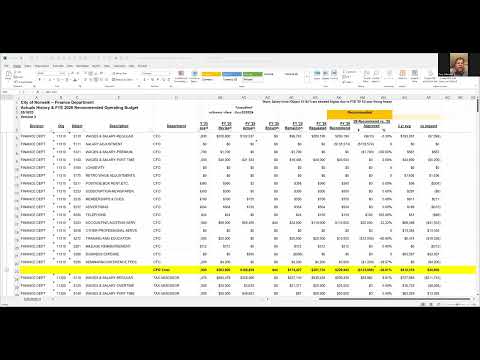
The review, led by Jared, Chief Financial Officer, and facilitated by Tom (BET member), focused on five themes: how the 1% reduction is being implemented, an auditor contract increase, tax assessor/collector revenues tied to a recent tax sale, IT staffing and cybersecurity needs, and several line‑item reallocations and one‑time revenue items. “Without that freeze and factoring in that freeze our overall division budget would be almost flat,” Jared said, describing how a prior hiring/salary freeze inflates year‑over‑year comparisons.
Why it matters: the 1% reduction is a council directive intended to limit the overall increase in next year’s budgets; the way the reduction is allocated affects departments’ operating plans. The auditor contract and tax‑sale receipts bear directly on the city’s external oversight costs and non‑recurring revenues that influence available funds and the mill rate calculus.
Jared told the board the finance division’s headline increase — shown as 6.72% year over year in the presentation — largely reflects the prior year’s salary freeze; he said once that effect is normalized the division budget would be roughly flat (about 0.5% increase). The budget also includes an additional $20,000 to retain a newly selected auditor on a five‑year contract; Jared said that contract will be forwarded to the Common Council for approval and carries an annual escalation of about 3%.
The board heard department‑level explanations. Paul Gorman, Tax Assessor, said the revaluation account was trimmed where possible and a carryover retainage payment was addressed; he noted office supplies and other small line items were increased only to avoid borrowing from other accounts. Lisa, Tax Collector, told the board the tax collector’s office is staffed by eight full‑time employees and that tax‑sale years produce spikes in non‑tax revenues, fees and interest. “We collected close to $7,000,000 on that tax sale,” Lisa said, explaining why interest and penalties rose markedly in the last tax‑sale year and why the revenue line fluctuates.
Officials flagged several reclassifications and clarifications for the board. IT costs tied to the QDS tax system were moved from an IT services account to an IT software account for consistency; purchasing noted its Bonfire procurement portal and legal advertising costs remain recurring expenses; central services noted a joint mailroom contract with the Board of Education and an upcoming joint RFP for mailroom services.
On IT and cybersecurity, Joyce (IT services) described the unfreezing of two positions previously held vacant and discussed plans to pursue a shared cybersecurity specialist rather than an individual full‑time hire; she said the city is exploring a shared or pooled arrangement with neighboring jurisdictions or a consistent, dedicated vendor contact rather than rotating consultants. Jared and Joyce said details and exact funding for a shared cybersecurity role were still under development.
The board also discussed non‑tax revenue one‑time items: staff said recent receipts included a developer settlement (identified in the discussion as Spinnaker) and a payment from the housing authority; staff characterized those as one‑time items and not recurring operating revenue.
No substantive policy decisions were adopted during the review; the meeting concluded with a routine motion to adjourn moved by Mayor Riley and seconded by Kendrick and Troy. The board scheduled the next review sessions for additional departments on the following nights.
Adjournment and next steps: department heads were reminded to continue seeking the mandated 1% savings through turnover and other line‑item reductions; the proposed auditor contract will be submitted to the Common Council for approval. Further discussion on grant recipients and several authorities was scheduled for the subsequent meeting.