Get Full Government Meeting Transcripts, Videos, & Alerts Forever!
Get email alerts on the Municipal Finance topic
No spam. Unsubscribe anytime.
Seattle forecast office recommends pessimistic revenue scenario amid trade-driven uncertainty
Summary
Seattle—s independent forecast office recommended that the Economic and Revenue Forecast Council adopt the pessimistic April 2025 revenue scenario, citing recent tariff announcements, financial-market volatility and weaker local taxable activity. The council recorded its concurrence by consensus.
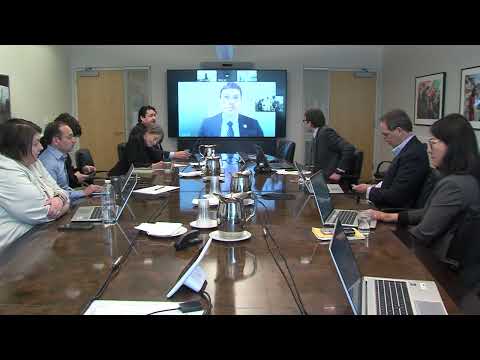
The Economic and Revenue Forecast Council on April 10, 2025, recorded its concurrence with the Office of Economic and Revenue Forecast's recommendation to use the pessimistic revenue scenario for the April 2025 official forecast.
The office presented three scenarios and told the council that recent tariff announcements and subsequent market volatility had shifted risks toward the pessimistic case. Director Perez and the forecast staff explained that the pessimistic scenario assumes larger and more persistent tariff effects, higher inflation pressures and slower employment growth, and that those factors would materially reduce revenues, especially in 2026.
Why it matters: The council's forecast informs the city—s budgeting process for the 2025—26 biennium. Forecast assumptions affect the mayor's budget instructions and the council's budgeting later this year. The office recommended the pessimistic scenario to avoid overstating available revenue given rapid recent developments in trade policy and financial markets.
Key details from the presentation included: 2024 general fund results were roughly in line with expectations overall, with a $7.3 million positive variance on the general fund (excluding grants and transfers). Construction-related taxable sales and construction-sector activity weakened in 2024 (construction activity declined about 7.1% year over year), and taxable sales were effectively flat for the year. Payroll expense tax (PET) collections for 2024 totaled about $360 million, roughly $46.7 million below the office—s baseline forecast for that revenue.
The forecast office showed that, under the April baseline, total general fund revenues (excluding grants and transfers) are forecast to grow about 2.0% in 2025 and 2.7% in 2026. Versus the adopted 2025 budget forecast, the April update reduces projected revenues over the two-year period (primarily in 2026) by roughly $33 million (and about a 9.5% two-year downward revision in the table when grants/transfers are excluded was noted in the presentation). Under the pessimistic scenario, the office estimated a larger downward revision of roughly $40 million over the two-year period.
On PET specifically, the office reported a revised April baseline of roughly $373 million (2025) and $391 million (2026) versus a 2024 actual of about $360 million. The office cited a combination of factors: concentration of PET across relatively few taxpayers (top 100 taxpayers account for the vast majority of PET revenues, and the top 10 account for roughly three-quarters), sensitivity to stock-price-linked compensation and restricted stock units, and a lower local employment base for certain large taxpayers.
Council discussion focused on PET drivers and data sources. Council President Sarah Nelson asked whether the shortfall reflected lower jobs in Seattle versus stock-price effects; staff said the revision reflects both a lower starting base (jobs located in Seattle) and a weaker outlook for equity markets. Forecast staff also said they are now incorporating Employment Security Department payroll data and location-analytics inputs (Blazer AI) to better track local payrolls and return-to-office trends. Staff clarified that data shown in April reflect 2024 activity (the employment-security data used were through the third quarter of 2024 and annualized), not 2025 Q1 developments.
After discussion the chair noted there were no objections and recorded the council—s concurrence with the forecast office—s recommendation. Chair Dan Straub said, "Hearing no objections, I'm going to direct the forecast office to record our concurrence with the recommended forecast in the meeting." The council will revisit revenue forecasts in August and October as the budget process progresses.
Votes at a glance
- Council concurred with the Office of Economic and Revenue Forecast—s recommendation to use the pessimistic April 2025 revenue forecast (adopted by consensus; formal concurrence recorded). - Other formal actions during the meeting (agenda adoption, minutes approval, and officer elections) were completed by unanimous consent or no objection; details follow in the actions list below.
The office will present the same materials to the city council finance committee next week; staff asked councilmembers and the public to raise any detailed questions in that forum. The council scheduled its next forecast meeting for August 4, 2025, at 9:30 a.m.