Get Full Government Meeting Transcripts, Videos, & Alerts Forever!
Get email alerts on the Local Governance topic
No spam. Unsubscribe anytime.
Council refers amended mayoral draft of city charter to special meeting after heated debate; several amendments adopted
Summary
After hours of debate the council adopted multiple amendments to the mayor’s returned draft — including restoring council appointment language, removing a one‑year ward residency requirement and agreeing to revise future charter committee appointments — then voted to continue the charter for final action at a special council meeting April 15.
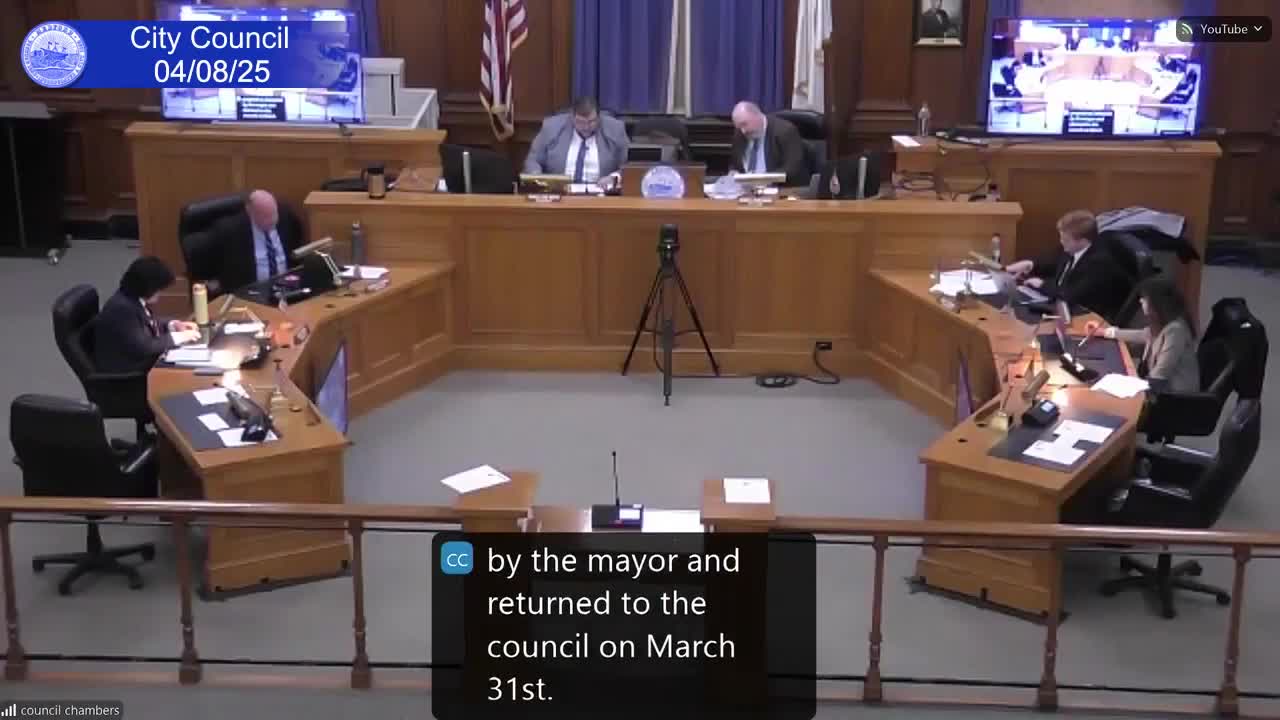
The Medford City Council spent much of its April 8 meeting debating changes to a mayor‑returned draft of a proposed city charter and agreed to several amendments before referring the package to a special council meeting April 15 for final consideration.
The mayor had returned a revised draft after the council’s governance review. Council deliberations on April 8 focused on representativeness, balance of power between the mayor and council, the mayor’s role on the school committee and appointment rules for future charter review bodies. Councilors said they wanted to preserve the council’s ability to make appointments by ordinance in some cases, ease an asymmetric residency restriction for ward councilors, and change how future charter review panels are constituted.
Key procedural steps and amendments adopted by the council on April 8 included: - Restoring the phrase "or ordinance" in section 3‑3(a) so the council can appoint members to some boards/commissions by ordinance as well as by charter. - Striking a one‑year ward residency look‑back for ward council candidates (section 2‑1(c)); the adopted language requires only that a ward counselor be a voter in the ward for which election is sought. - Amending section 9‑4(b) so future charter review committees would be composed of three appointees each from the mayor, the city council and the school committee (3/3/3) rather than the mayor‑weighted composition proposed in the returned draft. - Reverting petition certification language (section 8‑2) to the Board of Election Commissioners for voter roll access. - Setting the signature threshold in section 8‑2(e) at 12% so citizen initiative and repeal petitions use a single consistent threshold.
Councilor Collins moved, and members adopted, an amendment to remove the mayor from the school committee and replace that seat with an at‑large school committee seat; the council voted to include that amendment for additional consideration at the April 15 special meeting. The proposal to remove the mayor from the school committee was a focal point for several councilors who argued for shifting power and for clearer separation of executive and school governance, while other councilors and many residents urged that the mayor remain on the school committee to preserve connection between city leadership and school operations.
The council also voted to send the mayor’s draft as amended back to a special meeting on April 15 at 6 p.m. to give members more time to finalize the text before forwarding it to the Legislature. Anthony Wilson of the Collins Center, who addressed the council, advised that certain election‑mode and composition changes would require legislative approval (special act) while other technical edits could be handled during periodic review; he also noted that a future charter review route via signatures and election of a charter commission would remain legally available.
Why this matters: a new charter would rewrite the city’s foundational government document and affect how Medford elects representatives, how power is divided between executive and legislative branches, and how future charter reviews are conducted. The council’s amendments attempt to balance the mayor’s revisions with council prerogatives while preserving a path to voter consideration.
Next steps: the council will reconvene in a special meeting April 15 to consider the amended draft and try to finalize a version to send to the mayor and the Legislature for placement on an upcoming municipal ballot.