Get Full Government Meeting Transcripts, Videos, & Alerts Forever!
Get email alerts on the Surveillance Alpr topic
No spam. Unsubscribe anytime.
Medford parking director details license-plate reader use; council seeks clearer retention and access rules
Summary
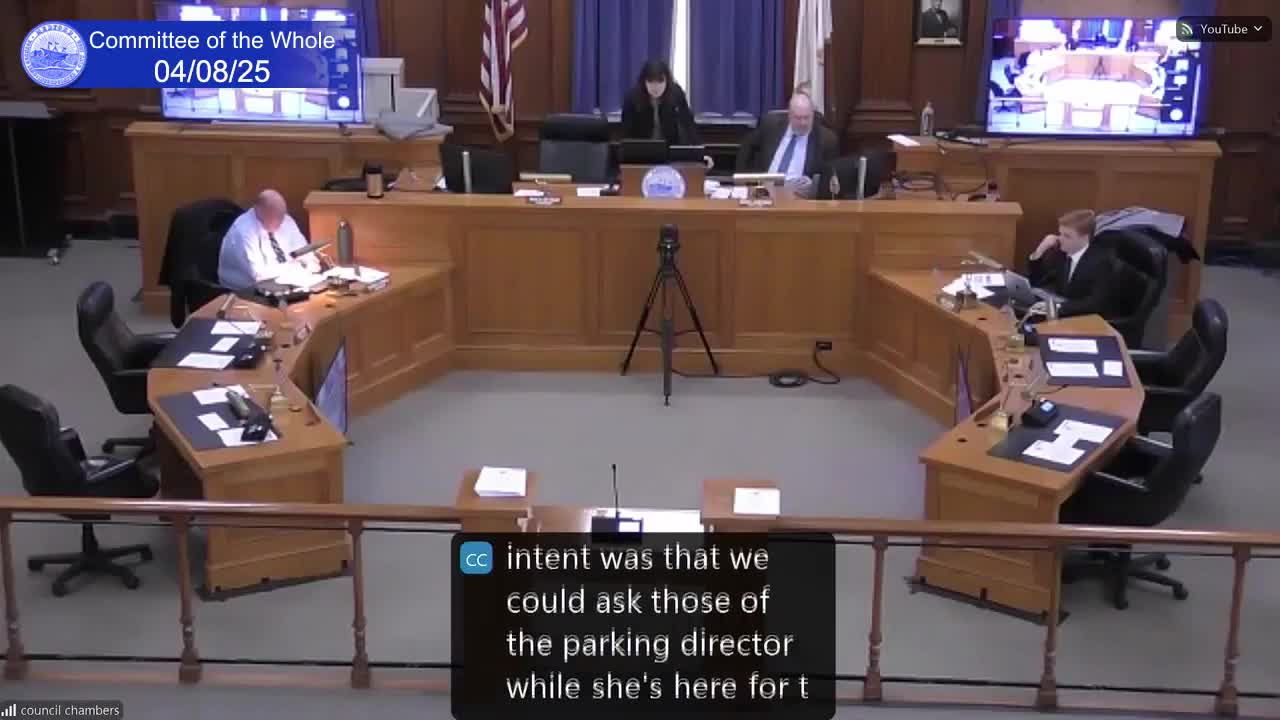
At a Committee of the Whole meeting on April 8, the Medford City Council reviewed the Parking Department—s impact report and use policy for automatic license-plate recognition technology (ALPRs).
Medford City — At a Committee of the Whole meeting on April 8, the Medford City Council reviewed the Parking Department—s impact report and use policy for automatic license-plate recognition technology (ALPRs). Parking Director Sarah McDermott told councilors the department operates two vehicles equipped with license-plate recognition cameras used primarily to enforce permit and restricted-parking rules.
Why it matters: The city—s review was carried out under the Community Control Over Public Surveillance ordinance adopted in 2023 and is the first time the Parking Department—s ALPR materials have come before the council. Councilors pressed for clearer records-retention limits, stronger contractual guarantees from private vendors, and an explicit prohibition on sharing ALPR data outside the city.
McDermott said the ALPR cameras read license-plate text and combine plate data with GPS coordinates to determine whether a vehicle is parked legally. She said permits in Medford are tied to license plates rather than physical stickers and that the system is used citywide but primarily on permitted streets. "The cameras are designed to read text primarily, so it will read the plate," she said, describing how the permit-linked enforcement works.
McDermott provided several operational details: her office has two ALPR-equipped vehicles; the system was placed into service in early July 2024; the total cost in the original quote spread over three years is $145,547.09; and the department has recovered more than $70,000 in citation revenue attributed to ALPR enforcement since deployment.
On data handling, McDermott said vendor messages indicated that non-citation data would be "dumped" after 30 days, but she also said the city—s command-center database still shows every hit since deployment. She told councilors the Medford Police Department currently has no access to ALPR-collected data and that prior administrative credentials that granted police broader access had been removed.
Councilors pressed for specific changes to the use policy. Vice President Collins and others asked for: (1) a clear, written retention period for non-citation ALPR data in the city—s use policy; (2) an explicit statement that the city will not share ALPR access with other agencies or private entities; and (3) a contractual or annual confirmation from vendors that they are not selling or otherwise sharing city-captured data. McDermott agreed the policy could be updated quickly and said she would submit amendments to be included in the city—s annual surveillance report.
Public commenter Barry Ingram of Draper Street, speaking on civil-rights concerns, warned that "the tracking of vehicles can be used to track people and has been used to track people," and urged deletion of non-citation data when there is no enforcement reason to retain it.
The committee voted to receive and place on file the Parking Department—s ALPR impact report and use policy, with the understanding that the director will supply the requested clarifying amendments on retention and vendor assurances. The motion, made by Councilor Scarpelli and seconded by Councilor Singh, passed 7-0 (Councilors Callahan, Lazaro, Lemming, Scarpelli, Singh and President Barris and Vice President Collins voted yes).
What the council directed next: staff will update the use policy to specify a retention schedule for non-citation data, add affirmative language prohibiting sharing access, and pursue written confirmations from vendors about data-handling and third-party access. The updated policy will be included in the city—s annual surveillance reporting.
Medford officials did not adopt an ordinance change at the meeting; they accepted the report and requested the policy amendments and vendor confirmations for the record.