Get Full Government Meeting Transcripts, Videos, & Alerts Forever!
Get email alerts on the Harbor Management topic
No spam. Unsubscribe anytime.
Norwalk Harbor Commission trims city request to $10,000 as mooring revenues rise
Summary
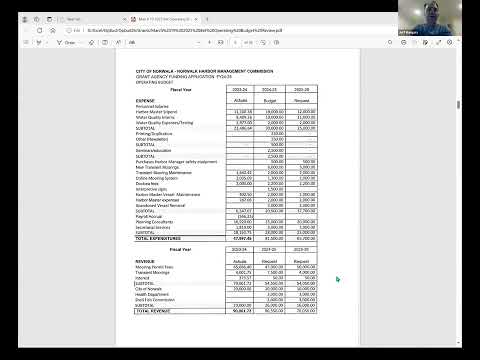
The Harbor Management Commission told the Board of Estimate and Taxation it reduced its grant request from $15,000 to $10,000, citing new transient mooring revenues, higher per‑foot fees and one‑time expenses for mooring hardware and a drone.
The Norwalk Harbor Management Commission asked the Board of Estimate and Taxation on March 19 to fund $10,000 for fiscal 2026, down from $15,000 last year, as the commission reports new transient mooring revenue and other modest income gains.
The request was presented by Alan Allen Tibb of the Harbor Management Commission, with Vice Chair Jeff Mangels available to answer questions. Tom (staff member) said the packet shows each grant recipient’s single line-item request and noted “they're looking for $10,000” this year compared with $15,000 in fiscal 2025.
Tibb described new transient mooring efforts that brought revenue growth. “We have a transient mooring program now where we use an electronic registration service called Dahua so that individuals from out of the community who are traveling on Long Island Sound can come to Norwalk and get a mooring for $40 a night,” he said. He added the commission has added dinghy tie-up slips at the visitors dock and plans to increase the number of transient moorings this year. The commission has also raised the per‑foot mooring fee from $3 to $5 and recently purchased roughly eight new mooring balls and a drone to assist harbor operations and enforcement, Tibb said.
Board members pressed the commission on revenue trends shown in the packet. A member pointed to page 8 of the materials and noted the packet lists harbor revenues at about $90,000 for 2024, $80,000 for the current year and a projected $70,000 for the coming year; the commissioner replied that some enforcement of unused permits and shoreline depth constraints have reduced permits even as per‑unit fees rose. The commission reported modest rental income from transient moorings and construction moorings tied to the Walk Bridge project; Tibb said the state caps seasonal mooring fees at $200 per mooring regardless of vessel size.
The board did not take a final vote on the harbor request at the meeting; members said they would leave the item open for follow-up and additional documentation. Tom (staff member) and board members said they would reconvene with the commission to reconcile the packet figures and follow up the next day.
The discussion highlighted the commission’s efforts to generate revenue while incurring new one‑time and recurring costs — inspections for moorings, replacement chain and maintenance, and purchased equipment — that the commission said continue to create operating expenses even as some user fees increase.