Get Full Government Meeting Transcripts, Videos, & Alerts Forever!
Get email alerts on the Water Quality topic
No spam. Unsubscribe anytime.
Loxahatchee River District outlines monitoring results, calls for stronger stormwater controls in Tequesta
Summary
Bud Howard of the Loxahatchee River Environmental Control District presented long-term river monitoring data, described bacteria and salinity patterns, and urged local action on stormwater controls and enforcement to protect seagrass, oysters and public health.
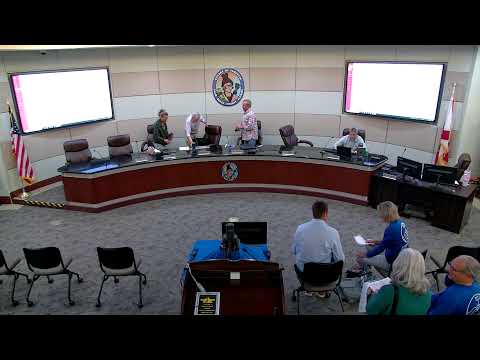
Bud Howard, director of information services at the Loxahatchee River Environmental Control District, told the Village of Tequesta Environmental Advisory Committee on Wednesday that decades of monitoring show the Loxahatchee River remains ecologically valuable but vulnerable to local stormwater inputs.
Howard said the district treats 6 to 7 million gallons of wastewater per day and operates a long-running monitoring program, Riverkeeper, with samples going back to 1991. He described weekly and monthly bacteria sampling, continuous salinity instrumentation at multiple stations and longer-term surveys of nutrients, seagrass and oysters.
"We do weekly bacteria testing," Howard said. "Salinity is an important factor" that helps managers understand how marine water moves into historically freshwater areas. He added the district posts data and visualizations online at lrecd.org.
Howard emphasized three takeaways: brown or tannin-stained water is not necessarily polluted; the Loxahatchee River is not connected to Lake Okeechobee; and much local bacteria and organic loading originates from runoff and storm drains rather than only septic systems. "Most of the properties east of I‑95 are on centralized sewer," he said. "But we're still seeing high bacteria" from sources such as pet waste, grass clippings and construction site sediment.
Why it matters: committee members pressed Howard on construction-site controls, pool discharges and enforcement. Howard said many stormwater systems in older neighborhoods were designed only to move water quickly to the river, not to treat it, which sends organics, fine sediments and bacteria directly into the estuary and contributes to organic-rich muck that harms seagrass.
Supporting details from the presentation: - The district’s Riverkeeper program and volunteer monitoring include monthly and quarterly sampling of many parameters; long-term datasets allow trend analysis back to 1991. - Instrumentation records 15-minute salinity that shows large tidal swings; Howard noted marine water pushed upstream during dry periods can reach areas that historically stayed fresh, stressing freshwater-dependent species. - Seagrass coverage in the estuary has trended downward since 2008; Howard said upstream sites showed the greatest decline and rainfall patterns appear related to recent variability. - Oyster restoration trials under private docks and larger pilot projects have produced flourishing beds in some areas; some experimental sites failed where underlying muck overtook structures. - The district participates in wastewater surveillance for viruses (including COVID fragments) via weekly flow-proportional samples; Howard described partnerships with BioBot and a Verily/academic consortium.
Regulatory and partnership context: Howard said the river is federally designated as a Wild and Scenic River and parts are within a state aquatic preserve. He described involvement with the Department of Environmental Protection, EPA beach-watch sampling and the Loxahatchee River Management Coordinating Council that coordinates local stakeholders on impairments and restoration that relate to state TMDL (total maximum daily load) processes.
Committee follow-up and direction: members asked about on-site enforcement for construction best-management practices and devices that protect storm drains. Village staff said the building official can issue citations and agreed to bring the building official to a future meeting to discuss construction‑site requirements and enforcement. Howard recommended public education campaigns, swale restoration, localized stormwater filters and more robust monitoring of storm drain inlets.
Howard urged a mix of public and private measures: better swale maintenance, stricter enforcement of turbidity and sediment controls on construction sites, removal/management of organic debris, and outreach to landscaping companies and homeowners. "All the grass clippings that we see residents and landscape workers blow ... all that stuff is going straight to the river," he said. "This is fundamentally wrong and I hope that we can all work together to try to improve it."
Ending: Committee members agreed to invite the building official to the next meeting to discuss enforcement and construction‑site maintenance. Staff noted the village participates in regional NPDES/MS4 permitting and state Clean Water Act obligations, meaning both technical fixes and enforcement are within existing regulatory frameworks.